Complete Pre-Session Safety Checklist for Foil Surfers, Coaches, and Operators
Research shows 26% of foiling injuries involve contact with the mast or foil itself: a two-minute dockside pre-flight catches the hardware failures that cause most of them.

Nearly a quarter of all foiling injuries come from contact with your own equipment. A 2023 peer-reviewed study published in the Open Access Journal of Sports Medicine found that 25.9% of wingfoil injuries involved the foil or mast, making your own gear the single most dangerous thing in the water with you - not other surfers. That number is both alarming and actionable: almost every foil-contact injury traces back upstream to gear that was already compromised before the rider hit the water. The two-minute pre-flight below is organized by consequence, from what will send you to the hospital, to what will send your wing to the bottom, to what will simply end your session early.
Injury-Risk Checks: Run These First, No Exceptions
The items in this category have a direct line to the emergency room if skipped.
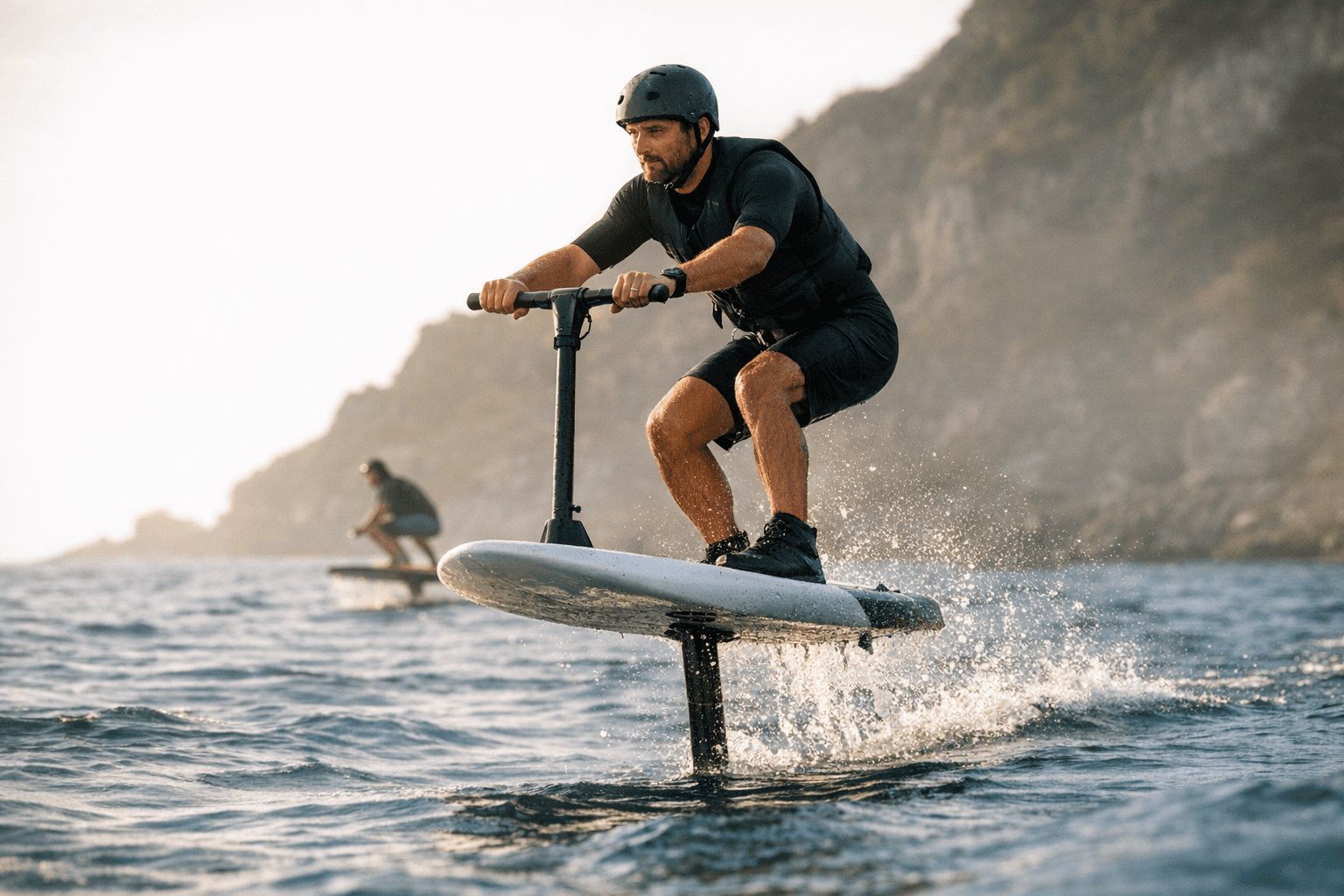
Start with your helmet. A certified watersports or impact helmet is non-negotiable - not a bicycle helmet, not a skateboard lid. Impact vests rated for watersports should be fitted for mobility, not just bulk, since a vest that restricts your paddle-out will get left on shore. If you're on an e-foil or any motor-assisted system, attach your safety lanyard or water-safe remote stop before you touch the water. This is not a mid-session task. The lanyard is your kill switch; treat it like a pilot's seat belt.
Leash and tether come next. Confirm the leash attachment is secure at the board end and that any quick-release or breakaway mechanism moves freely. A leash that deploys under load when you need it to hold, or locks up when you need to release, is worse than no leash at all. Test the pull before launching.
The conditions scan completes your personal risk profile. Wind, swell height, visibility, and crowd density all affect your escape routes. If you're still progressing, a crowded lineup is not just an etiquette issue - it is a collision risk with sharp carbon edges traveling at speed. Choose low-density spots until control is consistent. Before entering the water, brief your group on right-of-way priorities, confirm an agreed signal for requesting assistance, and know the local emergency number and the nearest lifeguard station. For high-risk sessions - deep water, offshore conditions, big swell - a support vessel or designated buddy is not optional.
Gear-Loss Risk Checks: Structural Integrity and Hardware
This tier covers failures that won't necessarily injure you in the first second but will destroy equipment and end your session, often well offshore.
Inspect the mast, front and rear wings, and fuselage for cracks, delamination, or gouges before every session. Pay particular attention to carbon layup edges and every connection point - these are stress concentrators, and a crack that looks cosmetic at the dock can propagate catastrophically under load. Run your fingers along the leading edges of the wings. If you feel a soft spot or hear a crunch that wasn't there last session, pull the gear from rotation.
Fasteners and torque are the single most common cause of mid-session disassembly. Loose hardware is not a nuisance failure; it is a systemic one. Every connection point on a foil has a published torque specification, and running hardware down by feel rather than spec either leaves a mast joint loose enough to walk out under load or cracks a carbon insert through overtorque. Carry a torque wrench and know the numbers for every joint in your specific setup - values vary significantly across brands and hardware materials. Apply threadlocker wherever the manufacturer specifies it, and be aware that threadlocker wears away with use and saltwater cycling. After your very first session on a new setup, re-torque all fasteners before the next one; thermal expansion and initial seating will have moved things.
The quick pass/fail for your mast-to-fuselage joint: grip the mast near the connection and apply a firm lateral wiggle. Any detectable play beyond the designed tolerance is a fail. Pull the bolt, inspect the thread, re-torque to spec, and retest before launching.
Electronics Pass/Fail: E-Foil and Drive System Specifics
Battery charge and health are the first check for any motorized system. A battery that reads full but has degraded cells will drop voltage under load at the worst possible moment - typically at the furthest point from shore. If your system has a battery management system readout, check cell balance, not just total charge percentage.
Inspect every waterproof connector for corrosion, deformation, or incomplete seating. A partially seated connector that passes a bench test can back out under vibration. Press each connector fully home, verify the locking collar or retention clip engages, and do a visual check for any sign of water intrusion in the housing. Compromised seals on motor or battery compartments create both electrical failure and safety hazards.
Run a remote control function test on dry land before launch. Confirm the fail-safe behavior: if radio contact drops, does the motor cut as designed? Check the remote battery independently - a remote that dies mid-session removes your throttle control entirely. Motor mounts and prop clearances deserve a physical check; any looseness in the motor mount translates directly into prop strike risk.
Time-Waster Checks: Buoyancy and Session Management
Integrated flotation - board bladders, e-foil compartment seals, any built-in buoyancy elements - should be confirmed intact before each session. A compromised bladder won't stop you riding, but it will change your board's behavior in a fall and complicate retrieval in a swim-in.
Once on the water, the operating discipline is as important as the pre-launch routine. Begin with low-speed passes in calm water before attempting higher-speed runs or complex maneuvers. Gradual warm-up reveals any remaining hardware anomalies under real load at low consequence. Maintain predictable straight lines when recovering or heading back out; crossing through paddlers or other surfers with a foil in tow is a serious risk for everyone in the water.
For e-foil riders, treat battery management as a live check throughout the session. Plan your turnaround point to retain enough charge to reach shore comfortably - err significantly on the conservative side, because battery consumption accelerates in chop, headwinds, and at higher speeds.
Post-Session: The Check That Protects Next Session
The rinse-and-inspect at the end of each session is where most mechanical problems are caught before they become failures. Rinse all saltwater off every component immediately. Inspect for fresh gouges, new corrosion at connection points, or any hardware that has migrated. Recharge batteries in a cool, dry location following the manufacturer's guidelines - thermal stress from hot-car storage is a leading cause of battery degradation. Document any damage and address it before the board goes back in the bag.
For coaches and rental operators running groups through this gear, the most effective tool is a short printed checklist that riders or students sign off on before launch. Formalizing these steps into a signed document does two things simultaneously: it creates a documented record of reasonable care that supports warranty claims and reduces operator liability, and it builds the inspection habit in students who will eventually be checking their own gear alone at a remote break with no coach in sight. That second outcome is the more valuable one.
A foil that passes this checklist isn't guaranteed to behave perfectly - carbon fails, seals age, batteries degrade. But the riders who run this routine consistently are the ones who catch failures at the dock rather than discovering them a kilometer offshore. That's the difference the two minutes buys you.
Know something we missed? Have a correction or additional information?
Submit a Tip