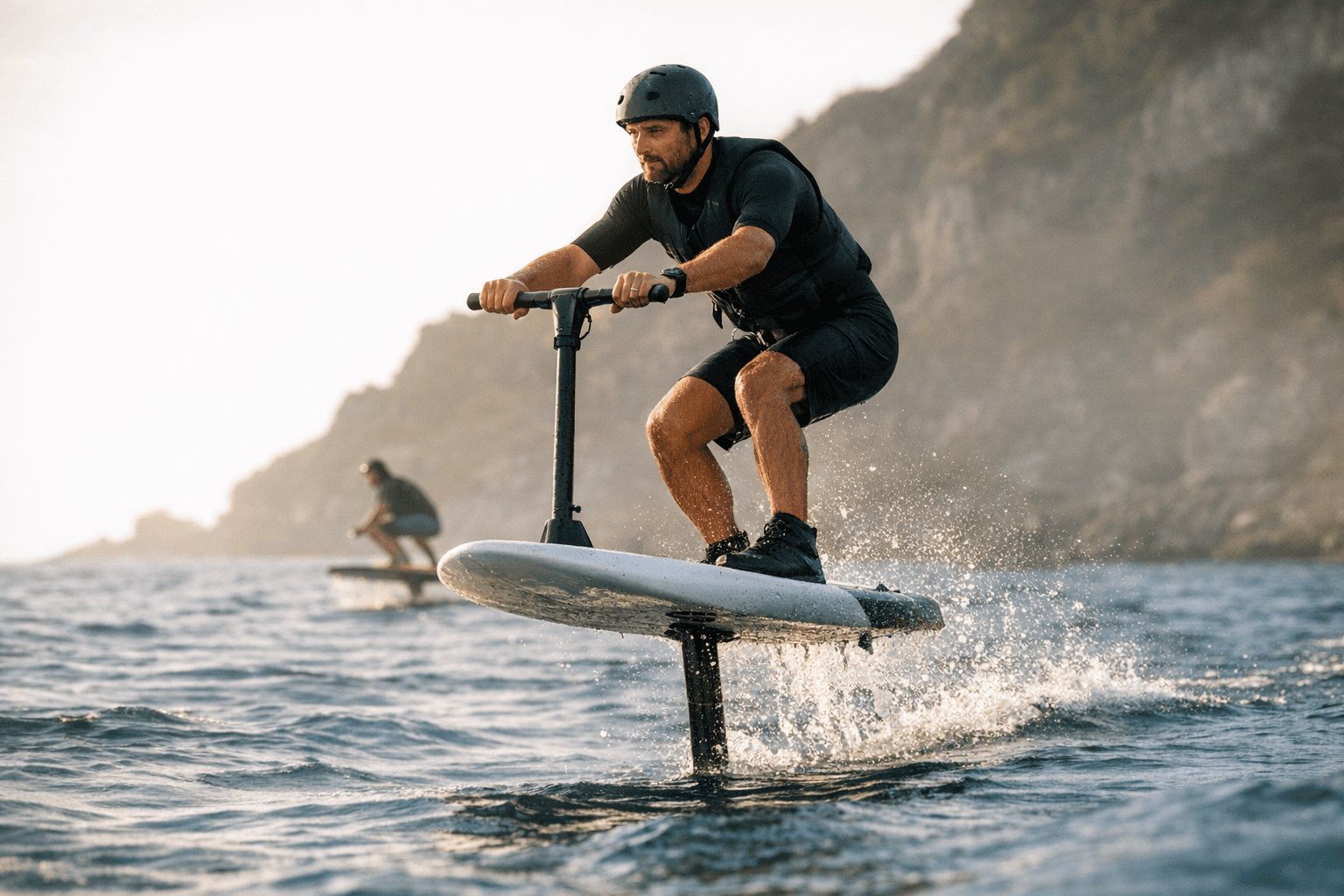
Foil Drive Issues Etiquette Code for Powered Foils in Shared Lineups
Foil Drive's six-point etiquette code, published March 27, targets the specific friction that powered assist systems create in crowded shared lineups.

Powered foil assist has reached enough critical mass at shared coastal breaks that Foil Drive, its leading commercial maker, felt compelled to do what most hardware companies never bother with: publish a formal code of conduct for how their product gets used in public water.
The six-point guidance, posted March 27, addresses the friction points that arise when assist systems enter mixed lineups alongside traditional surfers, prone foilers, wingfoilers, and paddlers. Foil Drive framed it as an obligation that comes with building the hardware. "As a company producing these devices, we have the responsibility to aid our community with the right tools to not only enjoy their time safely, but to be considerate of others, the environment and their gear," the company stated in the post.
The code leads with what most experienced foilers already know from hard experience: if you're still in the kangaroo-hop phase of learning, stay off the crowded peaks. Beginners belong at quiet beaches away from other water users, not threading their way through a packed A-frame while still getting their balance sorted. The collision risk is not theoretical. A mast traveling at foiling speed through a crowded lineup is a serious injury event, and one bad incident at a popular break is often enough to trigger local access restrictions.
The drop-in rule gets reinforced alongside a more specific warning about snaking, which in the assist context is particularly egregious. A rider with a motor has no excuse for paddling inside to steal priority. The unpowered surfer who has been sitting and reading sets earns that wave, and the assist system changes none of that math.
Channel returns are where most assist riders unknowingly create the most friction. Motoring back through the middle of an active lineup, weaving around paddlers mid-ride, is the single fastest way to get side-eyed out of a spot for good. Foil Drive's guidance is specific here: take the wide line, maintain predictable tracks, and keep clear of the main paddle zone entirely. At a point break with a defined channel, that means committing to the shoulder route even when the shortcut looks obvious.

The leash point carries a notable nuance. Foil Drive acknowledges there are circumstances where an exception may apply, but frames this as a decision requiring deliberate judgment rather than a routine opt-out. With the added weight of a motor pod, a board drifting loose becomes a faster-moving hazard than most surrounding surfers expect.
The guidance lands squarely on schools and rental operations. Foil Drive recommends that every onboarding session include an explicit etiquette briefing, and calls on local clubs and beach managers to establish simple corridor rules that physically separate powered foilers from unpowered craft. That kind of informal zoning represents the next logical step if voluntary conduct codes prove insufficient.
The window for self-governance in powered foiling is not unlimited. The more assist riders treat Foil Drive's code as optional background reading, the faster that window closes.
Know something we missed? Have a correction or additional information?
Submit a Tip