Foilscoot's Handlebar Design Aims to Simplify the Pump Foil Learning Curve
Benjamin Friant's Foilscoot pairs a pump foil board with a removable handlebar, cutting a discipline where most beginners need months to fly down to just a few attempts.
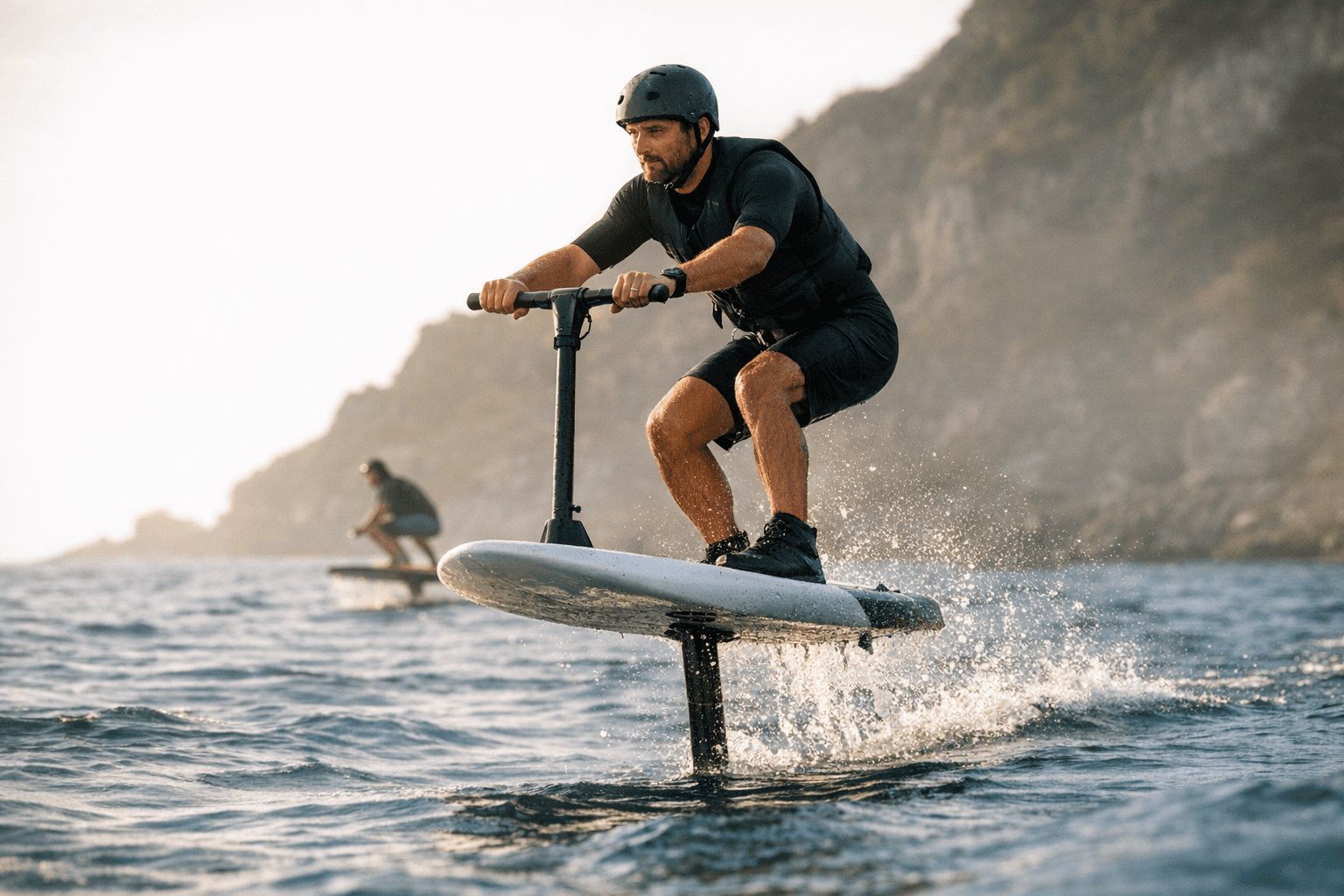
The pump foil has always been foiling's most unforgiving teacher. Get the rhythm wrong and you're swimming; get it right and you're skimming three feet above the water on nothing but leg drive and timing. Foilscoot, billed as the world's first pump foil scooter, argues that a handlebar between your hands changes that equation entirely, and two of France's largest watersports organisations appear to agree.
The device was designed by Benjamin Friant, a former professional scooter rider who also invented the snow scooter and brought it to commercial scale before discovering pump foiling. Friant's own account of the prototype moment is instructive: he mounted a handlebar onto a board with a foil underneath, pumped on his first attempt despite having almost no prior foiling experience, and concluded that what most early learners are actually missing is not athleticism but control. The Foilscoot is the answer he built from that conclusion.
On the first of pump foiling's three core learning hurdles, the initial takeoff, the handlebar gives beginners something a standard pump setup cannot: a fixed grip point during the chaotic first seconds of mast breach. Beginners on conventional boards typically drop back into the water repeatedly during this phase, each swim burning energy and confidence. With hands on the bar, riders can concentrate leg drive without simultaneously fighting lateral balance, collapsing two problems into one.
Balance through the pump cycle itself is where the performance gap is most measurable. A traditional pump foil demands that all oscillation be absorbed and generated below the hips, with arms free and posture perpetually self-correcting. The Foilscoot's handlebar distributes that demand upward, narrowing the coordination window enough that the product's own documented claims become plausible: most riders reach sustained flight in a few attempts, a timeline that contrasts sharply with the months or even years that conventional pump foil mastery can require.
The third hurdle is fall consequences. Uncontrolled separations during pump foiling send board and rider in unpredictable directions, particularly when the mast breaches at speed. Keeping hands on the bar tends to maintain the board beneath the rider, producing more predictable water entries and reducing the impact scenarios that make instructors cautious about putting total novices on pump foil equipment.
The hardware tradeoff is honest: the handlebar adds frontal resistance and mechanical complexity that a clean pump setup does not carry. Friant's design addresses this directly with a height-adjustable handlebar, built from aluminum and mounted to a carbon board, that removes in seconds. Riders can strip the bar the moment they no longer need it, which also means the Foilscoot functions as a genuine dock start trainer and a standard pump board within the same session. The carbon construction keeps the overall weight penalty competitive with comparable pump boards.
Institutional backing has come quickly. UCPA and the French Surfing Federation, which governs approximately 80,000 licensed members across roughly 200 clubs throughout France, have both endorsed the product, a meaningful signal that two large organisations with serious instructional obligations see it as a credible teaching tool. The Kickstarter campaign described the result as a success and the company has reported more than 80 units sold, with new orders now running through its dedicated online shop. A multi-country distribution network is expanding with the goal of pairing retail access with hands-on demo availability.
Whether school lineups start filling with Foilscoots will depend on how fast that network reaches working instructors. The federation relationships suggest the product is closer to that outcome than most first-generation watersports hardware tends to be.
This article was produced by Prism’s automated news system from verified source data, official records, and press releases, then run through automated quality and moderation checks before publishing. The system is built and supervised by the people who set the standards it runs under. Read our full AI policy.
Know something we missed? Have a correction or additional information?
Submit a Tip