Duotone Wing Academy helps foil surfers progress with structured video lessons
Duotone’s Wing Academy turns wingfoil progression into a clean path, from first wing handling to freestyle and wave riding, without the usual clip-hopping.
Why the Duotone Wing Academy actually matters
The Duotone Wing Academy is useful because it solves the problem most wingfoilers run into after the first few sessions: there is a lot to learn, but not much structure. Duotone launched the Wing Academy App in 2021, and it now has over 31,000 users, which tells you it has moved well beyond a side project. The appeal is simple. Instead of hunting through scattered clips, posts, and half-explained tricks, you get a sequenced path that starts with the basics and keeps building.
That matters most if you are a beginner trying to get through first flights without wasting weekends on avoidable mistakes, or an intermediate rider who has hit that frustrating plateau where jibes stall out, tacks feel inconsistent, and you know you should be better by now. It also makes sense if you are already in the Duotone ecosystem and want a single place to keep sharpening your riding. The app is free, and in a sport where riders often spend heavily on boards, wings, and foils before they have a dependable learning plan, that alone gives it real value.
What the app gives you on the water, and before you even get there
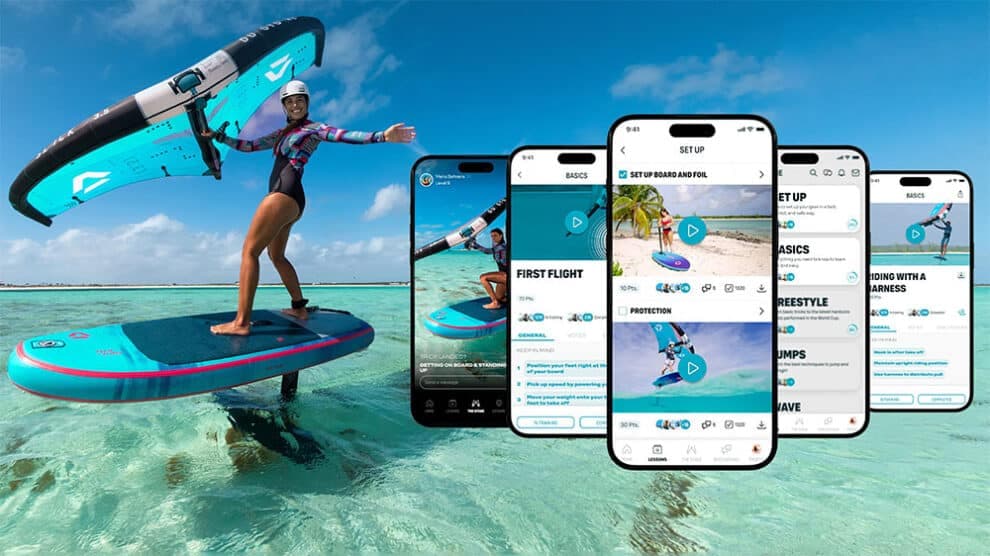
The strongest thing about the Academy is that it is built like a coaching path, not a content dump. Duotone says the app now offers more than 130 videos on one version of the platform, while other localized pages mention more than 100 or more than 98, which points to an evolving library rather than a static archive. The categories are practical: set-up, basics, freestyle, jumps, and wave riding. That is the kind of organization that helps you choose what to work on before a session instead of improvising once you are already tired.
The video presentation is another real advantage. Slow motion and multiple camera angles make it much easier to see body position, hand placement, and what staying on foil actually looks like when the maneuver is done correctly. That is not a small detail. In wingfoil, a lot of progression comes down to tiny mechanics, and when you can replay the move frame by frame, the lesson lands faster than it does in a fast, casual social clip.
The progression path is the point
Duotone’s own logic for building the academy is sound: wingfoiling disciplines are different enough that one general learning path does not fit everybody. The app reflects that reality by moving from foundational skills into more technical riding in stages.
At the entry level, the academy focuses on the essentials, including wing handling on land and safety. That is exactly where many riders need help, because too many people rush straight toward foil time without properly sorting the wing in their hands first. A cleaner start here usually means fewer blown launches, less confusion in the parking lot, and more confidence once you are clipped into the learning curve.
From there, the academy shifts into intermediate work such as jibes and tacks. That is the part of wingfoiling where real progression becomes visible, because these are the turns that separate a rider who is just getting around from one who can hold a line and recover cleanly. Duotone’s structure also serves riders trying to improve consistency in the basics that support those turns, including staying on foil longer and making transitions less chaotic.
Then the library opens into advanced freestyle, jumping, and foil-surfing maneuvers. Recent updates added 11 freestyle moves, including the Gliding 360, Front Loop, Palau Flip, Front Flip 360, and Backmobe. That is a serious jump in ambition, and it shows the academy is not just trying to coach the first few sessions. It is trying to keep pace with riders who want harder, flashier, and more technical progression once the fundamentals are in place.
Duotone has also added a new wave category with 15 videos aimed at getting riders ready to hit the waves. That is a smart move, because wingfoiling is no longer just a flatwater progression sport. The addition of Tech Talks, Parawing, Pump Foiling, and Prone Foiling shows the same thing: the academy is following the sport as it branches into more specialized disciplines rather than pretending wingfoil learning stays neatly in one lane.
The social tools make it more than a video library
The app is not only about watching lessons. Duotone has pushed it into a wider ecosystem with SPOTS, direct messaging, shops, and Pro Centers. SPOTS lets users check in at a wingfoil location and share their position with nearby riders, which is exactly the sort of feature that matters when you are traveling, learning at a new beach, or trying to find other people who actually ride the same conditions you do. That turns the app into a bridge between digital instruction and real-world sessions.
The social layer is not fluff. It helps solve a very real problem in foil sports, which is that progression gets faster when you can compare notes, meet riders, and keep yourself accountable. The app’s progress tracking and point-based motivation add to that. If you can check off tricks and see your own learning stack up over time, it is easier to keep returning to the same movement until it becomes clean.
That is why the academy feels especially relevant for riders without a strong local crew. It gives you a way to build structure even when nobody at your spot can talk you through a specific transition or freestyle attempt. Duotone has also framed the app as part of a broader ecosystem that includes Pro Centers, Young Blood Camps, and sustainability efforts, which makes the whole thing feel less like a marketing page and more like an attempt to support the sport from multiple angles.
Who gets the most out of it
The biggest winners here are beginners who need a clean starting sequence, plateaued intermediates who are stuck between competent and confident, and Duotone riders who want the brand’s coaching, community, and product world in one place. If you are the kind of rider who learns best from a random internet rabbit hole, you may still keep a browser full of clips open. But if you want the sport broken into sensible steps, the Wing Academy is far more efficient than trying to assemble your own curriculum one scattered video at a time.
For foil surfers and wingfoilers trying to speed up real sessions, that is the point. The academy does not replace time on the water, but it does make that time count for more. In a sport where a clean jibe, a confident first flight, or a new wave line can take weeks to lock in, a structured coaching app is no longer a nice extra. It is one of the few tools that can genuinely move the learning curve.
Know something we missed? Have a correction or additional information?
Submit a Tip