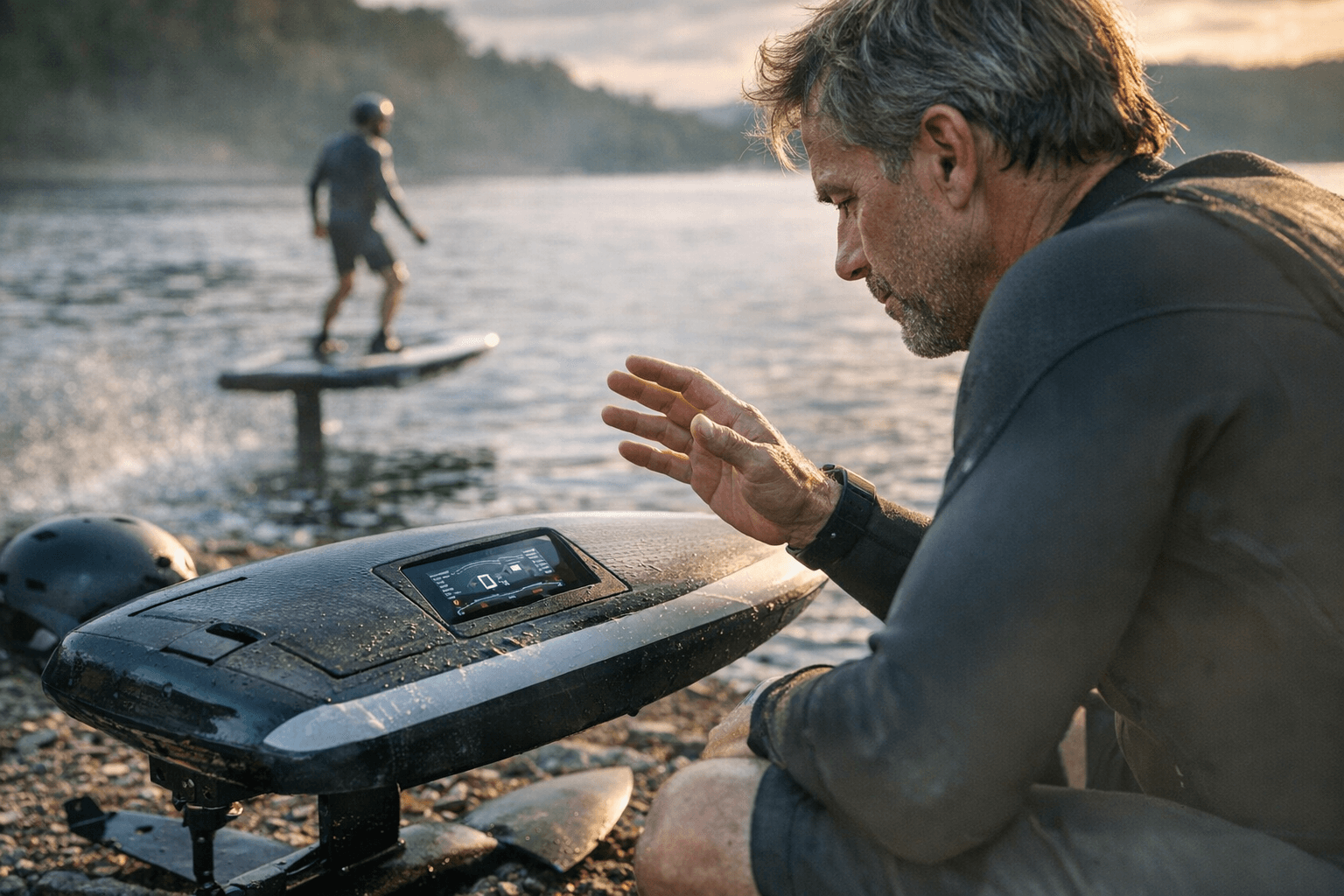
Folding prop for 6384 motor proves useful up to 27 km/h
A folding 6384 prop can be a real beach-launch upgrade: one rider uses it to 27 km/h, but the gain depends on KV, foil size and how much drag you can give up.
Why this small prop matters so much
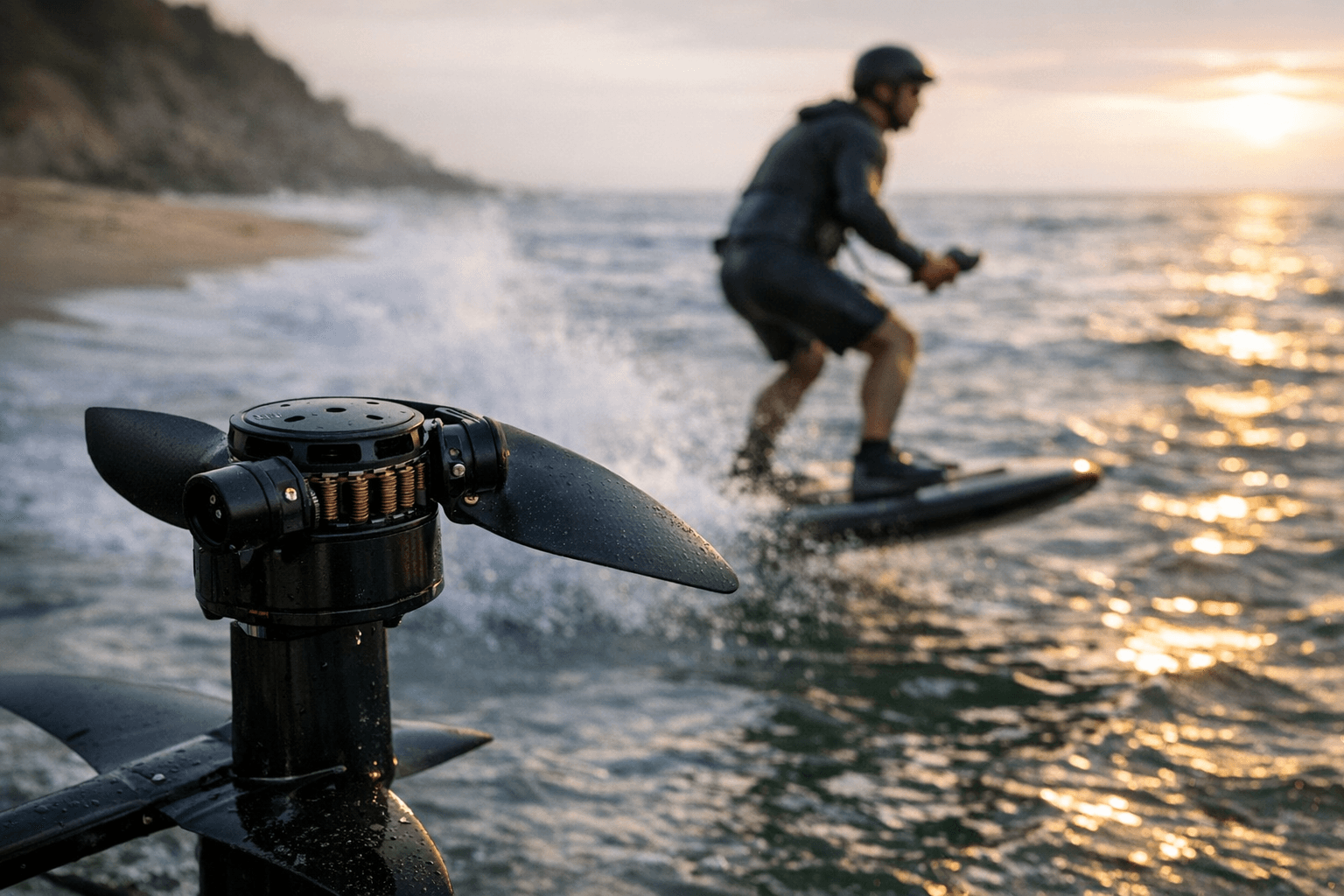
The folding prop on a 6384 build looks like a minor part until you ride behind it. On DIY eFoils and foil-assist setups, that little choice shapes how easily the board lifts, how much drag hangs under you once you are foiling, and how much risk you are taking every time you run a beach launch with the prop still exposed.
That is why the question in the FOIL.zone discussion feels so familiar: do you trust the prop that came with the motor, or do you change it before you put real time and money into the build? In this case, the answer from the community is practical rather than theoretical. A folding prop can work well on a 6384 setup, and one rider says they use it successfully up to about 27 km/h.
What the Flipsky folding prop is designed to do
Flipsky markets a 4.8-inch, two-blade folding propeller for 6374 and 6384 motors, and the company’s pitch is exactly what foil builders care about: less drag and less cavitation once throttle is released. That matters because foil-assist is not just about the sprint onto foil. Once you are up, the prop becomes dead weight unless it folds cleanly out of the water and stops fighting the ride.
The product details are straightforward, which is part of the appeal. The prop is ABS, one-piece molded, with a diameter of 152.6 mm and a height of 49.5 mm. Flipsky also sells a broader propeller line for DIY eFoil and hydro-propulsion customers, which shows this is not a niche one-off part. It is part of a larger accessory ecosystem built around people adapting watercraft hardware to very specific riding conditions.
The real-world behavior riders are reporting
The most useful part of the FOIL.zone discussion is that it moves beyond catalog language. One user says the Flipsky folding prop works well and that they use it up to about 27 km/h. That is the kind of number riders can actually use when deciding whether a folding design is enough for their own build.
Another builder reported a very different learning curve. Their 3D-printed props broke straight away, but switching to the Flipsky prop let them efoil on a large 85L board with a large Axis 1150 foil. That is a meaningful detail because it ties the prop to actual board and foil choices, not just a bench-test result. It also shows how fragile early experiments can be, and why many DIY riders eventually move toward a molded part when they want reliability in the water.
Who should consider the upgrade
The folding prop makes the most sense if your build lives in the messy middle between performance and convenience. If you are using a 6384 motor for foil-assist, care about low drag after takeoff, and want a prop that folds instead of braking water all the way through the glide, this is the sort of upgrade that can change the feel of the system without forcing you into a full redesign.
It is also attractive if your riding includes shallow beach launches, where a spinning or rigid prop can be more exposed to knocks, weeds, or bottom contact. The promise here is not only efficiency. It is also damage risk reduction, because a folding design is easier to live with when the board is moving through the awkward, high-risk moments between water start and clean flight.
The trade-offs that matter in practice
The key trade-off is that folding props are always a compromise between thrust, drag, and startup behavior. If your setup needs maximum punch from the first touch of throttle, a folding design may not feel as aggressive as a fixed prop, especially if the motor and prop are not well matched. That is why KV matters so much in the community discussion.
One builder specifically noted that the Flipsky prop likely would perform better at higher RPM because their motor was 120KV while the Flipsky motor was 140KV. That is an important clue for anyone mixing parts across brands or repurposing hardware from another build. A prop that feels excellent on one motor can feel underfed on another, and the whole system starts to change with motor speed, foil size, and board volume.
Why the 6384 platform keeps drawing these experiments
The 6384 motor family keeps coming up because it sits in that sweet spot of accessibility and capability. Flipsky markets a waterproof 6384 motor at 140KV and 4400W for surfing boat, underwater thruster, hydro propulsion, and eFoil use. That wide positioning explains why the same motor family shows up in so many DIY conversations. Builders are not buying one closed system. They are adapting one motor platform across several very different watercraft ideas.
That flexibility also means the prop becomes a recurring decision point. The rest of the build still depends on wiring, housing, battery choice, and control logic, but the prop is the part you feel immediately. It affects how the system loads up, how it cavitates, how it releases, and whether the board settles into a clean glide or keeps dragging a little harder than it should.
The wider DIY scene keeps pushing the idea forward
The FOIL.zone conversation does not stop with one molded prop. In 2025, builders were already discussing custom folding props for 6384 motors in 120KV and 150KV versions, with a diameter of 158 mm and a projected price of 60 euros. That tells you the community is still hunting for a better answer, not because the Flipsky option is useless, but because builders keep testing whether they can fine-tune the balance even further.
There is also a useful contrast in materials. Another FOIL.zone user said the aluminum Flipsky prop seemed to work great and that they did not notice any difference compared with the plastic prop. That kind of response is classic DIY foil culture: one rider wants durability, another wants simplicity, and both are trying to find the point where the part stops being the problem.
Should you change a proven setup?
If your current prop already gets you on foil cleanly, holds together, and keeps drag tolerable, there is no automatic reason to rip it off. The stronger case for the folding prop is for riders who want easier release after takeoff, lower drag during the glide, and a bit more forgiveness in beach-launch situations where the prop can be a liability.
The payoff is real, but it is not magical. A folding 6384 prop is a worthwhile change when your build is already close and you want refinement, not rescue. For DIY eFoil builders, that is often exactly the kind of upgrade that matters most: a small part that makes the whole ride feel calmer, cleaner, and a little less expensive to get wrong.
Know something we missed? Have a correction or additional information?
Submit a Tip