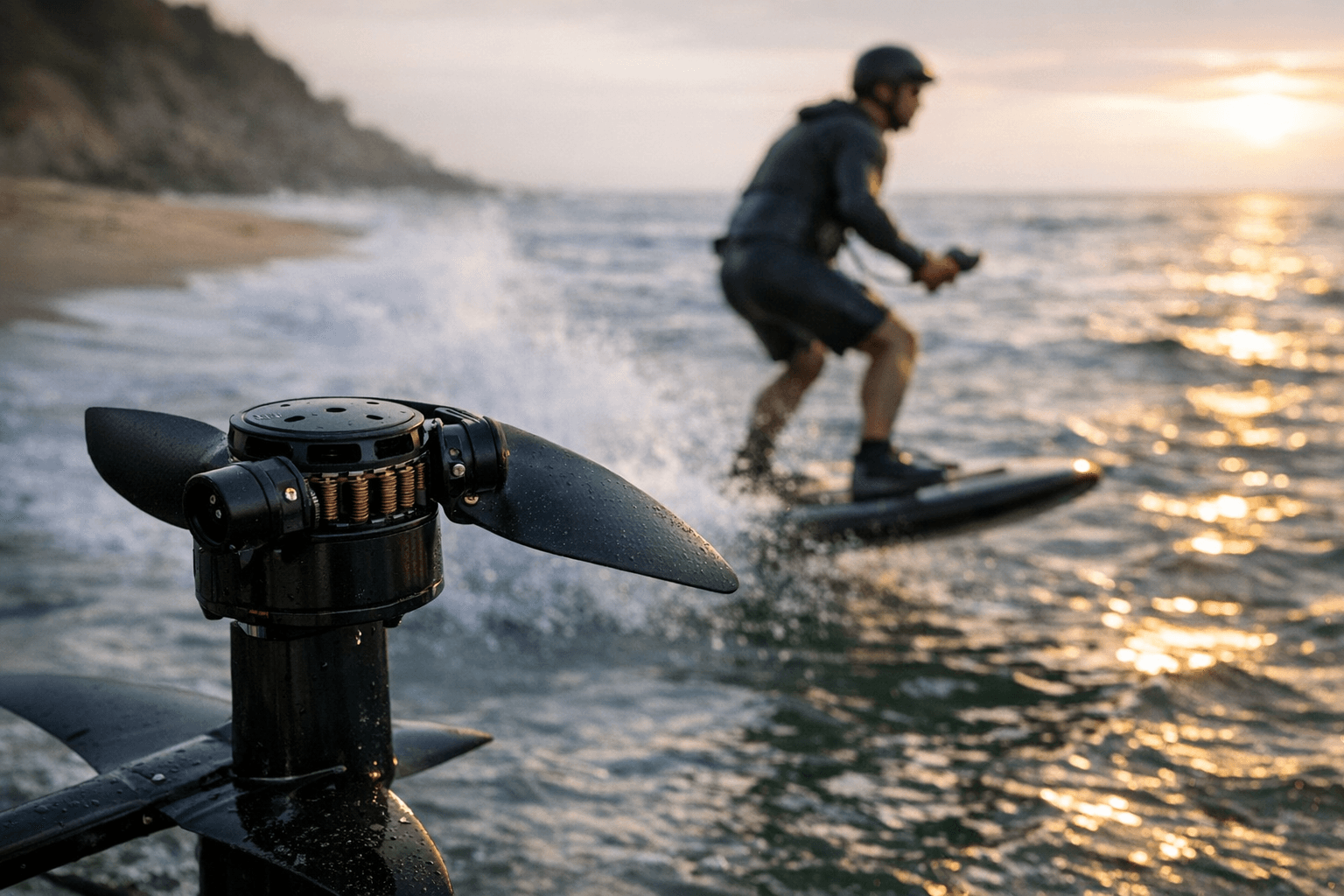
JetWave battery design draws attention as boot Düsseldorf theft tale emerges
A 7.3kg semi-solid eFoil battery and a boot Düsseldorf theft tale made JetWave’s pack the show’s most talked-about hardware.

The real test for JetWave’s battery is simple: does it give riders more water time, faster charging and less weight, or is “semi-solid” just a pricier label on the same old problem? On JetWave’s own numbers, the Endurance Battery carried 55Ah, 2.4kWh and 14.8kg, while the Quantum Battery cut that to 30Ah, 1.3kWh and 7.3kg, with IP68 waterproofing and a 1,000-cycle rating to 80% capacity.
That spec sheet got even more attention because the battery was already the subject of a strange boot Düsseldorf story. A FOIL.zone thread said a rider’s father saw the JetWave battery on display at boot Düsseldorf, spoke with the JetWave team and later learned the stand had been robbed. The same discussion said a mast from the brand was stolen the next day. In a hall packed with hardware, that is one way to signal a product has become memorable. JetWave had said it would exhibit at boot Düsseldorf 2026 in Hall 5/C46.
boot Düsseldorf is no small backdrop. Messe Düsseldorf calls it the world’s largest yacht and watersports trade fair, drawing more than 200,000 visitors from over 110 countries and around 1,500 exhibitors from 68 nations across 16 halls. The 2026 show ran from January 17 to January 25, which made the theft tale feel less like random forum gossip and more like an object lesson in how visible eFoil gear has become.
The technical angle matters just as much. In the battery world, semi-solid-state sits between conventional liquid-electrolyte lithium-ion cells and full solid-state designs. For riders and builders, that can mean a better balance of energy density, safety and manufacturability. It also matters because battery building is usually the ugliest part of a DIY foil project: dozens of cylindrical cells, busbars, heat management and a bulky enclosure before the board ever touches water.
That is why the forum’s speculation about Farasis S55 semi-solid NCM pouch cells caught traction. Farasis Energy lists pouch and prismatic formats, and third-party listings describe the S55 and S55C as 3.7V, 55Ah semi-solid NCM pouch cells. If JetWave really built around 12 of those, the appeal is obvious: fewer pieces, cleaner packaging and less of the DIY headache that turns a garage build into a battery engineering exercise.
JetWave is still making a claim, not closing the case. But the numbers are hard to ignore. A 7.3kg semi-solid pack with IP68 protection is the kind of spec that can change how riders think about carry weight, deck setup and risk on the beach. If JetWave can back the chemistry with real ride time and real charging behavior, it will be more than a trade-show curiosity.
Know something we missed? Have a correction or additional information?
Submit a Tip