Seven Innovations Pushing Hydrofoil Materials Toward a Greener, Recyclable Future
Every snapped mast and cracked front wing currently has one destination: landfill. Seven material and manufacturing innovations are building the infrastructure to finally change that.
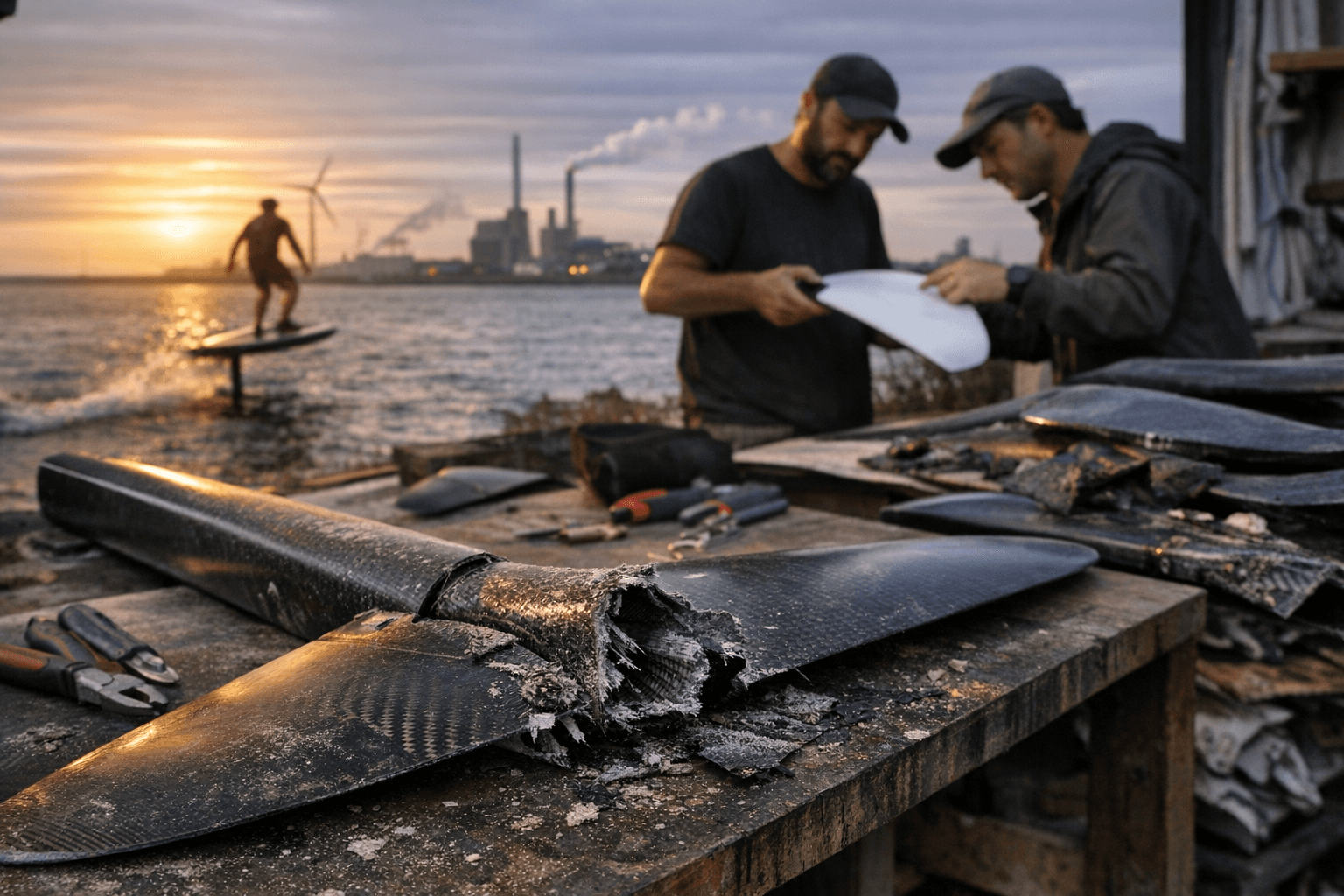
Every snapped mast or cracked front wing sitting in the gear pile behind your local surf school represents a materials problem the foil industry has quietly ignored for years. Carbon fiber epoxy composites, the backbone of virtually every high-performance foil on the market, are notoriously difficult to recycle; thermoset epoxy parts cannot be reprocessed into new structural components, and damaged foils typically have one destination: landfill. As the sport scales, that waste footprint scales with it.
Hydrofoiling.org's Review Team recently published a deep-dive synthesis drawing on supplier announcements, lab testing programs, and commentary from grassroots builders across Europe and Australia to map seven concrete paths forward. The argument isn't idealistic: early comparative testing suggests certain thermoplastic layups can match or even exceed thermoset epoxy part stiffness and fatigue life in some use cases. That technical credibility is the foundation for everything that follows.
Thermoplastic Matrix Systems
The most structurally significant shift under development is replacing conventional thermoset epoxy resins with thermoplastic alternatives. Where thermoset chemistries cure irreversibly, locking fibres permanently in place and making separation nearly impossible, thermoplastics can be remelted and reprocessed at end of life. Aerospace-grade resin classes, including LMPAEK-style formulations being developed at the performance end of the supply chain, represent this category. European research programs are leading much of the early work, and comparative testing programs cited by Hydrofoiling.org indicate that in certain layup configurations, thermoplastic parts are holding their own against the thermoset parts riders already trust, a prerequisite for any serious adoption at the brand level.
Automated Fibre Placement
Waste reduction doesn't only happen at the end of a part's life; it starts when the laminate is being built. Automated Fibre Placement, a process borrowed from aerospace manufacturing, lays carbon fibre tows precisely where structural models say they need to be, dramatically reducing the offcuts and trim waste that conventional hand layup generates. Aerospace-grade suppliers are already running AFP processes, and Hydrofoiling.org notes that this manufacturing discipline is increasingly accessible to foil-specific producers. For mast and wing construction, where complex three-dimensional geometries demand intricate fibre orientations, AFP also improves consistency across production runs, reducing the performance variance that makes batch-to-batch quality control difficult in hand-laid shops.
Repair-Friendly Joinery and Replaceable Tips
One of the most practical near-term changes involves how foil components are designed for assembly and disassembly in the first place. Repair-friendly joinery, where bonded or mechanically fastened sections can be separated without destroying the parent structure, and replaceable wing tips address the reality that most foil damage is localised. A cracked tip or an impact-damaged leading edge shouldn't condemn an entire front wing to the skip. Grassroots producers in both Europe and Australia are experimenting with designs that make partial replacement viable, and the downstream effect on waste reduction could be significant: instead of scrapping a complete component, riders repair or swap only the damaged section and put the rest back to work.
Embedded Structural Health Monitoring
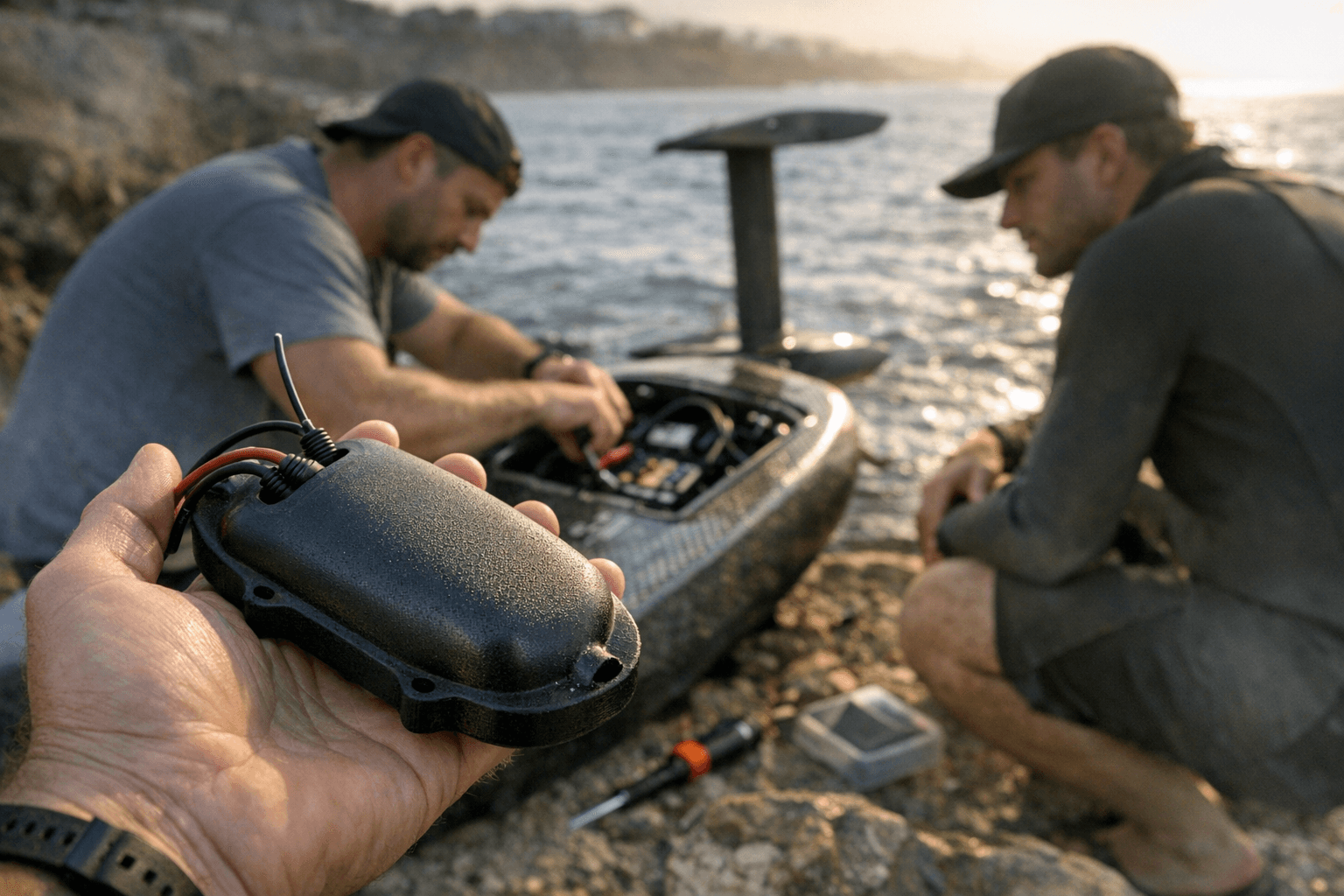
The fourth innovation moves into electronic territory, embedding low-power structural health monitoring sensors directly into foil components during manufacture. The concept, well established in aerospace and civil engineering, applies acoustic emission detection, strain gauging, or similar techniques to track micro-cracking and fatigue accumulation inside a laminate, invisibly, without surface inspection. Hydrofoiling.org describes ongoing integration work aimed specifically at reducing premature replacement. A foil that communicates its actual structural state rather than prompting precautionary swaps based on age or cosmetic wear keeps serviceable parts in service longer, and that directly reduces consumption. For rental fleets and resort e-foil programs, where asset management drives purchasing decisions, this kind of structural data could reshape retirement cycles entirely.
Recyclable Core Materials
The structural skin gets most of the attention in composite construction, but the core materials sitting inside masts and wings matter equally for recyclability. Conventional foam cores used in sandwich constructions are often bonded with thermoset adhesives that make separation and reclamation impractical. The shift Hydrofoiling.org describes prioritises recyclable foam core formulations paired with bonded thermoplastic skins, creating a sandwich structure where both elements can, in principle, be separated and reclaimed at end of life. This systems-level thinking, making every layer of the laminate recyclable rather than treating recyclability as a skin-deep property, is what separates genuine circular design from greenwashing.
Closed-Loop Brand Recycling Programs
Material innovation only closes the loop if collection infrastructure exists to match it. Several brands are piloting closed-loop recycling programs at the product level, where foils are designed and sold with an explicit end-of-life pathway: the customer returns the component, the brand reclaims and reprocesses the material, and it re-enters the supply chain rather than a landfill. Hydrofoiling.org frames this as both a technical and a commercial proposition. Brands that invest in recyclable composites and closed-loop programs could trade short-term margin for stronger second-hand markets and genuine consumer trust, a meaningful competitive signal as coastal communities and regulators pay closer attention to the sport's environmental profile.
Standardised End-of-Life Infrastructure
Closed-loop programs work at brand scale, but the sport's long-term sustainability requires something broader: standardised end-of-life collection and repurposing infrastructure for composite foil parts. Right now, even if a rider wanted to responsibly dispose of a retired wing, the pathways simply don't exist in most markets. The call here is for industry-wide standardisation, including agreed materials labeling, collection point networks, and repurposing protocols capable of handling everything from snapped masts to delaminated fuselages. Without this shared infrastructure, individual brand programs remain isolated experiments. With it, the foil industry would have the systemic toolkit to manage the composite waste its own growth is generating.
For riders, the near-term effect of these changes will likely be incremental: marginally higher product prices on first-generation recyclable foils, but meaningfully better repairability and long-term value. For rental operations and e-foil resorts, the combination of repairable designs and health-monitoring sensors could cut total cost of ownership and extend the productive life of assets that currently cycle out after a season of hard use. Foil adoption is scaling fast enough that the waste profile of the sport's dominant material has become a problem worth solving, and the builders in Europe and Australia already testing these approaches are proving it doesn't require a performance trade-off to do so.
Know something we missed? Have a correction or additional information?
Submit a Tip