Moab shuttle debate raises budget questions, offers new Arches access plan
A $3 million Arches shuttle could move the trip start to downtown Moab, while the county fight over $500,000 raises real public-safety budget questions.
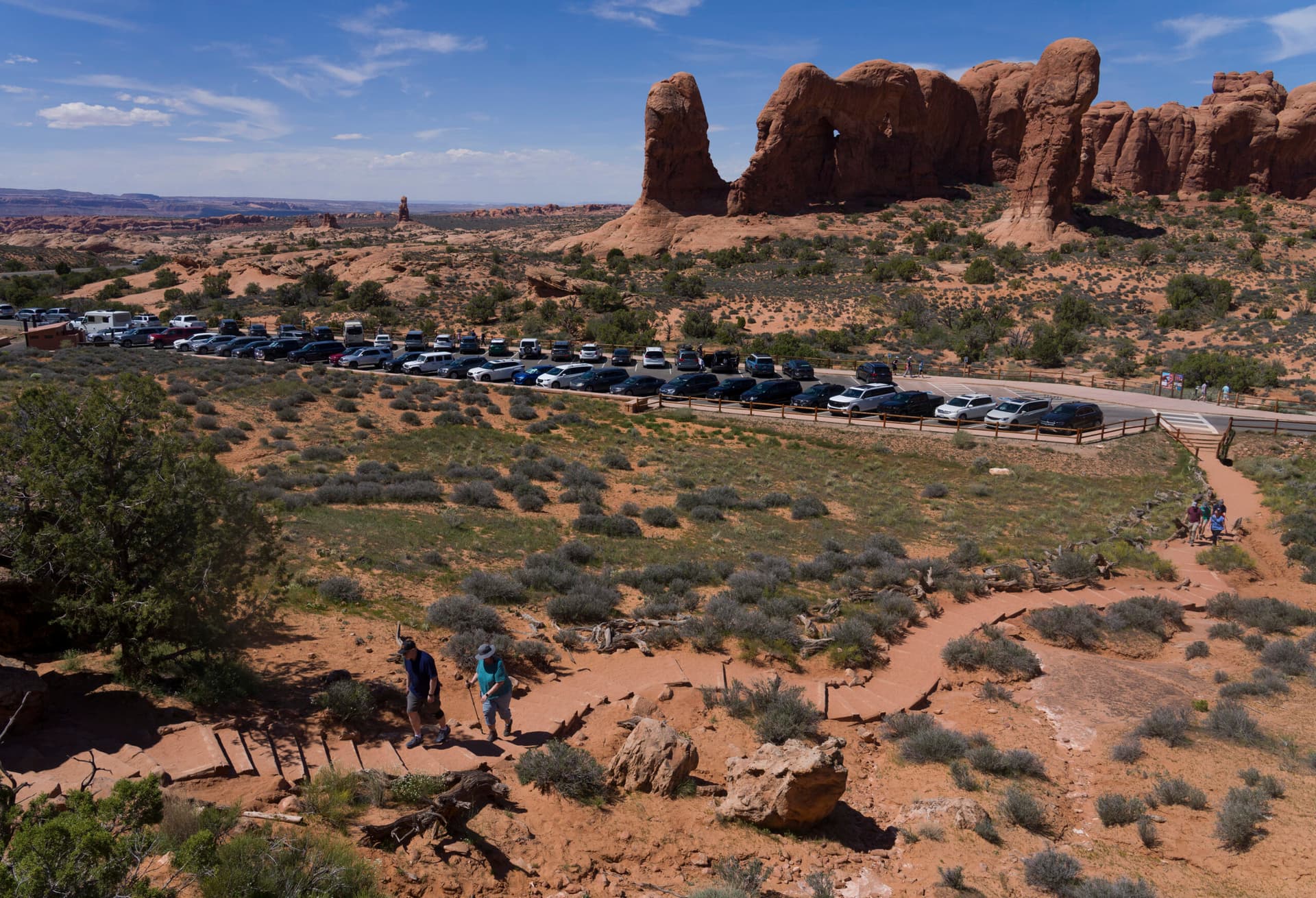
If the Arches shuttle moves from debate to reality, the biggest change for independent travelers is simple: the day may start in downtown Moab instead of at the park gate. Grand County commissioners approved a $500,000 local match in a 4-3 vote on May 19, and the proposed six-month pilot is being sold as a cleaner way to handle the congestion, parking, and entrance-line problems that have built up for years at Arches National Park.
What changes for a Moab trip
This is not just a transportation tweak. The county says the shuttle idea has been studied in at least seven federal planning efforts since 1999, which tells you how long the access problem has resisted easy fixes. The current version is tied to a $3 million Season 1 budget, with $1.5 million from the National Park Service, $1 million from the Utah Transportation Commission, and Grand County’s $500,000 share coming from its transient room tax mitigation fund.
For travelers, that means the trip could shift from a self-drive routine to a hybrid plan. Instead of assuming your car gets you all the way to the entrance and solves the whole day, you may end up parking in Moab and riding in from town, especially if the pilot is rolled out as a direct connection between downtown Moab and Arches.
Parking and where the day starts
Parking is the first thing this shuttle debate changes, even before anyone sees a bus. Arches has dealt with parking congestion, long entrance lines, and crowding at scenic-drive sites, and the park began temporarily closing its main entrance during heavy visitation in 2018, sometimes for 3 to 5 hours at a stretch. A shuttle is meant to reduce that pressure, which is why the county and park are treating access like a systems problem instead of a simple lane problem.
For an independent traveler, the practical takeaway is that parking may stop being the main planning question at the park boundary and become a downtown Moab question instead. That shifts the calculus for hotels, trailhead timing, and how early you need to be on the road. If you usually race the sunrise crowd to the entrance, the shuttle proposal suggests a very different pattern: stage in town, move through a transit connection, and let the park absorb fewer private vehicles.
Reservation timing and sunrise access
The timing piece matters just as much as the parking piece. Arches used timed-entry reservation systems in 2022, 2023, 2024, and again in 2025, but on February 18, 2026, the National Park Service said advanced timed-entry reservations would not be required this year. Visitors may enter during operating hours, which means the old reservation calendar is no longer the main gatekeeper for access in 2026.
That does not mean congestion is gone. The park service still says vehicles may be diverted if areas become too congested, so travelers should not read the end of timed entry as a free-for-all. Sunrise and sunset visits remain the moments most likely to test the system, because those are the hours when everyone wants the same light and the same overlooks. If the shuttle is running, the real question becomes whether its schedule and frequency support early starts and late exits, or whether the ride itself becomes the new bottleneck.
Families, cyclists, and the gear question
Families with kids are likely to feel the difference fastest if the shuttle actually reduces the long, uncertain wait at the gate. Less idling, fewer parking hunts, and fewer arrival-time gambles are the obvious wins. The flip side is that a shuttle adds one more step to the day, so families will want to know how easy it is to load strollers, snacks, water, and the usual pile of desert gear without turning the trip into a logistics puzzle.
Cyclists have their own set of questions. Grand County’s broader argument is that a shuttle is part of a gateway-community solution, not just a tourism perk, and that matters because Highway 191 and the road into Arches already carry a lot of pressure. The open question for riders is whether the pilot makes the approach safer and calmer, or whether it simply moves the congestion somewhere else. Until the operating rules are set, cyclists should treat the shuttle as promising but still incomplete.
Why the money fight matters
The budget debate is not background noise, it is the story. Moab Sun News says the shuttle proposal drew more than 120 comments on its preview post, and that reaction spilled into the harder question of where the county’s $500,000 would come from. Local reporting says the money would come from the transient room tax mitigation fund, which is why residents are asking whether tourism money is being redirected away from sheriff, EMS, search and rescue, and other TRT-funded services.
That concern lands even harder because the county expanded its Q&A on May 21 to address the funding question directly. The timing also explains the pressure to move quickly. Grand County says the project is being pushed now because the National Park Service has a one-year Centennial Challenge funding window that requires a 1-to-1 nonfederal match and must be obligated by September 30, 2026. The Utah Transportation Commission approved $1 million on May 15, and with the county match in place, local officials are treating the budget as the missing piece that lets the pilot move forward later in 2026.
The National Park Service’s own guidance captures the logic behind the whole effort: “few national parks can independently conceive, plan, implement, and operate a fully effective transit system.” That is the case Grand County is making, and it helps explain why Moab is being pushed into the role of a gateway community in the same conversation as Yosemite, Acadia, and Zion.
What travelers still need to watch
The unanswered details are the ones that matter most when you are actually trying to plan a trip. The county and park still need to nail down procurement and contract timing, fare structure, and how ridership will be measured against the decades of prior studies that never solved the congestion problem.
- Will the shuttle be easy enough to use for a same-day Arches visit from Moab?
- Will fares be simple, or will the price structure add friction for families and solo travelers?
- Will the service be useful at sunrise and sunset, when the park is most crowded?
- Will cyclists and other self-directed visitors keep enough flexibility to make the shuttle optional, not mandatory?
That is the real shift this debate is pointing toward. If the shuttle launches, an Arches visit may stop being a question of whether you can beat the gate in your own car and become a question of how well Moab can move people, money, and pressure without breaking the experience that draws them there in the first place.
This article was produced by Prism’s automated news system from verified source data, official records, and press releases, then run through automated quality and moderation checks before publishing. The system is built and supervised by the people who set the standards it runs under. Read our full AI policy.
Did this article answer your question?