Artem Alekhin blends realism and geometry in anatomy-first tattoos
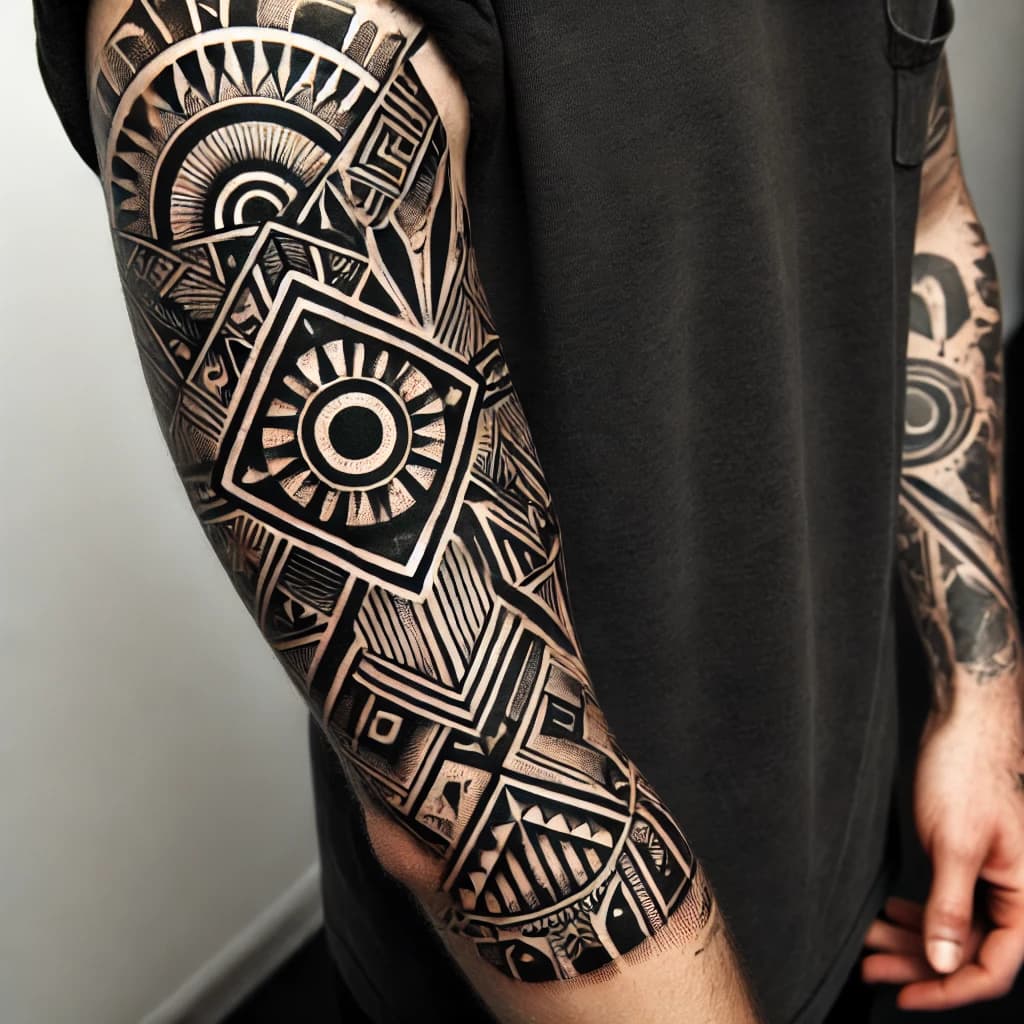
Artem Alekhin treats geometry as structure, not decoration, and lets anatomy decide the final composition. Realism adds feeling while clean lines keep the piece coherent.
Anatomy is the frame, not the obstacle
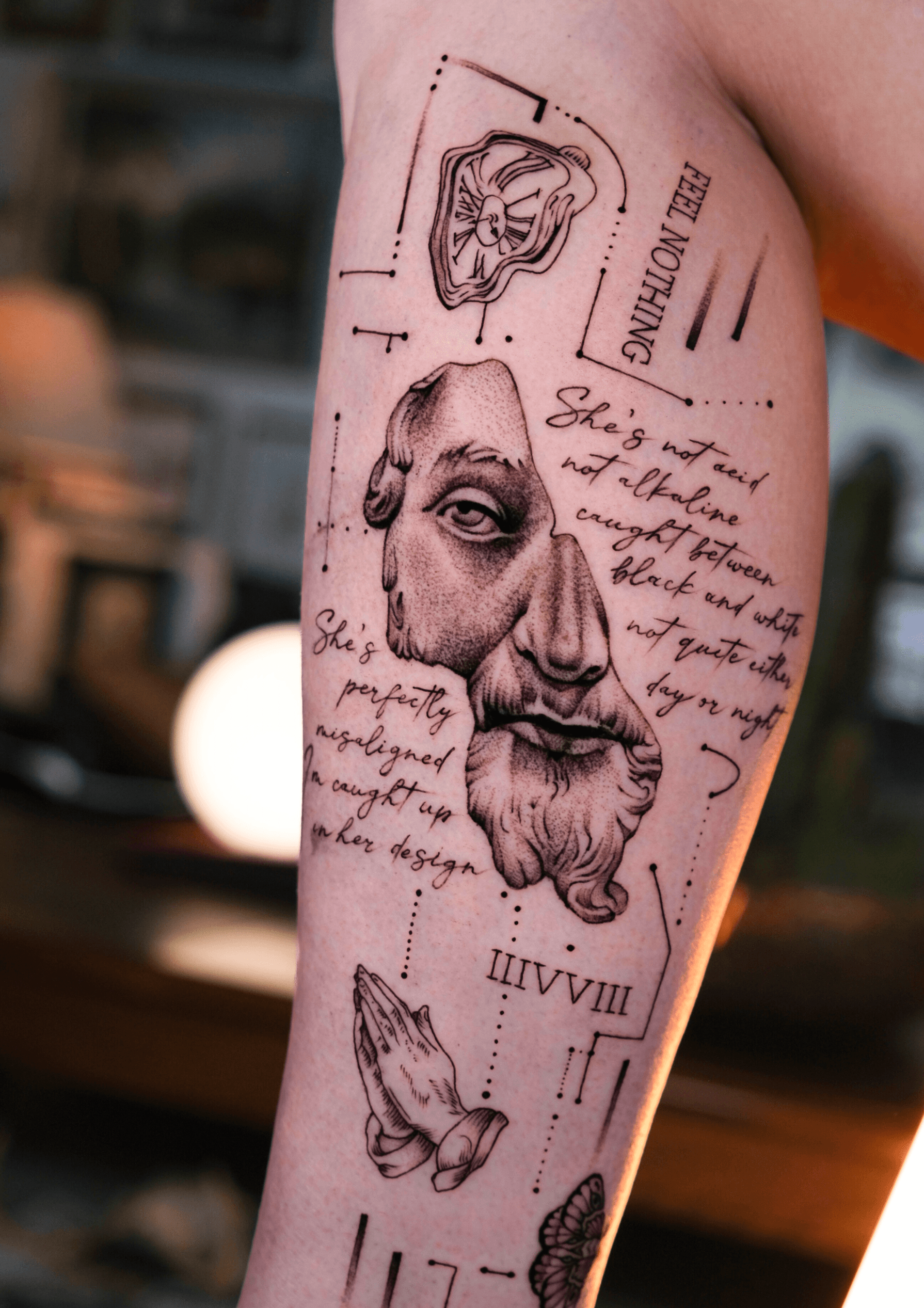
Artem Alekhin’s work lands in the sweet spot where realism and geometry stop competing and start supporting each other. The core idea is simple but easy to miss: the body is not just a surface for a design, it is the design’s first constraint, its movement system, and its final test. That is why his best pieces read as fused compositions rather than separate styles stitched together.
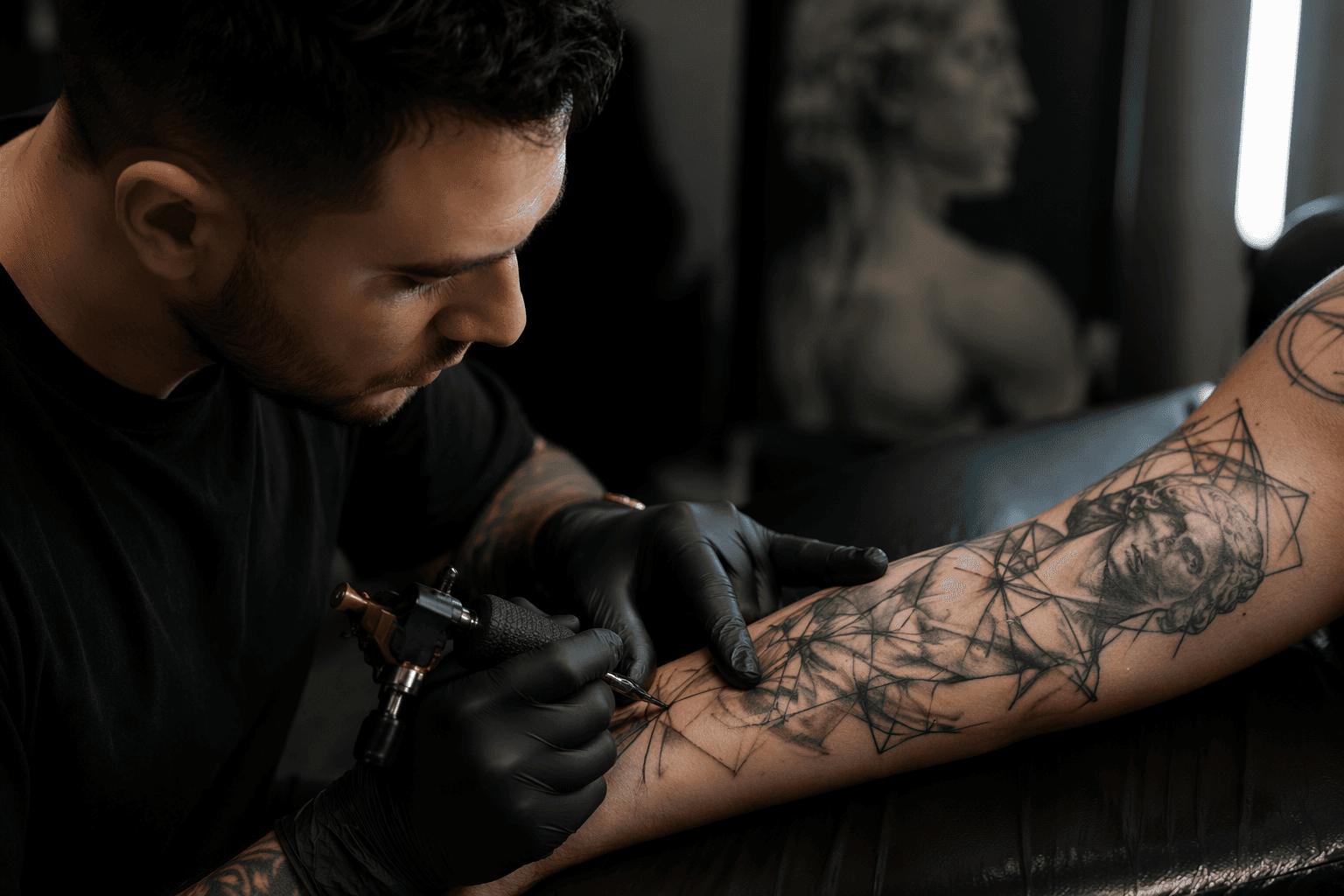
Alekhin’s approach treats tattooing as a dialogue with the person wearing it. The design, the session, and the finished result are all parts of the same relationship, and that mindset explains why his geometry never feels pasted on. In his hands, symmetry is not a visual trick. It only matters when it works with muscle, bone, and motion.
How realism and geometry share the same skin
The strongest hybrid pieces do not ask geometry to do the job of realism, or realism to imitate structure. Instead, geometry becomes the scaffold that gives the image order, while realism supplies texture, weight, and emotional pull. That balance is what makes the fusion feel deliberate rather than crowded.
Alekhin came into tattooing through experimentation and trial and error, and that origin shows in how he talks about form, light, shadow, discipline, and precise control. Those are not separate skills in this style. They are the mechanical foundation that lets clean lines and dotwork sit beside portrait detail without collapsing into noise.
The practical lesson for geometric tattooing is that structure has to earn its place on skin. A triangle, frame, mandala fragment, or line system should never look like a sticker sitting on top of a body. It should guide the eye through the composition, opening space for the realistic elements to breathe.
What makes the mix work is usually a set of small decisions that add up:
- Transitions: sharp geometry should soften into realism through shading, dotwork, or a change in line density so the shift feels intentional.
- Framing shapes: circles, arcs, grids, and angular borders should follow the body’s planes instead of fighting them.
- Negative space: empty skin is not wasted space here, it creates rhythm and keeps the piece from becoming visually heavy.
- Placement logic: the geometry should reinforce the natural movement of the arm, torso, or leg, especially where the body bends or twists.
- Visual hierarchy: the geometric layer should support the portrait, animal, or organic motif, not compete with it for attention.
That last point is where a sophisticated fusion piece separates itself from a mismatched one. If the geometric structure is too dominant, the realism gets flattened. If the realism overwhelms the frame, the geometry becomes decoration instead of architecture.
Why this approach fits the current tattoo landscape
Alekhin’s style resonates because it mirrors a broader shift in how people think about tattoos. Pew Research Center reported in August 2023 that 32% of U.S. adults have at least one tattoo, and 22% have more than one. In the same survey, 69% of tattooed adults said they got inked to honor or remember someone or something. That is a big clue about why anatomy-first, story-driven work is gaining traction: people want tattoos that carry meaning, not just clean imagery.
This is where geometry becomes more than a trend language. It gives structure to a personal subject. When someone wants a memorial piece, a family reference, or a design anchored in a private story, geometry can frame that meaning without making it literal. The result is a tattoo that feels organized by motif, placement, and emotional intent.
The historical backdrop matters too. Smithsonian Magazine has noted that humans have been marking their skin for thousands of years, and that the 5,200-year-old Ötzi the Iceman, found in 1991 near the Italian-Austrian border, carried dots and small crosses on the lower spine, right knee, and ankle joints. Those marks may have been therapeutic. That detail is striking for geometric tattooing because it shows that body-specific patterning is not new at all. The idea that repeated marks can be meaningful, structural, and connected to anatomy has ancient roots.
Precision also carries responsibility
The medical side of tattooing adds another layer to Alekhin’s emphasis on control. A 2022 systematic review documented inflammatory, infectious, and tumoral tattoo-related reactions in the medical literature. The Lancet’s 2024 review added that tattoo-associated infections have been seen in both professional and non-professional settings, with immunocompromised people, especially those with HIV, facing particular vulnerability.
That reality makes discipline more than a style choice. In geometric work, where clean edges and controlled spacing are part of the visual promise, technical precision is inseparable from care. Good structure is not just about aesthetics. It also reflects a methodical approach to placement, execution, and aftercare awareness.
What separates a strong fusion piece from a mismatched one
The best realism-geometry tattoos feel inevitable once they are finished. The framing lines do not interrupt the portrait, the dotwork does not clutter the read, and the negative space gives the piece air instead of absence. Every element seems to answer the same question: how does this shape live on this body?
That is the deeper value of Alekhin’s anatomy-first method. It rejects the idea that geometric work has to be rigid or formulaic, and it shows how precision can make a tattoo more expressive rather than less. When geometry supports movement, identity, and body flow, it stops being a trend filter and becomes the thing that holds the entire composition together.
This article was produced by Prism’s automated news system from verified source data, official records, and press releases, then run through automated quality and moderation checks before publishing. The system is built and supervised by the people who set the standards it runs under. Read our full AI policy.
Did this article answer your question?