Buddhist endless knot tattoo or pendant, choosing a respectful design
The endless knot can look elegant fast, but it only reads right when its sacred geometry, symmetry, and placement stay intact. Treat it as a Buddhist symbol first, then decide whether it belongs on skin or as a pendant.

A Buddhist endless knot can be beautiful in two very different forms, as a tattoo or as a pendant, but the design only holds its power when the geometry and the meaning stay in balance. The knot, also called the Shrivatsa, is one of the Eight Auspicious Symbols in Tibetan Buddhism, and its single unbroken line gives it a visual logic that many geometric tattoo fans instinctively love. That same simplicity is why it deserves extra care: if you flatten it into generic ornamental flash, you lose the very continuity, interconnectedness, and spiritual weight that make it compelling in the first place.
Why the endless knot reads so well in geometric work
The endless knot is built from one continuous line, so it already behaves like a strong tattoo concept before any artist touches stencil paper. Clean structural forms, mirrored loops, and a sense of endless flow make it fit naturally alongside sacred-geometry pieces, but its Buddhist context changes the stakes. The symbol is not just a pattern to fill space; it belongs to a living visual tradition, and that is what separates a thoughtful piece from a pretty but careless one.
Buddhist reference sources describe the Eight Auspicious Symbols as sacred signs of spiritual and material well-being. That matters because the endless knot is not floating free as decoration, it sits inside a symbolic set that has been used to communicate blessing, protection, and auspiciousness. If you are drawn to the knot because it feels calm, balanced, and mathematically satisfying, that instinct is already close to the symbol’s core meaning, but the design still needs to be handled as something more than abstract geometry.
Tattoo or pendant: the first decision shapes everything
The pendant-versus-tattoo question is not just about where the motif sits. It changes scale, line weight, and how much detail the knot can keep before it starts to blur into decoration. A pendant can rely on metal, polish, and light; a tattoo has to survive skin texture, movement, and time, which means the loops need enough breathing room to stay readable.
If you are planning a tattoo, ask whether the knot is meant to feel devotional, mindful, or protective, or whether you are simply responding to the symmetry. That answer should guide placement. A centered sternum piece, a nape-of-neck design, or a forearm version all communicate differently, and the endless knot works best when the body placement respects its balance instead of fighting it. If you are choosing a pendant, the same logic still applies, because the object should feel like a wearable symbol, not just a trinket shaped like one.
How to keep the geometry intact on skin
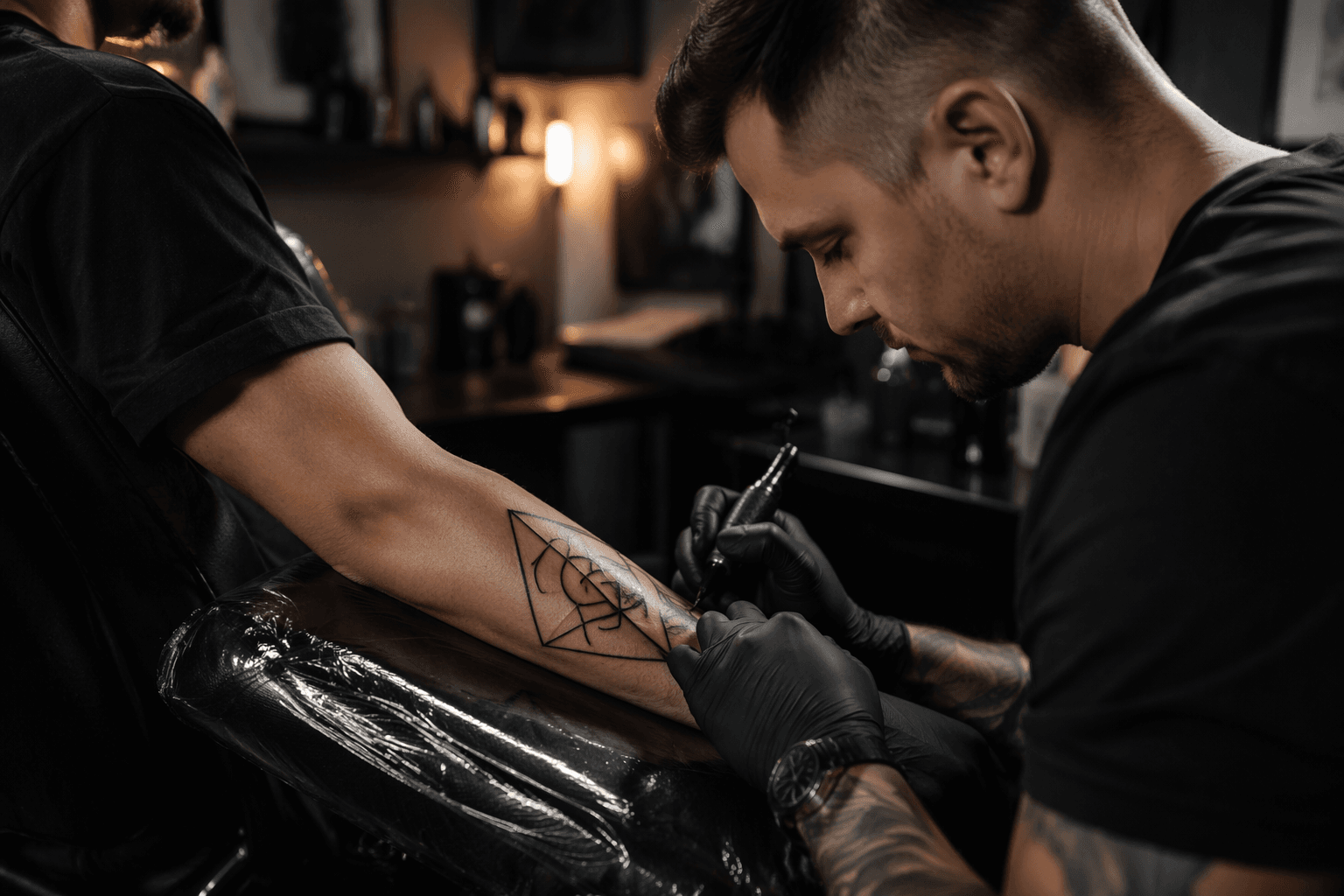
The endless knot looks simple until you try to draw it cleanly, which is exactly why it rewards careful stencil planning. The loops should feel continuous, the crossings should be deliberate, and the spacing should stay even enough that the eye can follow the line without confusion. If the symmetry drifts, the design stops reading as a knot and starts reading as a tangled ornament.
- keep line weight consistent so the line feels unified, not overworked
- leave negative space where the weave needs to breathe
- scale the design large enough that crossings do not collapse together
- place it where the body does not distort the knot beyond recognition
A respectful tattoo usually benefits from restraint:
That final point matters more than many clients expect. A design that looks perfect on a flat digital mockup can warp badly across a shoulder curve or a wrist bend, and with a motif this dependent on visual order, even small distortion changes the whole read.
The symbol’s history is part of the design brief
The endless knot has a broader place in Buddhist visual culture than most first-timers realize. The Metropolitan Museum of Art has shown the Eight Buddhist Treasures, including the endless knot, on objects such as bowls, cup stands, and sutra covers, where the symbols were used as traditional decorative motifs. On one bowl, the interior carries the Eight Buddhist Treasures, and on a cup stand, the objects resting on lotus buds include an endless knot among the other emblems. The museum also notes that these symbols were initially introduced to China with Buddhism and later became established decorative forms.
That long travel through objects matters for tattoo planning because it proves the symbol has always moved between media, from ritual art to household items to decorative surfaces. A pendant and a tattoo are not random modern inventions in that lineage. They are part of the same habit of carrying meaning across material forms, which is why the endless knot can still feel at home on skin without losing its identity.
Respect is not optional with sacred imagery
Because the knot belongs to a living religious tradition, the cultural context has to stay visible. Buddhist media has explicitly framed cultural appropriation as part of the contemporary conversation around spiritual imagery, and that makes a difference when the design leaves the temple, the home altar, or the jewelry case. The question is not whether you are allowed to appreciate the symbol. The question is whether you are willing to carry it in a way that acknowledges what it represents.
That is where consultation matters. A good artist should be ready to talk about whether the client is approaching the piece from devotion, mindfulness, protection, or aesthetic appreciation. Those are not interchangeable motives, and they may suggest different choices in size, placement, or whether the tattoo should stay plain rather than surrounded by unrelated ornament. The more clearly the intent is named, the easier it becomes to avoid a design that feels visually polished but spiritually careless.
Why the old symbol still feels current
The endless knot has endured because it solves a problem that geometric tattoo lovers understand instantly: how to make a form feel orderly without making it dead. The single line suggests continuity, the weave suggests interdependence, and the symmetry gives it calm. That is exactly why the motif has moved so easily from early Buddhist art in India, where symbolic imagery appears as far back as roughly 200 BCE to 400 CE, into later decorative traditions across Asia.
If you are deciding between tattoo and pendant, the best choice is the one that protects that calm instead of flattening it. A good endless knot design should look like something that belongs to a long visual tradition and also to your body, which is a harder balance than it sounds. When the line stays unbroken, the symmetry stays true, and the context stays visible, the knot does what it has always done: it turns geometry into meaning.
This article was produced by Prism’s automated news system from verified source data, official records, and press releases, then run through automated quality and moderation checks before publishing. The system is built and supervised by the people who set the standards it runs under. Read our full AI policy.
Did this article answer your question?