Daniel Frye blends geometric tattooing with tribal blackwork and pattern traditions
Daniel Frye shows geometric tattooing as a system of flow, black contrast, and lineage, not just clean shapes. His work points to body-scale composition as the real test.

Daniel Frye’s profile is a useful reminder that geometric tattooing rarely lives alone. In his case, the lines, repeats, and symmetry sit inside a bigger practice shaped by tribal blackwork, Borneo and Polynesian tattooing, ornamental patterning, and even large-scale Japanese work. That mix changes how you read a geometric piece: not as a stand-alone shape, but as part of a larger map across the body.
Geometry as structure, not decoration
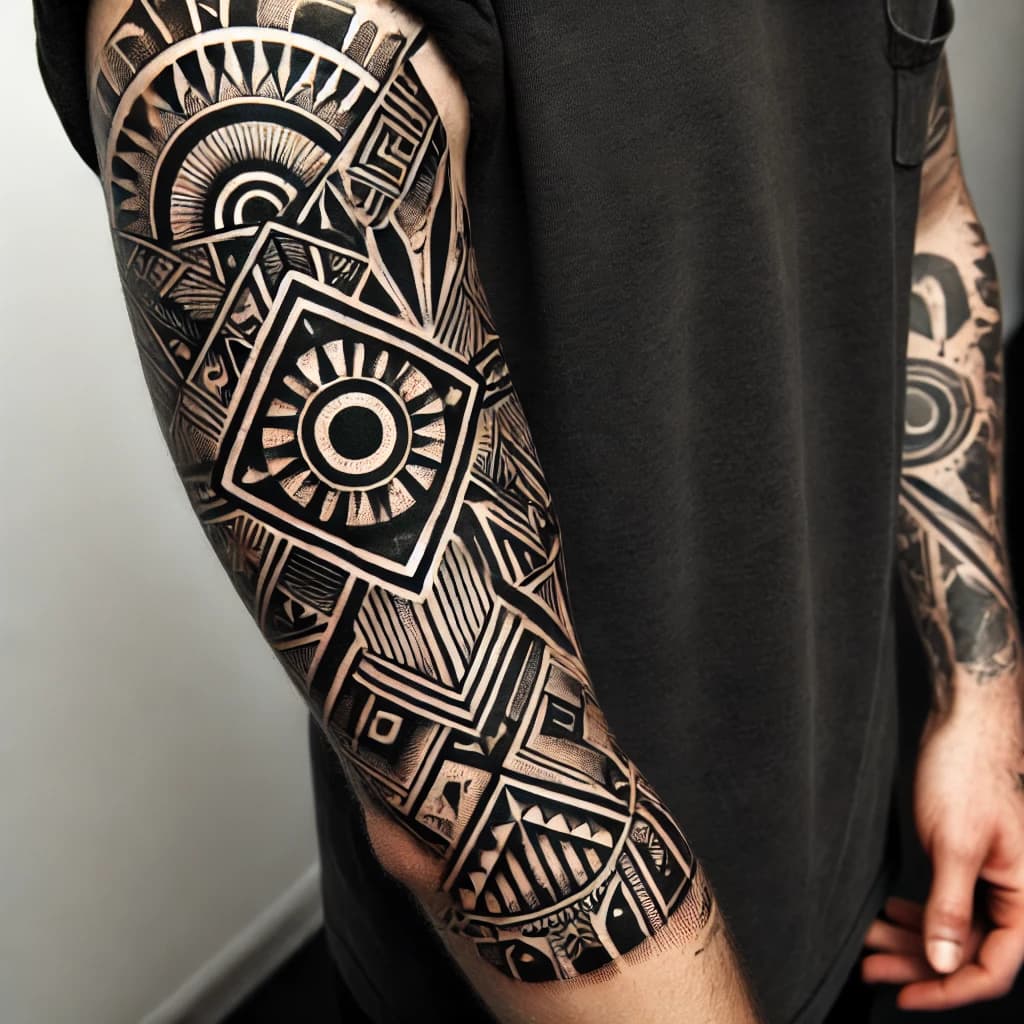
The strongest geometric tattoos often do more than look precise. They set the rhythm for everything around them, using spacing, contrast, and repetition to guide the eye from one part of the body to the next. Daniel Frye’s profile, which places him in Margate, England, makes that especially clear because his practice is not framed as a narrow crisp-line specialty. He is described as specializing in bold tribal and intricate blackwork tattooing, while also working with ornamental and geometric styles.
That matters because geometric tattooing is often mistaken for a surface-level aesthetic, all neat angles and clean symmetry. Frye’s mix suggests something more architectural. A well-planned geometric section can anchor a sleeve, connect a chest panel to the upper arm, or carry a concept through large areas of skin without the piece feeling chopped into separate motifs. In that sense, geometry becomes a structural language inside a broader composition.
Blackwork is the bridge
Tattoodo’s blackwork guide helps explain why Frye’s profile spans so many related styles. The guide places blackwork from tribal roots to contemporary geometric and dotwork, and says the style can include tribal tattoos, dark art, illustrative and graphic art, etching or engraving styles, and even lettering or calligraphic scripts when only black ink is used. That range shows why blackwork artists often move naturally between styles that some clients might separate in their heads.
For geometric tattoo fans, that overlap is useful. Blackwork creates the contrast that lets geometric patterning hit hard on the skin, especially when the design relies on density, repeated forms, or strong negative space. Frye’s combination of blackwork and geometric work suggests comfort with visual weight, which is often what makes a larger piece feel cohesive instead of merely decorated.

Why lineage matters in pattern-based work
Frye is also described as being well versed in Borneo and Polynesian tattooing, and that is not a minor detail. The Smithsonian notes that Polynesian tattoo traditions developed over millennia and often feature highly elaborate geometric designs that can cover the whole body. That gives the modern geometric artist a much deeper frame than simple symmetry: the pattern is part of a body-wide system.
PBS’s Skin Stories project adds more context. In Samoa, tatau has been applied by hand for more than 2,000 years, with tools and techniques changing very little. In Tahiti, tattoos historically marked rank and status, and across what is now French Polynesia, island groups and even individual islands could have their own distinctive designs. Taken together, those details show why pattern traditions carry more than visual appeal. They map identity, rank, origin, and belonging onto the body.
For anyone looking at geometric work today, that lineage matters. The best artists in this space are often the ones who understand that pattern is never only pattern. It can be cultural language, placement logic, and an organizing principle for how a tattoo moves with the body.
What Frye’s portfolio signals to collectors
A substantial portfolio paired with breadth across tribal, blackwork, ornamental, geometric, and Japanese work tells you something important about process. It suggests an artist thinking in terms of coverage and flow rather than isolated motifs. That is the kind of thinking that becomes crucial when the goal is a sleeve, a bodysuit fragment, or a large-scale piece where the negative space between forms matters as much as the forms themselves.
If you are evaluating geometric artists, the question is not just whether the linework is crisp. Look for whether the work understands the body as a surface with movement, curvature, and transitions.

- Does the portfolio show black fields and pattern systems, not just single symbols?
- Is there evidence the artist can move between geometric, ornamental, and tribal vocabularies without losing coherence?
- Do larger pieces wrap naturally around limbs, shoulders, or torso planes?
- Is there a sense of pacing, where dense sections and open skin are used deliberately?
That last point is where Frye’s mix becomes especially relevant. Geometric work gains power when it is part of a larger composition that respects the body’s shape.
From Ötzi to now, pattern has always been bigger than style labels
The long view makes the modern category feel smaller and richer at the same time. Ötzi the Iceman, often cited as the oldest physical evidence of tattooing, carried 61 tattoos dating to around 3300 BCE. That early record reminds you that line-based marking and patterned placement have been part of human body art for a very long time.
Read alongside Polynesian and blackwork traditions, that history pushes geometric tattooing beyond the idea of a clean modern trend. The style can be contemporary and precise, but it also sits inside older traditions of marking, mapping, and covering the body with meaning. Frye’s profile lands in that space: not geometry as a standalone trick, but geometry as one tool in a larger, disciplined visual language.
That is the real lesson in his work. The most interesting geometric tattoos are often the ones that know when to stand out and when to support the whole body picture, and that is where structure becomes style.
This article was produced by Prism’s automated news system from verified source data, official records, and press releases, then run through automated quality and moderation checks before publishing. The system is built and supervised by the people who set the standards it runs under. Read our full AI policy.
Did this article answer your question?