Geometric lion tattoos look bold, but lasting clarity is the challenge
Geometric lion tattoos are strongest when the face stays readable after healing. The best designs protect symmetry, spacing, and line weight from the start.
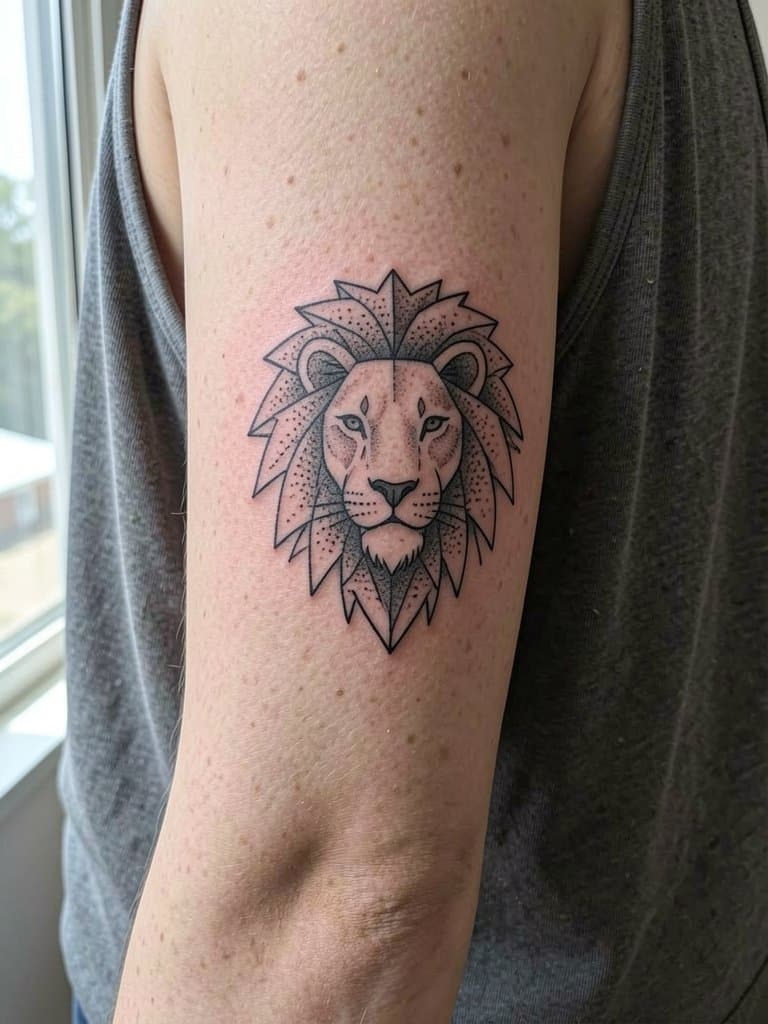
Geometric lion tattoos win attention fast because they look disciplined, bold, and almost architectural on day one. The real test comes later, when the skin settles and the design has to keep reading as a lion, not just as a cluster of angles. That is where line weight, spacing, and facial clarity matter more than the first photograph.
Why the lion works so well in geometry
The lion already carries a heavy symbolic load. Across Africa, China, and Europe, it is tied to strength, courage, leadership, royalty, and protection, and that meaning makes it a natural fit for a style built on structure. In Chinese culture, lion imagery also connects with good fortune and lion dances that are meant to drive away evil spirits, while medieval European heraldry used lions to signal bravery, nobility, and divine right.
Geometry changes the mood without erasing the symbol. Instead of fur texture doing all the work, the design relies on precise shapes, symmetry, negative space, and sometimes sacred geometry or mandala motifs to turn the head into something more modern and engineered. That is what makes the motif so compelling: it can feel both primal and calculated at once.
What makes a geometric lion hold up on skin
A geometric lion succeeds when the most recognizable parts stay clear after healing. The mane can be stylized, but the eyes, muzzle, and overall facial structure need enough breathing room to survive the long run. Thin single-needle lines can look razor sharp on day one, but tiny angular facets and overly packed mane details are exactly the kind of features that can blur as the skin settles.
That is not just an aesthetic warning. The American Academy of Dermatology notes that tattoo reactions can show up immediately, weeks later, or even years later, and the Mayo Clinic emphasizes that tattoos are not risk-free. Dermatology literature in PubMed also deals with tattoo complications, including adverse reactions, hypersensitivity, infections, and removal, which is another reminder that the afterlife of a tattoo matters as much as the stencil.
There is also the practical issue of blowout. When ink is deposited too deeply, it can create blurred or fuzzy edges, and once that happens the crisp geometry you wanted can turn soft in a way that is hard to reverse. In a lion design, that kind of failure usually shows up first in the muzzle, cheek lines, and the outer edges of the mane, where the eye expects clean transitions.
A simple way to judge the design before you book
Before you fall for the first striking mockup, look at the tattoo like a design system. Ask whether the lion still reads instantly if the smallest facets soften a little over time. If the answer is no, the concept may be too dependent on tiny details to age well.
A useful checklist:
- The face has to anchor the image. Eyes, nose, and muzzle should be recognizable without relying on every little line.
- Symmetry should feel intentional, not rigid. Geometric work can be perfectly centered, but the mane can carry controlled variation so the whole piece does not feel stiff.
- Negative space should define planes, not just leave gaps. If the empty space is doing the structural work, the design will stay cleaner as it heals.
- The mane should simplify into larger shapes. Too many thin spikes or shards can collapse into visual noise once the skin closes over them.
- The scale has to match the detail. A cramped lion cannot support the same faceted language as a larger composition, because the body needs room for the planes to open up.
This is why geometric tattoo design is never just about the pattern. The style guide logic is built on precision, symmetry, and breathing room, and the lion only benefits from those rules if the artist uses them to clarify the face instead of decorating every inch.
Placement changes whether the lion breathes or jams up
Placement is not an afterthought here. A geometric lion needs enough surface area for the head to feel deliberate, because a cramped version can lose its power and start to look crowded instead of strong. On a larger composition, the lion head can work as a clean focal point, which gives the geometry space to read in full rather than compressing into a dense knot of facets.
Curves matter too. Because the body is not a flat page, the design has to work with the way skin moves and heals, not against it. That is why the best placements are the ones that let the symmetry stay legible without forcing the mane or facial planes to wrap so tightly that the whole thing starts to distort.
Aftercare and risk awareness are part of the design
If you want the tattoo to age well, the conversation cannot stop at style. The American Academy of Dermatology says more and more patients ask dermatologists for skin care tips that keep a tattoo looking its best, and that advice matters because tattoos are effectively skin wounds during healing. Mayo Clinic’s guidance makes the same point from another angle: understand the safety and healing implications before you get inked.
That matters even more with a geometric lion, because the style depends on clarity. The American Academy of Dermatology also warns that tattoos can disguise skin cancer and make it harder to detect, so the health side of the equation is not abstract. A sharp design that supports your skin over time is better than a dramatic one that trades longevity for instant impact.
A good geometric lion is not the one with the most facets. It is the one that keeps its eyes, muzzle, and overall read intact after healing, when the boldness has to survive beyond the first clean photo. That is the real standard: a lion that still looks like a lion when the skin has done its part.
This article was produced by Prism’s automated news system from verified source data, official records, and press releases, then run through automated quality and moderation checks before publishing. The system is built and supervised by the people who set the standards it runs under. Read our full AI policy.
Did this article answer your question?