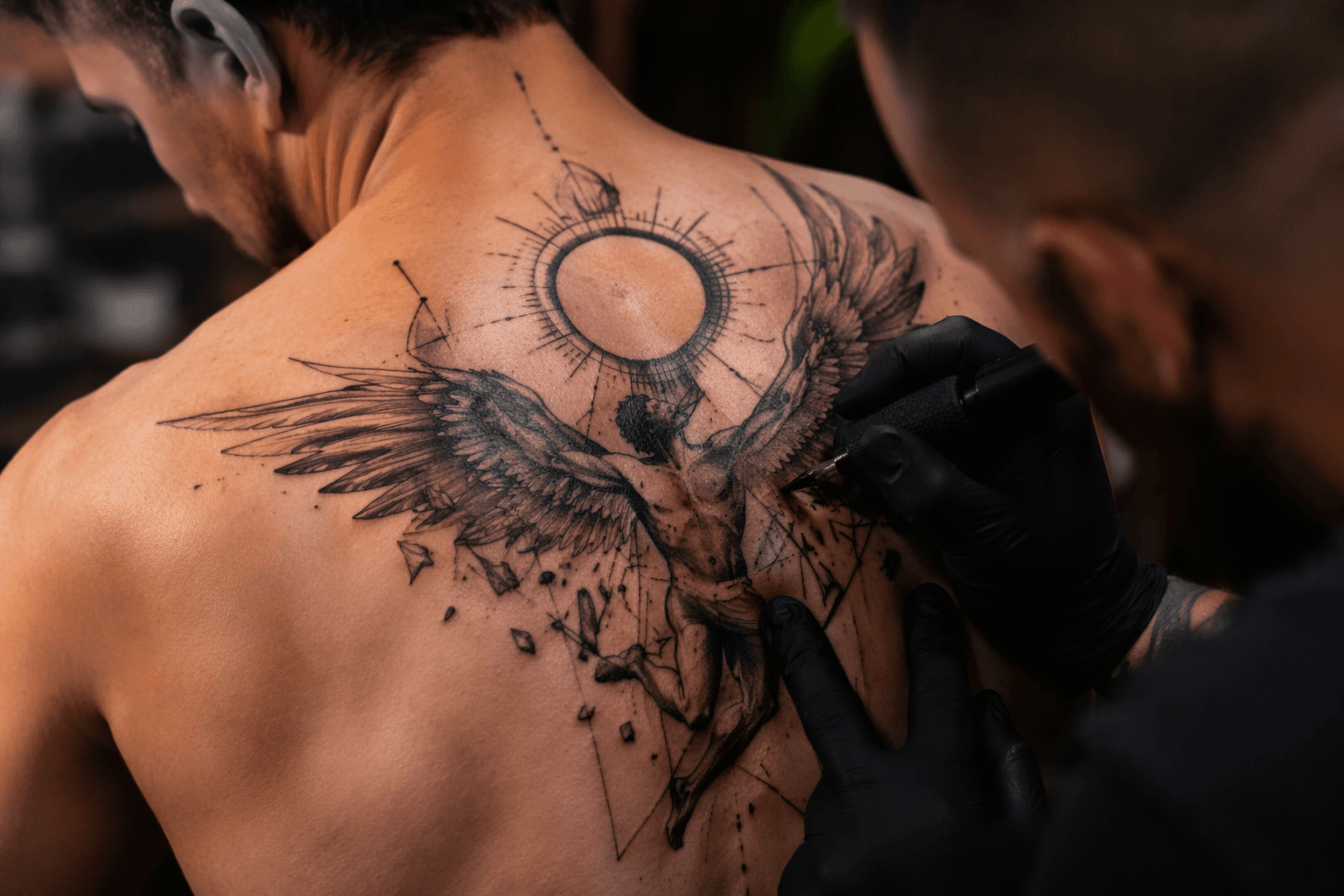
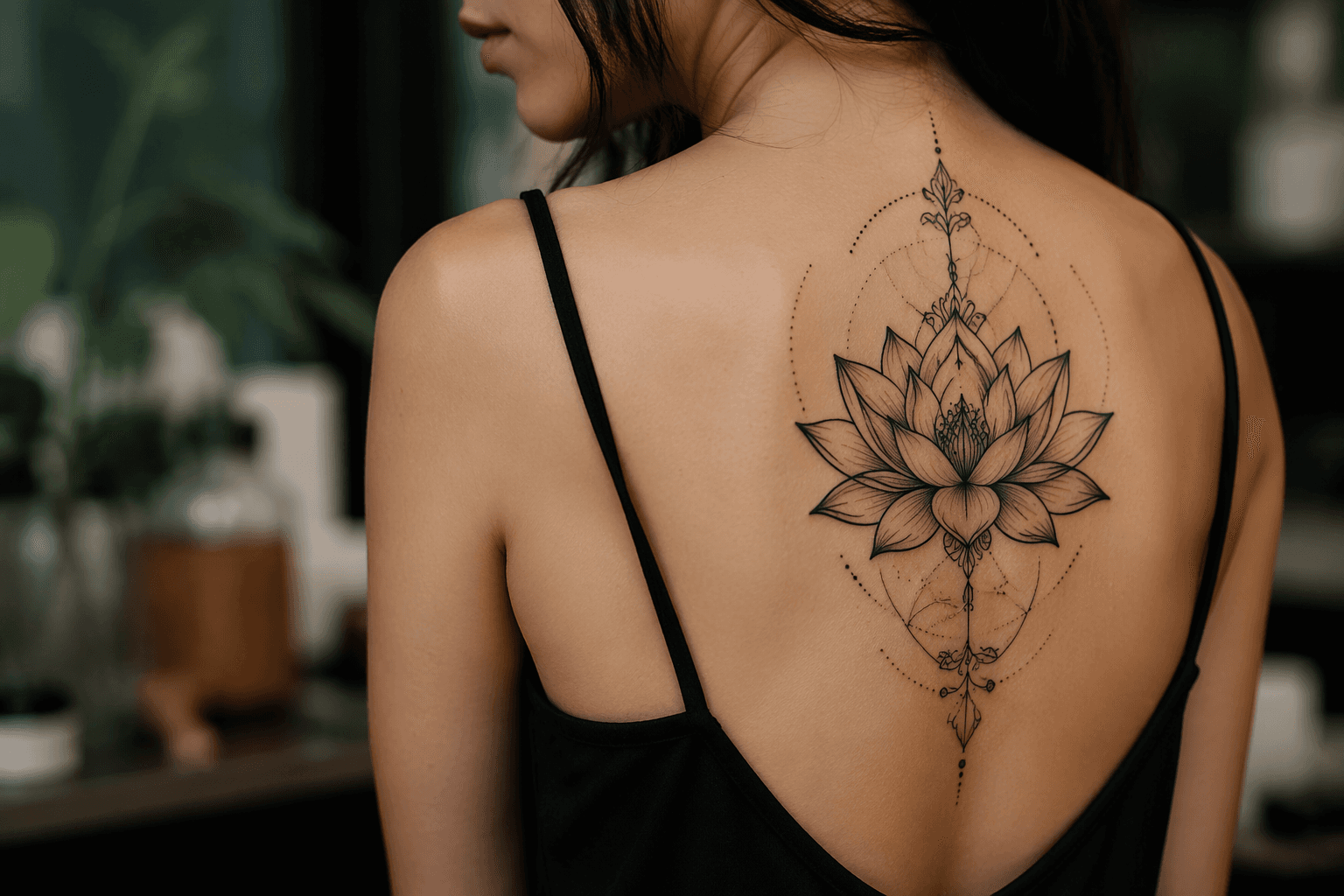
Geometric sun and moon tattoos balance symmetry, placement, and scale
Sun-and-moon couples work when the bodies, not just the drawings, are in sync. Placement, line weight, and scale turn a familiar symbol into a balanced geometric pair.
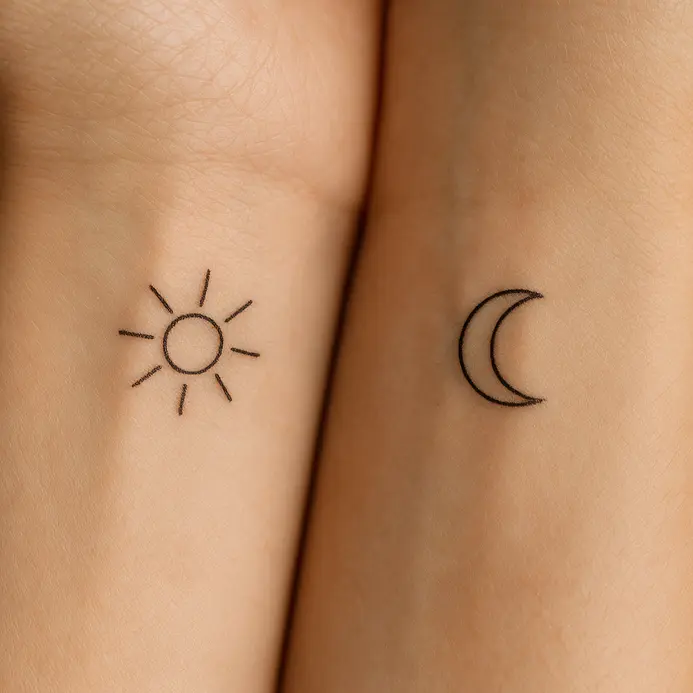
A good sun-and-moon couple tattoo does not win by being identical. It works when the two designs feel like they were measured against the body first, then drawn, with placement and proportion doing as much of the emotional work as the symbol itself. That is where geometric versions become especially interesting: the pairing stops being a cute matching idea and starts reading like a visual system, with mirrored geometry, consistent line weight, and enough negative space to let each half breathe.
Placement sets the relationship
The strongest geometric sun-and-moon pairs begin with anatomy. A narrow wrist naturally favors a smaller crescent moon, while a broader forearm or upper arm can carry a sun with more visual weight without throwing the balance off. That difference matters because the eye reads scale before it reads symbolism, and a pair that ignores the body can end up feeling mismatched even when the drawings are technically beautiful.
A useful example is the tiny fine-line sun-and-moon pairing built around a rising sun and a crescent moon, each floating above three wavy lines. That layout is clean enough for wrists or inner arms, which makes it a practical model for couples who want the tattoos to sit close together in spirit without becoming identical twins on skin. The lesson is simple: the motif can stay the same while the placement does the customizing.
Line weight is the quiet glue
The most convincing paired tattoos do not rely on matching imagery alone. They rely on shared visual weight. Even if one person prefers a bold, textured sun and the other wants a minimalist moon, the designs hold together better when the artist keeps a consistent anchor in line thickness, spacing, and overall rhythm.
That consistency is what prevents the tattoos from reading like two separate ideas forced into a romance story. In geometric work, line weight acts almost like a shared grammar. A sun built from crisp outlines, repeated rays, or subtle dotwork can still converse with a moon that is simpler and more restrained, as long as both designs live in the same visual register.
Symmetry matters, but so does asymmetry that feels intentional
Geometric couple tattoos are not always about perfect mirroring. They are often about controlled contrast, where the sun and moon echo one another through shape language rather than exact duplication. One side may lean into a fuller circle, radiating structure and motion, while the other uses a crescent, open space, or a softer arc to suggest quiet and absence.
That is where negative space becomes part of the design instead of just empty background. Geometric tattoos often depend on clean intervals, and sun-and-moon pairings are especially effective when those gaps feel measured. The result is a composition that feels connected without being locked into sameness, which is exactly why the pairing works so well as a couple motif.
Dotwork gives the celestial symbols depth
Dotwork is one of the smartest ways to push these tattoos toward geometric territory. Instead of leaning on soft illustrative shading, stippled surfaces create texture that can make a moon feel structured, atmospheric, and architectural at the same time. Tattoodo’s dotwork moon geometry example explicitly ties that kind of lunar imagery to intuition, cycles, subconscious themes, balance, structure, and cosmic connection, which is a strong reminder that celestial tattoos do not have to be literal to carry meaning.
That approach also helps the pair feel more dimensional on skin. A dotted sun can suggest energy without becoming heavy, and a dotted moon can keep its edge while still feeling delicate. When both pieces use the same textural logic, the tattoos read as a coordinated system rather than a random couple of pretty symbols.
The motif carries meaning even at small scale
Sun-and-moon tattoos endure because the symbolism is immediate. Tattoos.com frames the pairing as day and night balance, cycles, and complementary forces, and that shorthand is part of why the design keeps coming back in couple tattoo culture. The sun is not just decorative here either. In the way ink culture talks about it, the Sun is the star at the center of our solar system and the primary source of energy for life on Earth, which gives even a small sun a surprisingly large emotional charge.
That is also why scale does not have to be grand to matter. Tattoodo’s small-tattoo guide makes the point plainly: meaningful tattoos do not have to be large or intricate to communicate a deep message. A small wrist moon or inner-arm sun can carry the same symbolic weight as a larger piece if the proportions are handled carefully.
Couple tattoos live between sweetness and caution
Part of the enduring appeal of sun-and-moon pairings is that they sit in a recognizable social conversation. Inked Magazine has described sun-and-moon designs as one of the classic matching-tattoo ideas people frequently choose for couples, and it has also noted how artists and clients have debated couple tattoos for decades. Some see them as a sweet bonding gesture. Others refuse to do matching ink except for blood relatives or someone deceased, which tells you how loaded the category can be.
That tension is exactly why geometric restraint can help. A pair that is visually elegant, balanced, and adaptable feels less like a declaration that has to survive every possible future and more like a shared design choice grounded in taste. Inked has also written about couples getting tattoos together as a bonding experience, especially when the imagery is romantically themed, and sun and moon fit that role because they suggest complementarity without needing literal portraits, initials, or dates.
The best versions read like one conversation, not two speeches
The most effective geometric sun-and-moon tattoos are the ones where every decision points back to the same question: how do these two shapes talk to each other on the body? A fine-line wrist moon can answer a slightly larger forearm sun; a dotted lunar texture can meet a crisp solar outline; a wider placement can carry more visual weight while a narrow one stays airy and precise. Tattoodo’s gallery of sun-and-moon work shows how often the motif moves across traditional, minimal, and ornamental styles, and that range is exactly what makes the design durable.
When the balance is right, the tattoos feel linked even if they are not identical. That is the real geometric payoff: not matching for its own sake, but building a pair whose symmetry, placement, and scale make the duality physically believable on skin.
This article was produced by Prism’s automated news system from verified source data, official records, and press releases, then run through automated quality and moderation checks before publishing. The system is built and supervised by the people who set the standards it runs under. Read our full AI policy.
Know something we missed? Have a correction or additional information?
Submit a Tip