Iris Flower Tattoos Blend Botanical Realism With Geometric Dotwork Designs
Despite 190 iris tattoo variations, geometric hybrids collapse into just four scaffold archetypes; knowing which one you're building determines everything from dot density to session count.
Scroll through 190 iris tattoo images in a single sitting and something unexpected happens: the apparent visual diversity narrows fast. Strip away color choices and scale, and the geometric-hybrid entries in InspirationDe's large-format iris gallery cluster almost exclusively into four structural archetypes: the mandala halo, the faceted polygon frame, the dotwork gradient fill, and the fine-line stem with negative space surround. That compression is the most useful piece of information the gallery offers, and it's the one most clients and artists miss when they treat a curated collection as simple inspiration rather than a trend map.
The four geometric iris archetypes
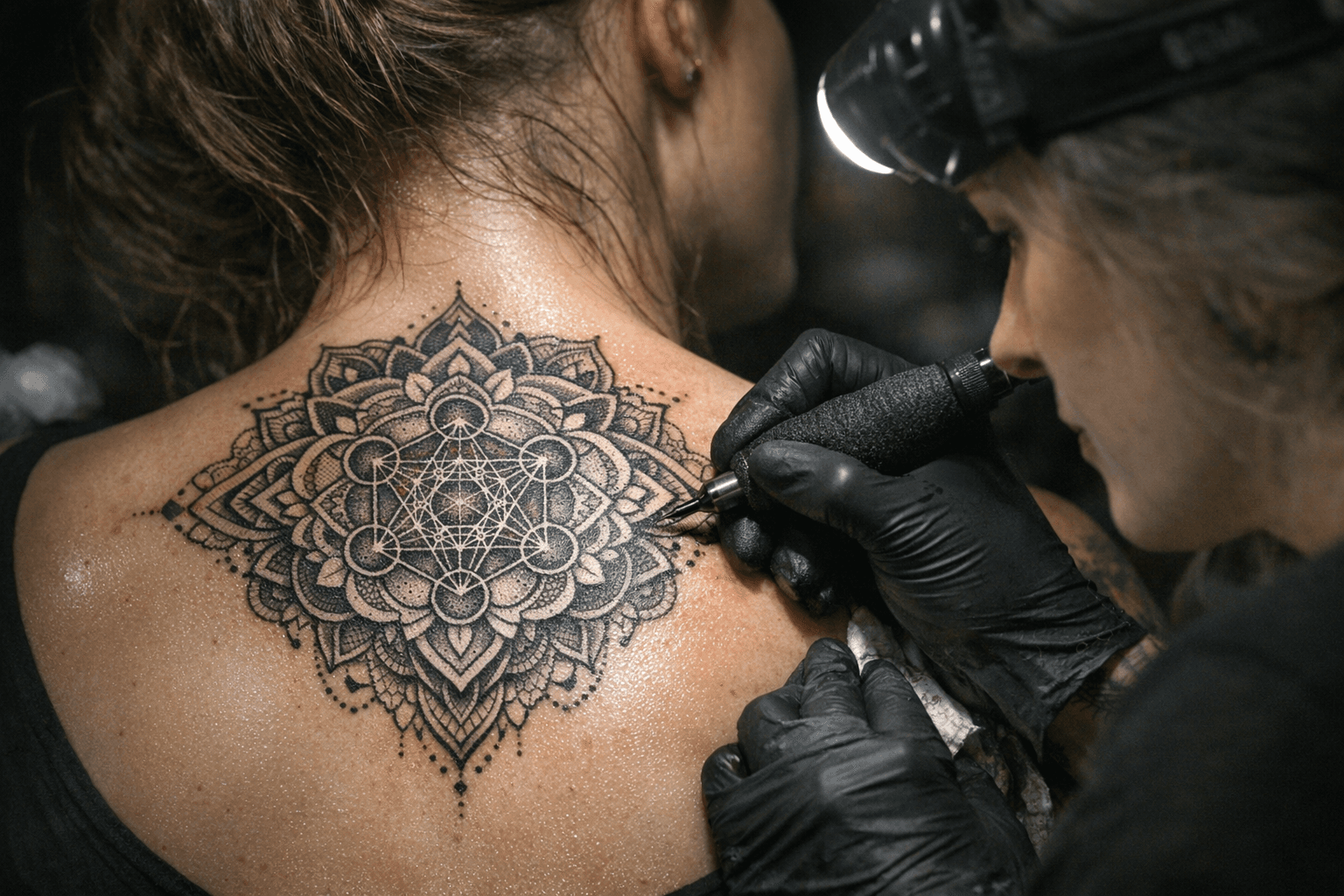
The mandala halo is the most architecturally ambitious of the four. The iris sits at the center of a radial composition, with concentric rings of linework or lace detail expanding outward like a halo. The botanical form anchors the symmetry; the geometry completes it. Because mandala construction demands clean bilateral balance, this archetype punishes uneven petal placement more than any other. Even a two-millimeter drift in where the iris center sits will throw off the radial rhythm.
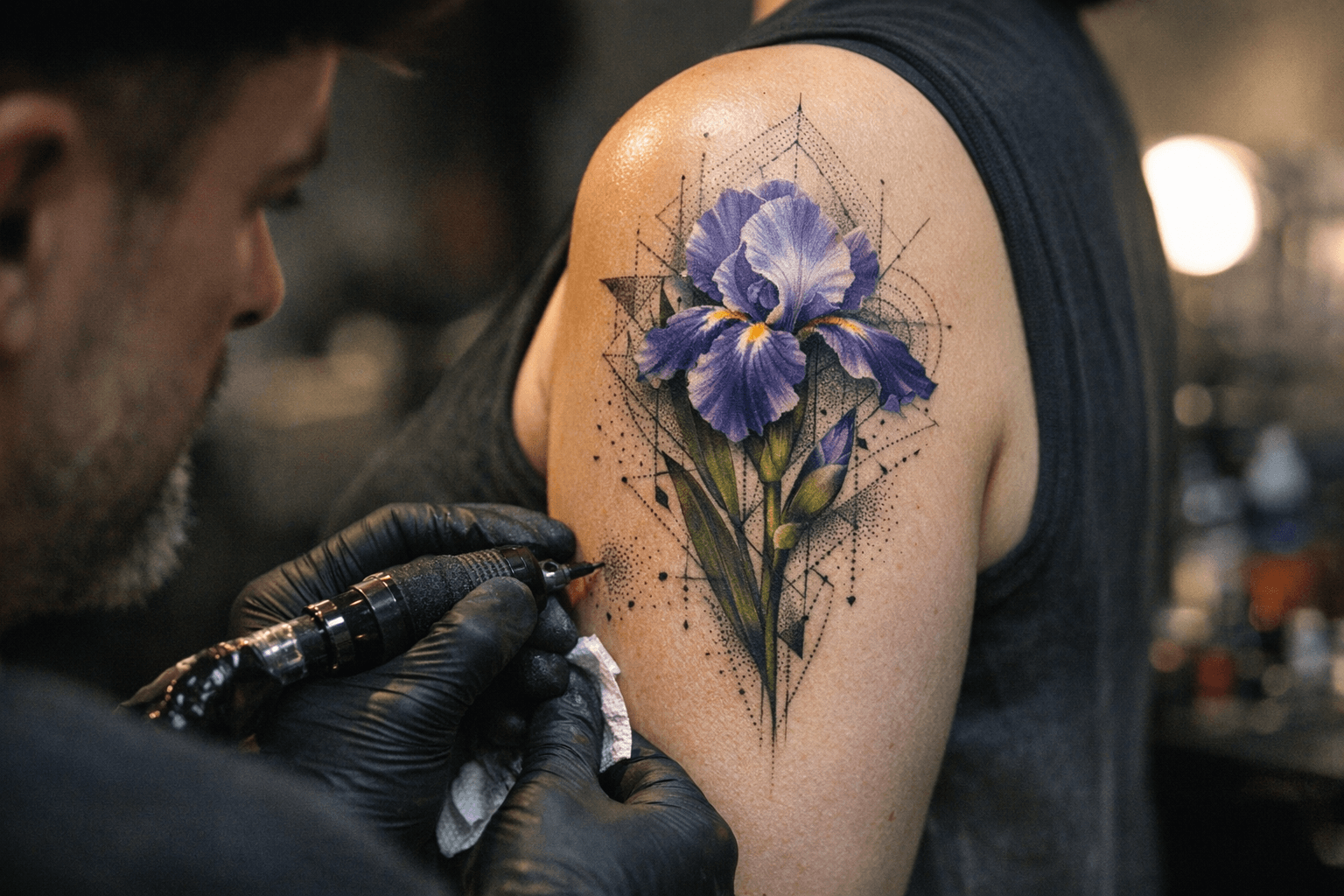
Faceted polygon framing takes the opposite approach: instead of radiating outward from the bloom, it contains the flower inside a hard-edged geometric shell. Triangular anchors are the most common choice here, though hexagons and diamond cuts appear regularly in the gallery as well. The polygon acts as a window, and the iris fills it. The tension between the organic petal curves and the hard corners of the frame is exactly the point; the design works because those two visual languages are kept deliberately separate.
Dotwork gradient fill treats geometry less as a structural frame and more as a textural language. Petals are built up through stippling, with dot density doing the shading work that brushwork would do in a painting. Closer dots produce deeper shadow at the petal folds; wider spacing opens up to skin tone at the highlighted edges. This approach can absorb a lot of botanical complexity because the dots soften competing edges rather than sharpening them. It is also one of the more forgiving archetypes when the piece heals, since minor dot migration reads as intended gradation rather than as a flaw.
The fourth archetype, fine-line stem with a negative space surround, is the most minimalist and the most technically unforgiving. A single iris rendered in fine linework floats inside an open geometric shape, with negative space carrying most of the visual weight. There is no shading, no fill, no dotwork cushion. Every line has to be confident and anatomically correct, because there is nothing else to look at.
Translating the iris into clean geometry: what actually makes it work
The iris is one of the more complicated botanical forms to tattoo. It has overlapping planes, reflexed (downward-curving) outer petals called falls, upright inner petals called standards, and a central column that divides the bloom with strong directional lines. Bringing any geometric system into contact with that structure without creating visual noise requires a deliberate hierarchy of decision-making.
The foundational rule: pick one visual priority and let the other serve as context. If the iris petals carry the emotional weight of the piece, the geometric scaffold should sit at a noticeably lighter line weight, functioning as a setting rather than a co-lead. If the geometry is the primary statement, the botanical element should be simplified, perhaps reduced to a silhouette or a minimal linework version of the bloom, so it reads as organic texture within the structure rather than competing with it.
Line-weight hierarchy is the most direct technical lever available. The difference between a 0.3mm and a 0.5mm needle pass reads clearly on healed skin, and using that difference deliberately across the two design layers is what separates pieces that read as intentionally two-layered from pieces that read as confused. The geometric scaffold should always be the lighter pass.
For dotwork-heavy pieces, dot-density planning happens before the needle touches skin. Map the darkest zones (the deep petal folds, the base of the falls) against the lightest zones (the petal tips, the upper standards) and assign rough density targets. This prevents the common outcome where dotwork shading becomes uniform gray wash across the whole bloom because density was improvised during the session.
Size and placement thresholds matter more for geometric iris work than for almost any other hybrid floral style. Mandala halos require a minimum diameter of roughly 10 centimeters to keep the radial linework readable after healing. Faceted polygon frames need enough interior space for the iris to breathe; placing a full iris bloom inside a frame smaller than eight centimeters forces compression that blurs on healing. Fine-line negative space pieces are the exception: they can scale down to forearm-width, but only if the iris itself is simplified to its essential five-line anatomy rather than rendered in full botanical detail.
Avoid these common failures
Geometric floral hybrids have a specific failure profile worth knowing before booking or designing a piece.
- Competing visual weights: this is the most common problem. Two elements at the same line weight, same tonal value, and similar complexity cancel each other out. The solution is contrast by design, not by accident. Commit to which element is dominant before drawing a single guide line.
- Dot density improvisation: artists who plan dot placement on the fly tend to produce flat, uniform mid-tones instead of a genuine gradient. Plan the darkest and lightest zones in the stencil stage.
- Under-scaling the geometric element: a triangular frame that barely clears the outermost petals loses all structural authority. The geometry needs visual breathing room to function as a frame rather than a collision.
- Over-complexity at small scale: stacking a dotwork gradient, a fine-line mandala ring, and a fully detailed iris into a piece under eight centimeters guarantees a healed result that reads as gray smudge. Each layer added to a small piece requires removing detail from the others.
- Skipping healed documentation: for studios building their portfolio in this niche, fresh photos of geometric-floral work are essentially useless as sales tools. The piece that looks crisp at the end of a session may look completely different six weeks later, and that healed photo is what converts a consultation into a booking.
What clients and studios should know going in
Geometric iris pieces, particularly mandala halos and densely stippled gradient fills, consistently require more session time than their size suggests. The combination of botanical line complexity and geometric precision means artists cannot rush either layer. For larger pieces, staged appointments, one session for the geometric scaffold and a separate session for the botanical fill, protect both layers by giving the skin time to recover before the second round of trauma.
Aftercare for hybrid pieces is more specific than for single-style work. The micro-line geometry is vulnerable to over-moisturizing in the healing window; heavy ointment application can push ink out of fine lines before it anchors. The dotwork sections, conversely, benefit from consistent hydration to prevent the skin from cracking through stippled areas. Artists who give clients split aftercare instructions, one regime for the linework zones and another for the dotwork zones, report better healed results.
The broader trend at work in the iris gallery is worth noting. Geometric tattooing continues moving away from pure abstraction toward hybrid narrative work, using botanical subjects as the organic counterpoint to mathematical precision. The iris is an ideal candidate for this because its native structure already carries its own internal geometry: the triple symmetry of the falls, standards, and style branches maps naturally onto triangular and hexagonal frameworks. Artists who understand that underlying botanical logic before they draw the geometric overlay produce work that looks inevitable rather than imposed, and that is ultimately what keeps a piece readable for decades.
Know something we missed? Have a correction or additional information?
Submit a Tip