Dotwork Ornamental Tattoo by Alexandriarising.ink Showcases Precise Stippling and Sacred Geometry
A single misplaced dot in a sacred-geometry ornamental can betray itself on healing. @alexandriarising.ink's featured dotwork piece shows exactly how to get it right.
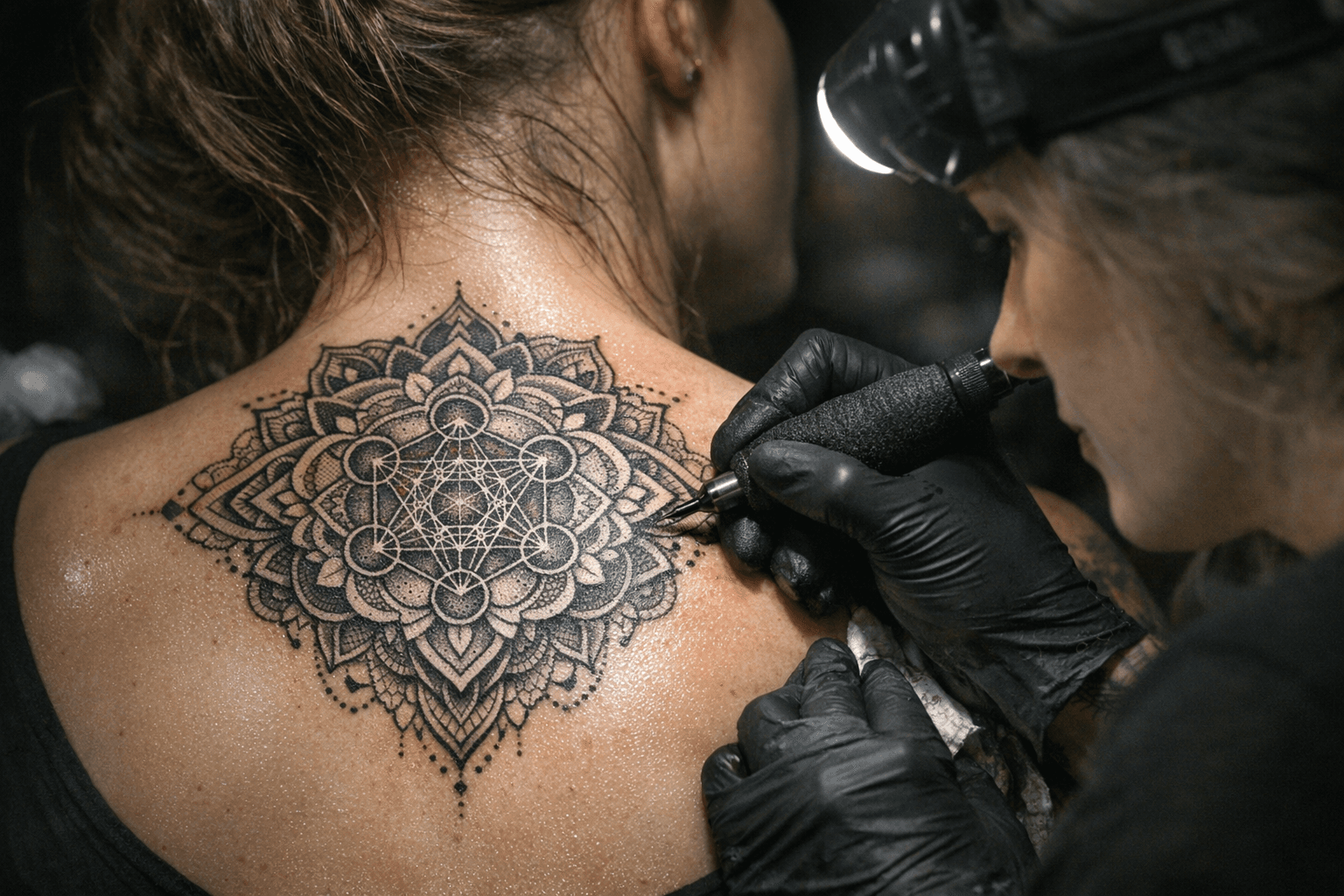
Precision failures in dotwork ornamental tattoos don't announce themselves on the needle — they reveal themselves two weeks later, when healing skin exposes every inconsistency in dot spacing, ink depth, and radial symmetry. That's the technical stakes behind the piece by @alexandriarising.ink that was curated on InspirationDe on April 4, 2026, and it's why the photograph, selected by site curator Maan, is circulating as both an inspiration reference and a quiet checklist for artists working in this style.
The work combines two overlapping technique families that don't forgive shortcuts. Stippling, the pointillist foundation, builds tonal fields entirely through dot density: where dots cluster, shadows form; where they spread, skin reads as light. Layered over that foundation is ornamental linework, specifically micro-line filigree and a radial mandala center that pulls the composition into the kind of sacred-geometry symmetry associated with Flower of Life and Sri Yantra structures. What makes @alexandriarising.ink's execution stand out in the photograph is that neither system is competing with the other. The stippling gradients recede cleanly, the linework stays crisp, and the radial axes hold alignment across the full field.
Engineering that result starts with needle selection. Dotwork ornamentals at this scale typically require single needles or tight round liner clusters of three to five. Larger groupings accelerate trauma, widen each puncture point, and undermine the micro-scale dot spacing that gives stippling its tonal range. Hand speed matters equally: too fast and dot density drops unevenly across the pass; too slow and the needle lingers, pushing pigment past the dermal layer into subcutaneous fat, which is the mechanical cause of blowouts. Those blurry, ink-spreading distortions are permanent without correction work, and in a radial sacred-geometry design, even a minor blowout on one axis breaks the mirrored symmetry of the entire composition.
Stencil placement compounds all of it. Ornamental geometry mapped freehand requires the artist to hold every axis measurement in real time against a moving surface. Most artists working at this precision level use stencil transfers to anchor the radial grid before any needle touches skin, then trust the stencil only as far as the skin allows: stretch, curvature, and anatomical contour all warp a flat stencil in ways that require live correction. What heals as a perfect circle on a flat reference photograph can shift on a curved forearm or a knee ditch.
For clients booking this style, three questions cut through most of the risk. Ask to see healed photographs specifically, not fresh shots; a piece that photographs beautifully in the first hour can look muddy and asymmetric after the upper layers of the epidermis regenerate. Ask which needle configuration the artist uses for dotwork shading and whether they stencil the full radial grid or build sections freehand. And take aftercare instructions seriously: heavy scrubbing and sun exposure during the first weeks of healing destroy micro-detail that cannot be rebuilt without a touch-up session, and in ornamental geometry, a single faded quadrant destroys the visual logic of the whole design.
@alexandriarising.ink's piece, documented in a high-contrast photograph that holds up to close inspection, represents the standard this style demands. The InspirationDe feature signals that micro-dot texture combined with ornamental geometry is the design vocabulary collecting the most saves among collectors and artists in early 2026. For a style this technically exposed, that demand is both a compliment and a pressure.
This article was produced by Prism’s automated news system from verified source data, official records, and press releases, then run through automated quality and moderation checks before publishing. The system is built and supervised by the people who set the standards it runs under. Read our full AI policy.
Did this article answer your question?