61 Sacred Geometry Tattoo Ideas Organized by Motif, Placement, and Meaning
Most Instagram-popular sacred geometry tattoos fail on skin within five years — here's which 61 motifs actually hold, and exactly how to redraw the ones that don't.

Every sacred geometry tattoo begins with a promise: precise, repeating structure that mirrors the architecture of the universe. The problem is skin isn't a flat canvas, and the geometry that photographs beautifully on paper can collapse into a muddy blur once it's placed on a curved shoulder, healed through a winter, or exposed to a few summers of sun. This is a design clinic as much as an idea guide. Each motif below comes with honest notes on where it works, where it fails, and what you or your artist should change before the needle touches skin.
The Core Motifs
1. Flower of Life, full 19-circle version. The most tattooed sacred geometry motif in existence, this overlapping-circle pattern represents the cycle of creation and the interconnectedness of all life.
At full scale (5 inches or more on a back or thigh), it holds beautifully; below 3 inches, the inner petal intersections begin merging on healed skin. If you want it smaller, drop to the outer ring only and let negative space do the structural work.
2. Flower of Life, single-ring simplified version. Stripping the Flower of Life down to its first ring of six circles around a central one keeps the symbolic meaning intact while giving each line enough breathing room to survive a decade of healing.
This is the version that actually belongs on a forearm or upper arm without becoming unreadable at year five.
3. Seed of Life. Seven overlapping circles of equal diameter, the Seed of Life is considered the origin nested inside the Flower of Life.
It's one of the few sacred geometry symbols that genuinely scales to wrist or ankle size because its geometry is open and relatively uncluttered. Keep lines no thinner than 0.5mm and space the seven circles so the overlapping lens shapes (vesica piscis zones) stay distinct.
4. Egg of Life. The Egg of Life uses the same seven-circle template as the Seed of Life but arranges the outer circles in a different configuration, producing a symbol tied to the structure of the embryo and the musical scale.
It reads best on flat surfaces; on a wrist or collarbone, confirm with your artist that the circle spacing won't compress on one side due to curvature.
5. Fruit of Life. Thirteen circles extracted from the Flower of Life, the Fruit of Life is considered the blueprint for Metatron's Cube.
It holds all possible geometric structures within it, and the 13 spheres are said to represent creative potential. This one requires scale: rush it below 4 inches and the internal spacing between circles collapses, producing a moiré-like visual interference when the skin settles.
6. Metatron's Cube, classic. Connect the centers of the 13 circles of the Fruit of Life and you get Metatron's Cube, a figure that contains all five Platonic solids simultaneously.
It's linked to Archangel Metatron as a symbol of protection and balance between spiritual and physical realms. The internal line density is extreme; tightly packed straight lines running across curved skin are the primary cause of the moiré interference that ruins this piece for many collectors. Thicken structural lines by 20% and drop the secondary cross-hatching altogether if you're going smaller than 5 inches.
7. Metatron's Cube, sternum placement. The sternum is the recommended placement for Metatron's Cube because the flat bone provides a natural centering anchor and the ribs fan outward in a way that actually mirrors the cube's radial lines.
Use the xiphoid process and clavicle notch as landmarks before stenciling. Be aware that skin over the sternum has very little fat, making ink depth critical and blowout risk real if the artist is heavy-handed.
8. Metatron's Cube, upper arm sleeve anchor. Used as the geometric core of a sleeve, Metatron's Cube on the outer upper arm benefits from the bicep's flat surface when the arm hangs naturally.
Map it with the arm relaxed, not flexed. A design mapped on a flexed bicep will distort when the arm returns to resting position, compressing the upper geometry and stretching the lower.
9. Seed of Life, wrist placement. At 1.5 to 2 inches in diameter, a Seed of Life on the inner wrist is achievable, but the wrist is a high-movement zone with thinner skin, making it a blowout risk with ultra-fine lines.
Minimum line weight of 0.6mm, no interior dotwork finer than a medium-density pattern.
10. Seed of Life, ankle placement. The outer ankle sits on bone with minimal skin padding, accelerating ink migration and line spread.
A Seed of Life here should be drawn with bolder lines than you think you need — what looks heavy in the stencil will look right after two years of healing.
Fibonacci and Proportion-Based Motifs
11. Fibonacci spiral, single. Derived from the sequence where each number equals the sum of the two before it, the Fibonacci spiral is the geometry of nautilus shells, galaxy arms, and sunflower seed heads.
As a tattoo, a single spiral in clean linework sits beautifully on the forearm or upper arm. The pitfall is that a true Fibonacci spiral is not the same as a simple logarithmic curve — have your artist construct it from actual quarter-circle arcs inside golden rectangles, not freehand.
12. Fibonacci spiral, double mirrored. Two spirals mirrored along a central axis create a visual tension that reads as both biological and cosmic.
This works exceptionally well on the chest or collarbone, with the spirals radiating outward from center. Because the lines splay apart as they expand, this motif naturally avoids the line-density problem that kills tighter patterns.
13. Golden ratio rectangle with spiral overlay. The golden ratio (approximately 1:1.618) rectangle nested with its internal spiral is a more architectural take on Fibonacci geometry.
Forearm placement works well because the rectangle's long axis can align with the arm's length. Avoid placing it across the inner wrist where skin flex will cause the right angles to read as trapezoids.
14. Golden ratio spiral on ribcage. The ribcage presents one of the most dramatic natural curves in the body, and a golden ratio spiral that follows the rib contour can feel genuinely integrated into anatomy.
The risk is that the spiral's center must be placed precisely, or the curvature of the ribs will visually compress one side. Mock it up with a printed stencil on the body before committing.
15. Nested golden ratio rectangles (Whirlpool). Multiple golden rectangles nested inside each other create a whirlpool effect that represents proportion as a universal constant.
This is a medium-scale piece that works on the upper thigh, where the flatness of the surface lets the nesting read without distortion. Use varying line weights, heaviest on the outermost rectangle, to establish visual hierarchy.
The Platonic Solids
16. Tetrahedron (fire). The four-faced Platonic solid associated with the fire element, the tetrahedron in 2D projection reads as an equilateral triangle with interior triangular subdivisions.
Clean and bold, it's one of the most tattoo-friendly sacred geometry shapes because its line count is low and its angles are dramatic. Works at any scale down to 1 inch.
17. Hexahedron/Cube (earth). The cube in 2D isometric projection produces the familiar Necker cube illusion, a symbol of earth energy and stability.
It's visually simple but spatially interesting, and scales down well to knuckle or wrist placement. The isometric angles can distort on curved surfaces, so check the stencil placement carefully.
18. Octahedron (air). Two square pyramids base-to-base, associated with air and mental clarity.
In 2D projection it creates a diamond with interior lines. At small scales this is one of the cleaner Platonic solid tattoos because the internal geometry isn't dense.
19. Icosahedron (water). Twenty triangular faces representing water, the icosahedron in projection creates a visually complex angular sphere.
This is a medium-density piece; at under 2 inches the internal triangle intersections begin merging on healed skin. Best placed on flat or slightly curved surfaces like the upper arm or thigh.
20. Dodecahedron (spirit/ether). Twelve pentagonal faces, associated with the cosmos and the fifth element.
The pentagon-based geometry makes this the most visually unusual of the five solids as a tattoo. It rewards scale: bring it to at least 3 inches to keep the pentagonal faces individually readable. The shoulder is ideal placement.
21. All five Platonic solids as a set. Tattooing all five solids as a unified composition, typically arranged in a circular or spine-like configuration, is a significant project requiring staged sessions.
Mapping each solid around a central Metatron's Cube is one proven layout, since Metatron's Cube contains all five simultaneously and creates natural visual logic for the grouping.
Mandala Variations
22. Classic radial mandala, forearm. A mandala placed radially on the forearm with the center aligned over the centerline of the arm reads as intended when the arm is extended, palm up.
This is the most visually reliable mandala placement because the surface is relatively flat. Use bony landmarks at the wrist and elbow to center it.
23. Shoulder blade mandala. The scapula's broad flat surface is one of the best mandala placements on the body, and the shoulder blade's natural oval shape can inform the mandala's outer boundary.
Large pieces here benefit from the scapula as a central anchor. Confirm placement with the arm both hanging and raised, as the skin over the scapula shifts significantly with arm movement.
24. Upper back full mandala. A mandala centered on the spine between the shoulder blades reads as symmetric when viewed straight-on.
Use thoracic vertebrae as the vertical axis reference. The curvature of the upper back means that a mandala designed flat will appear slightly wider and flatter than drawn when placed; compensate by drawing it slightly taller (elongated on the vertical axis) in the stencil.
25. Single-ring mandala, micro scale. For collectors who want mandala geometry at wrist, ankle, or behind-the-ear scale, a single-ring mandala with 8 or 12 petal subdivisions is the design solution.
It retains the radial structure and symbolic meaning of a full mandala while eliminating the interior detail rings that become unreadable below 1.5 inches.
26. Mandala with dotwork fill. Dotwork shading within mandala rings softens the hard symmetry of pure linework and gives the piece visual depth without adding more lines.
Critically, dotwork ages more gracefully than tightly spaced parallel lines: individual dot loss is less visually disruptive than a line that partially fades, which can create a broken-grid effect.
27. Mandala sleeve segment. Using a mandala as the centerpiece of a geometric sleeve requires planning the transition zones carefully.
The mandala's radial energy should flow outward into sleeve elements (Fibonacci lines, geometric animals, Platonic solid accents) rather than stopping abruptly at its outer ring.
28. Elbow ditch mandala. The inner elbow (antecubital fossa) is a structurally fascinating placement for a radial mandala because the natural fold of the arm provides a center axis.
Blowout risk here is elevated because the skin is thin and the area flexes constantly, which stresses healing ink. Bold line weights are non-negotiable; fine line mandalas in the ditch routinely become unreadable within three years.
29. Kneecap geometric mandala. The kneecap is a visually striking placement but mechanically problematic.
The skin over the patella is thin, the area experiences constant movement and stretching, and the rounded surface distorts radial patterns. Expect significant ink spread in the fine detail areas. This placement is better suited to bold, simple geometric patterns than to intricate mandala work.
30. Mandala as portrait surround. Framing a realism portrait or figure with a geometric mandala halo is a hybrid approach that pairs the precision of sacred geometry with figurative work.
The mandala's outer ring defines the piece's boundary cleanly. The key design decision is whether the geometry is integrated into the figure or sits as a distinct layer behind it.
Sri Yantra and Yantra Motifs
31. Sri Yantra, classic. Nine interlocking triangles surrounding a central point (bindu), the Sri Yantra represents the union of divine masculine and feminine energies.
It's one of the most complex sacred geometry patterns in terms of internal line intersections, and those intersections are exactly where cheap execution shows. The inner triangle meeting points must be precisely aligned or the entire piece reads as crooked.
32. Sri Yantra on ribcage. The ribcage's lateral surface, running from armpit toward the hip, provides enough vertical length for a Sri Yantra at scale.
The curvature of the ribs means the left and right sides of the yantra will sit on slightly different planes; a skilled stencil transfer accounts for this by pre-compensating the design horizontally.
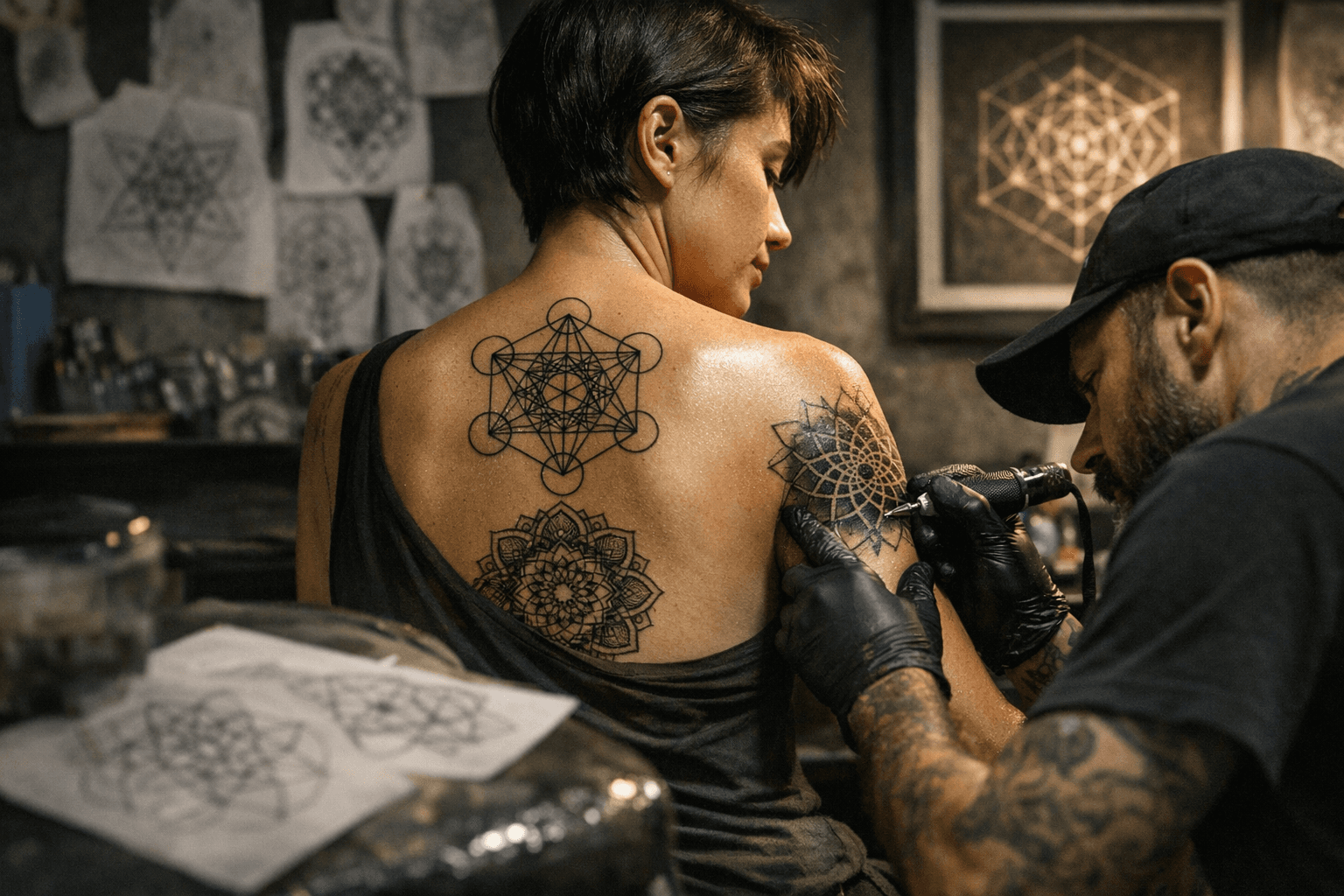
33. Sri Yantra with dotwork gradients. Adding dotwork shading to the triangular zones of a Sri Yantra creates a dimensional effect, making the central triangle appear raised.
Density of dots should decrease outward from the bindu to reinforce the sense of radiating energy. This approach also ages well because dot loss in the outer rings is visually acceptable.
34. Yantra-inspired geometric sleeve element. Yantra geometry (interlocking triangles, central point, outer rings) can function as a repeating motif within a larger sleeve without being a literal Sri Yantra reproduction.
Used as a standalone geometric element, it adds angular energy that contrasts productively with the rounded forms of mandalas and spirals.
Vesica Piscis and Circle-Based Motifs
35. Vesica Piscis, standalone. Two overlapping circles of equal radius, creating an almond-shaped (mandorla) intersection, the Vesica Piscis represents the intersection of the spiritual and physical worlds and the balance of opposites.
It's a clean, high-contrast piece that works at virtually any scale because its geometry is simple. Good placement options include the inner wrist, upper arm, and back.
36. Vesica Piscis chain, forearm. A sequence of Vesica Piscis forms linked along the forearm creates a visual chain that references the progression from Seed of Life to Egg of Life to Flower of Life.
It reads as both biological and architectural and suits forearms and calves where linear compositions have room to run.
37. Triple overlapping circles. Three circles of equal radius each passing through the others' centers produce the foundation of the Seed of Life and a powerful triple-lobe form.
This motif carries meaning in Celtic art (the triquetra) and sacred geometry simultaneously. It's one of the simplest sacred geometry tattoos that still carries real visual weight.
38. Circle with inscribed triangle (simplest sacred geometry). A single equilateral triangle inscribed within a circle is elementary sacred geometry, encoding the relationship between the first Platonic solid and the circle.
It's a minimalist option that works at finger-ring scale, though finger tattoos require bold lines to survive the constant friction and flex that characterize finger skin.
Merkaba and Star-Based Motifs
39. Merkaba (Star Tetrahedron), classic. Two tetrahedrons interlocked, one pointing up and one pointing down, the Merkaba is associated with spiritual awakening and the light-body concept.
Its corresponding chakra is the third eye. As a 2D projection it creates a six-pointed star with internal triangular geometry. This is a high-line-density motif; at under 2.5 inches, internal lines should be thinned and some secondary detail dropped.
40. Merkaba, upper arm placement. The outer upper arm's flat-to-slightly-curved surface handles the Merkaba's angular geometry well.
Map it with the star's vertical axis perpendicular to the ground when the arm hangs naturally. Tilted Merkabas on the upper arm are a common execution error caused by stenciling with the arm extended rather than relaxed.
41. Merkaba, chest placement. Centered on the chest with the star's upward-pointing triangle aligned with the collarbone, a Merkaba reads as a shield or protective emblem.
The chest's broad surface handles the line density better than smaller placements. Use the sternum as a central axis and confirm symmetry before beginning.
42. Star of David geometric variant. The Star of David (hexagram) shares the Merkaba's two-triangle structure but without the three-dimensional reading.
As a purely 2D form it's simpler and more tattoo-stable across scales. It can function as a standalone piece or as one layer within a more complex sacred geometry composition.
Nature-Derived Sacred Geometry
43. Nautilus shell spiral. The nautilus shell is nature's most recognizable application of the logarithmic spiral.
As a tattoo, the spiral itself is only part of the story — the internal chamber geometry (the septa) is what distinguishes a sacred geometry nautilus from a simple decorative curl. Include at least five chamber divisions to retain the mathematical meaning.
44. Sunflower Fibonacci geometry. A sunflower head drawn as pure geometry, showing the two counter-rotating Fibonacci spirals (typically 21 in one direction, 34 in the other) that organize the seed pattern, is a highly specific sacred geometry motif.
It's demanding to execute and demands scale; a minimum of 4 inches is needed to show the spiral count difference.
45. Geometric tree of life. A Tree of Life rendered in pure geometric linework, replacing organic branch forms with Fibonacci spiral branches and a root system based on mirrored geometry, bridges the organic and mathematical.
This is a strong upper back piece where the trunk can align with the spine and branches spread toward the shoulder blades.
46. Honeycomb/hexagonal tessellation. The hexagon is nature's most efficient tiling geometry, used by bees in honeycomb construction.
A hexagonal tessellation tattoo represents efficiency, community, and natural order. It's also one of the most durable sacred geometry patterns because the bold structural lines of a proper hexagonal grid resist aging better than fine-line patterns.
47. Geometric leaf with Fibonacci venation. A single leaf drawn with Fibonacci-based venation (main vein as the primary spiral, secondary veins as Fibonacci subdivisions) is a botanical-sacred geometry hybrid.
It suits placement on the forearm, where the elongated leaf form aligns naturally with the arm's axis.
Historical and Cultural Motifs
48. Celtic knotwork with geometric underlay. Celtic knotwork patterns are continuous-line geometry with deep historical roots.
Placing a Celtic knot over a sacred geometry grid (visible as faint background structure) creates a piece that works on two levels: the organic flow of the knot and the mathematical rigor of the grid beneath it.
49. Polynesian-geometric hybrid. Geometric markings in Polynesian tattooing represent some of the oldest body art traditions in the world.
Pulling specific Polynesian geometric elements — the enata (human figure), the ocean wave pattern, the shark-tooth row — into a composition that also incorporates Platonic solid outlines or Fibonacci spirals creates a piece rooted in both ancient and modern geometric traditions.
50. Eye of Providence in triangle. An eye inside an equilateral triangle is one of the most widely recognized sacred geometry emblems, appearing in architecture, currency, and spiritual iconography across centuries.
It's a strong, simple tattoo at almost any scale. The triangle must be equilateral (all sides equal), not merely pointed: an isoceles triangle with an eye reads as decorative rather than geometric.
Technique and Style Variations
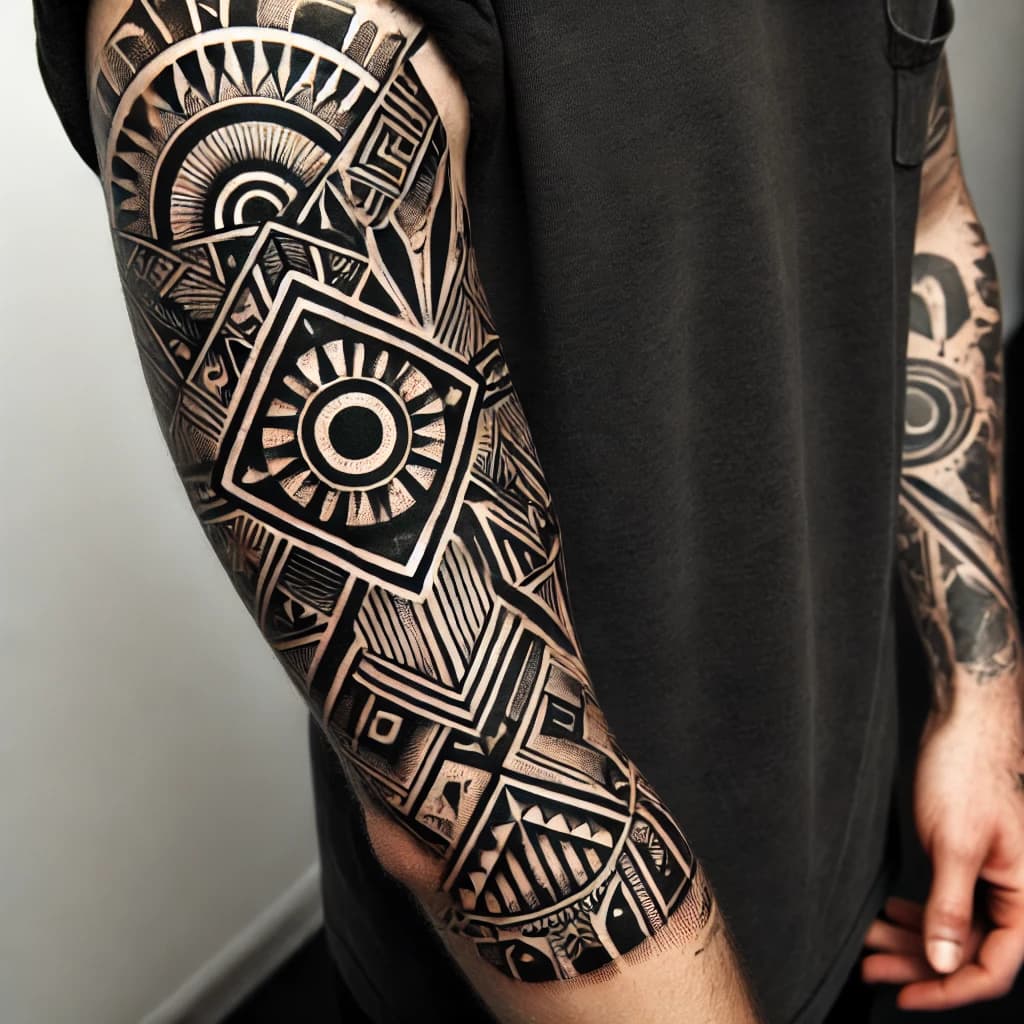
51. Pure blackwork sacred geometry. Heavy solid black fills within geometric sections create maximum contrast and excellent long-term visibility.
Blackwork ages with more grace than fine linework because solid fills don't exhibit the same broken-grid decay. The trade-off is that mistakes and asymmetries are immediately visible.
52. Dotwork-only sacred geometry. A Flower of Life or Metatron's Cube executed entirely in dotwork, with no solid lines, produces a soft-edged, almost luminescent effect.
Dot density controls value; outer edges should taper to lighter dot spacing to create a sense of the geometry emerging from the skin. Artists executing this must be experienced in dotwork specifically: rushed or irregular dot spacing looks mechanical rather than meditative.
53. Fine line sacred geometry. Ultra-fine line sacred geometry has dominated social media for years, and it fails on skin at a predictable rate.
Lines below 0.3mm that pack tightly together produce a moiré interference pattern as the skin heals and the lines soften slightly toward each other. If you want the fine-line aesthetic, keep lines at 0.5mm minimum and space them so no two parallel lines are closer than 1.5mm.
54. Geometric tattoo with watercolor wash. A sacred geometry linework piece with a loose watercolor wash applied inside certain sections creates a strong contrast between mathematical precision and organic color blur.
The geometry holds the composition together as the color fades over years; the linework must be bold enough to remain the dominant element even as the wash lightens.
55. Negative space sacred geometry. Geometry defined by what isn't tattooed rather than what is: heavily blackwork-filled areas surrounding a white (skin) geometric form.
The Flower of Life as negative space within a black field is visually striking and ages well because the skin tones don't shift. The risk is that over time, black ink can creep slightly into the negative space, narrowing fine white lines.
56. 3D geometric tattoo with shading. Adding dimensional shading to Platonic solid projections, particularly the cube and icosahedron, creates the illusion that the geometry is a physical object resting on or emerging from the skin.
This requires an artist with both geometric precision and realism shading skills, a rare combination worth researching specifically.
57. Sacred geometry with color fill (single accent color). Adding one accent color to a section of an otherwise black sacred geometry piece draws the eye to a specific element, typically the central motif or a symbolic inner shape.
A single warm gold or deep blue applied to the bindu of a Sri Yantra or the central circle of a Metatron's Cube is more effective than multi-color fills, which compete with the geometry for attention.
Placement-Specific Designs
58. Spine column sacred geometry. A vertical sequence of sacred geometry motifs running down the spine, from the base of the skull to the sacrum, is one of the most architecturally coherent placements on the body.
The motifs can map to chakra positions, moving from simple geometry at the root to more complex forms at the crown. The spine's straight axis provides a natural centering guide that eliminates the symmetry mapping challenge present in other placements.
59. Full back sacred geometry composition. A full back piece combining a central Flower of Life (or Sri Yantra) with radiating Fibonacci spirals, Platonic solid accents, and a Metatron's Cube grid is the most ambitious sacred geometry project.
It requires a minimum of two to three sessions and should be planned as a unified composition from the start, not assembled piecemeal. Staged sessions allow healing assessment before adding adjacent geometry.
60. Behind-the-ear micro sacred geometry. The space behind the ear accommodates approximately 1 to 1.5 inches of tattoo.
At this scale, only the simplest sacred geometry holds: a single Vesica Piscis, a triple-circle, or a seven-dot Seed of Life. Fine internal detail will be invisible within three years. This placement is also a blowout risk because the skin behind the ear is thin; confirm your artist's experience with small-scale and thin-skin placements specifically.
61. Custom composite: personal sacred geometry system. The most meaningful sacred geometry pieces are those that combine multiple motifs into a personal symbolic language: a Fibonacci spiral branching from a central Seed of Life, Platonic solid accents marking life transitions, a Metatron's Cube as a protective outer boundary.
Planning a composite requires the same landmark mapping and staged-session strategy as a full back piece, regardless of the final dimensions. The geometry must be designed as a unified system, not a collection of separate symbols that happen to share skin.
The consistent variable across all 61 of these, from a micro Vesica Piscis behind the ear to a full back composition, is the same: precision at the drawing stage saves every problem that artists and collectors try to solve at the needle stage. Sacred geometry doesn't forgive sloppy stencils, rushed measurements, or line weights chosen for immediate visual impact over long-term readability. A piece that survives a decade is built in the planning, not the execution.
This article was produced by Prism’s automated news system from verified source data, official records, and press releases, then run through automated quality and moderation checks before publishing. The system is built and supervised by the people who set the standards it runs under. Read our full AI policy.
Did this article answer your question?