Updated Guide Walks Tattoo Studios Through Bloodborne Pathogen Compliance Requirements
A studio shut down over missing training records or improper sharps disposal isn't a compliance failure — it's a preventable infection waiting to have happened first.
Bloodborne pathogen compliance isn't the part of the craft that gets talked about at conventions. Nobody posts their exposure control plan to Instagram. But a contaminated ink cap or a mishandled needle during a four-hour geometric session carries the same biological risk whether the work is a sacred geometry mandala or a scratch piece, and the studios that treat safety protocols as paperwork rather than practice are the ones that end up closed, fined, or worse: at the center of a client infection story.
A compliance guide updated in early April 2026 by bloodborne pathogen certification and studio safety resource BloodborneCertification.com lays out exactly what OSHA requires of tattoo studios and cosmetic clinics, why the gaps between regulatory language and daily shop behavior are where real harm happens, and what studio owners, managers, and working artists need to do about it now.
The Federal Floor: What 29 CFR 1910.1030 Actually Requires
The entire compliance framework rests on a single federal standard: OSHA's Bloodborne Pathogens Standard, codified at 29 CFR 1910.1030. This isn't new law, but regulatory attention to the tattoo industry has sharpened considerably through 2025 and into 2026, driven in part by FDA guidance and recall activity around microbially contaminated tattoo inks, including contamination found in sealed, unopened bottles. When health agencies start scrutinizing the ink supply chain, studio-level compliance tends to follow.
The standard covers any employee with occupational exposure to blood or other potentially infectious materials. In a tattoo studio, that means everyone who touches needles, ink, contaminated surfaces, or waste — which, practically speaking, is the entire working staff. The requirements aren't suggestions. Studios that operate without a written exposure control plan, without documented training, or without proper sharps disposal infrastructure are in violation of federal law, regardless of whether a state inspector has ever walked through the door.
The Exposure Control Plan: More Than a Binder on a Shelf
The written exposure control plan is the document everything else hangs off of. OSHA requires it to be accessible to all employees, reviewed and updated at least annually, and revised whenever tasks or procedures change in ways that affect occupational exposure. That last clause matters more in a tattoo studio than many owners realize: if an apprentice transitions to tattooing, if a new technique gets introduced, or if the studio starts offering permanent cosmetics alongside traditional work, the plan has to reflect those changes.
In practice, the exposure control plan should name every position with potential exposure, map the specific tasks that create that exposure, and specify exactly what controls reduce risk. For a studio specializing in geometric work, that means documenting stencil transfer procedures, single-use needle protocols, disposable ink cap handling, and how multi-stage sessions are structured to prevent cross-contamination between setups. Visible station rules reinforcing PPE requirements aren't just good practice; they're evidence of implementation during an inspection.
Training: The 10-Day Rule and What "Role-Specific" Really Means
OSHA mandates that training happen within 10 days of an employee being assigned to tasks involving occupational exposure, and annually every year after that. The guide is explicit that this training needs to be role-specific and matched to daily tasks, not a generic online test that produces a certificate without changing behavior.
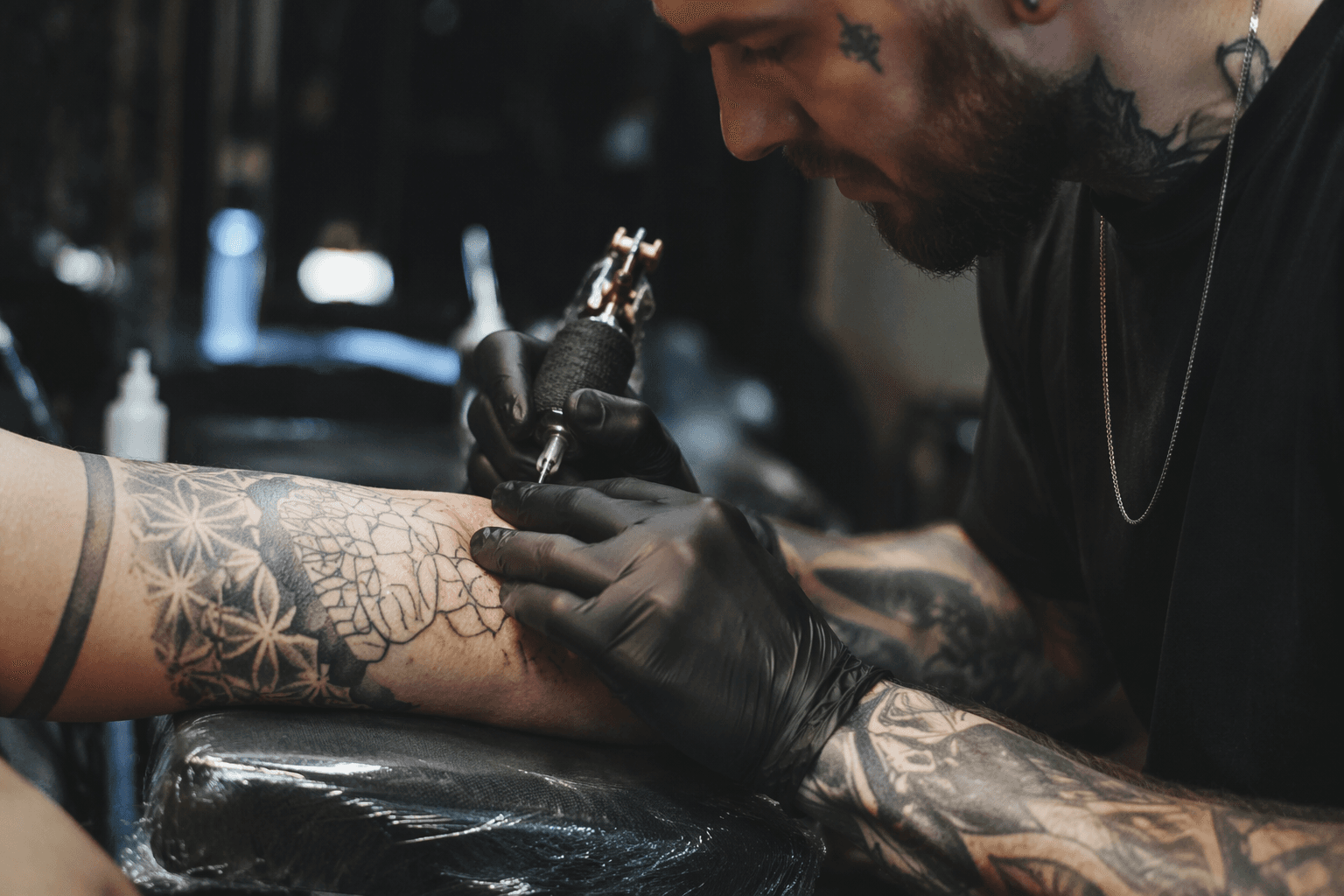
For a geometric artist, meaningful training covers the specific exposure vectors that come with the work: what happens when a dotwork session runs long and glove integrity degrades; how to handle a contaminated razor used during stencil prep; what the correct sequence is for breaking down a station after a multi-hour linework appointment without spreading contamination to adjacent surfaces. The guide also requires that training be delivered at an appropriate level and language for the employees receiving it, a detail that inspection reports show is frequently overlooked when studios bring in outside medical trainers unfamiliar with the body art context.
Training records must be kept. The date, the content covered, and who attended all need to be documented and retained. This is one of the most common inspection failure points, and it's one of the easiest to avoid with a simple log maintained at the studio.
Hepatitis B, PPE, and the Sharps Protocol
Hepatitis B vaccination must be offered to every employee with occupational exposure. The offer must be made at no cost to the employee, after training is completed, and within a reasonable time of assignment. If an employee declines, that declination has to be documented with a signed waiver. Studios that have never formally offered vaccination or documented who accepted and who declined are carrying compliance risk they may not be aware of.
PPE in the studio context means gloves as a baseline, with aprons, eye protection, and masks required depending on the procedure and the risk of splatter or aerosolization. The studio is responsible for providing, cleaning, repairing, and replacing PPE; that cost cannot be passed to artists or staff. Glove changes mid-session, particularly during long geometric appointments where the artist is repeatedly moving between ink caps, reference materials, and client contact, need to be reflexive rather than an afterthought.
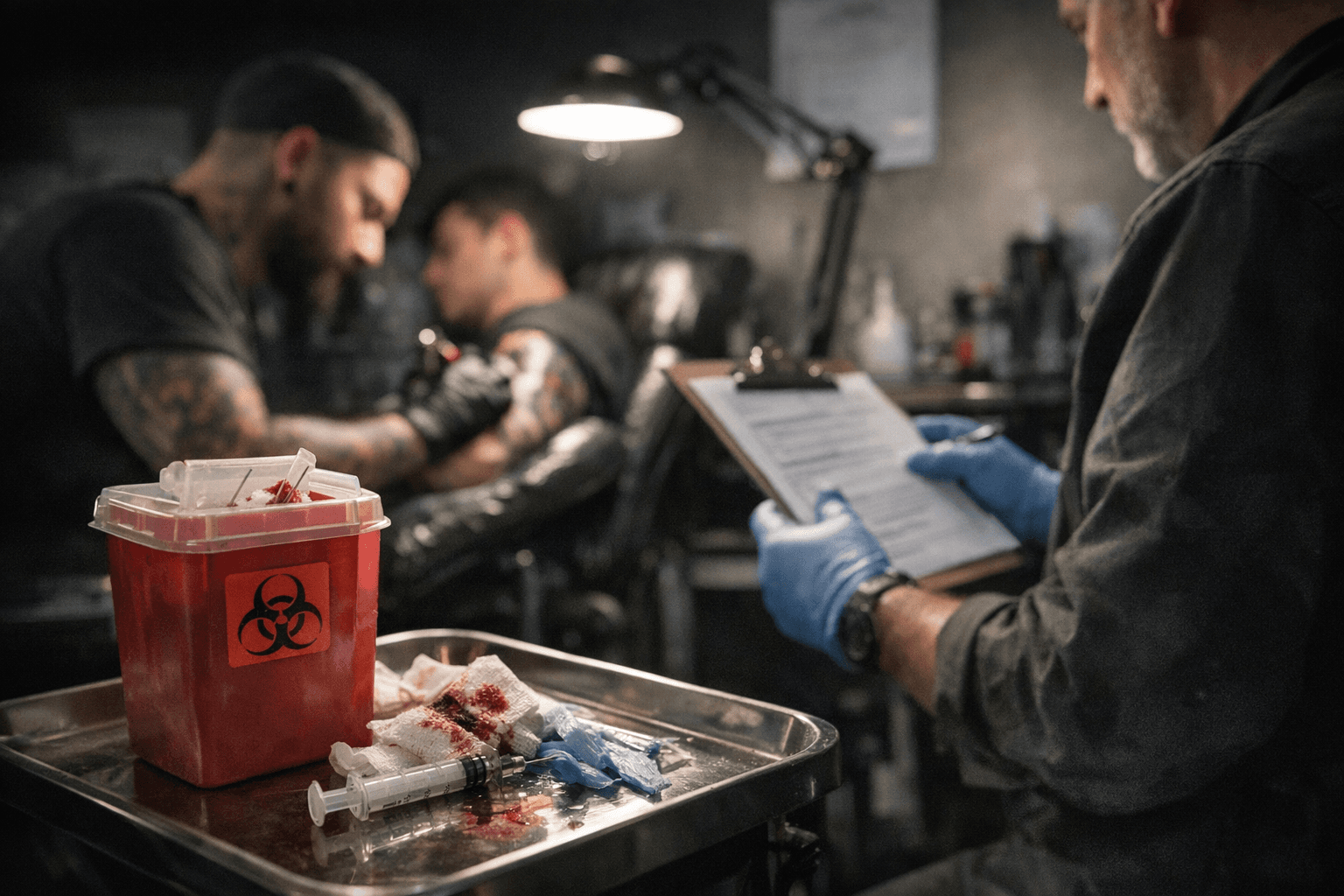
Sharps handling is where studios get caught most often. Needles go directly into puncture-resistant, labeled sharps containers at the point of use. They do not get recapped, bent, or placed on the tray to be disposed of later. Sharps containers that are overfilled, improperly sealed, or not disposed of through a licensed medical waste contractor are violations that show up in inspection reports repeatedly. A sharps injury log is required unless the studio qualifies for a specific exemption under OSHA's injury recording rules.
What Inspectors Actually Find: The Red Flags
The guide identifies the inspection failure points that recur across studios. These are the specific gaps worth auditing before a regulator does it for you:
- Missing or outdated training records, including no documentation that annual refresher training occurred
- Sharps containers that are overfilled, improperly labeled, or mixed with general waste
- No written post-exposure protocol, or a protocol that exists on paper but has never been communicated to staff
- An exposure control plan that hasn't been updated to reflect current tasks, employees, or techniques
- PPE that is present but not consistently used, or not replaced when compromised
The post-exposure protocol is worth particular attention. If a needlestick happens during a session, every person in the studio should know immediately what the sequence is: first aid, documentation, referral for medical evaluation, access to post-exposure prophylaxis information. Studios that haven't rehearsed this scenario are the ones that respond to it badly when it actually occurs.
Why Geometric Work Raises the Stakes
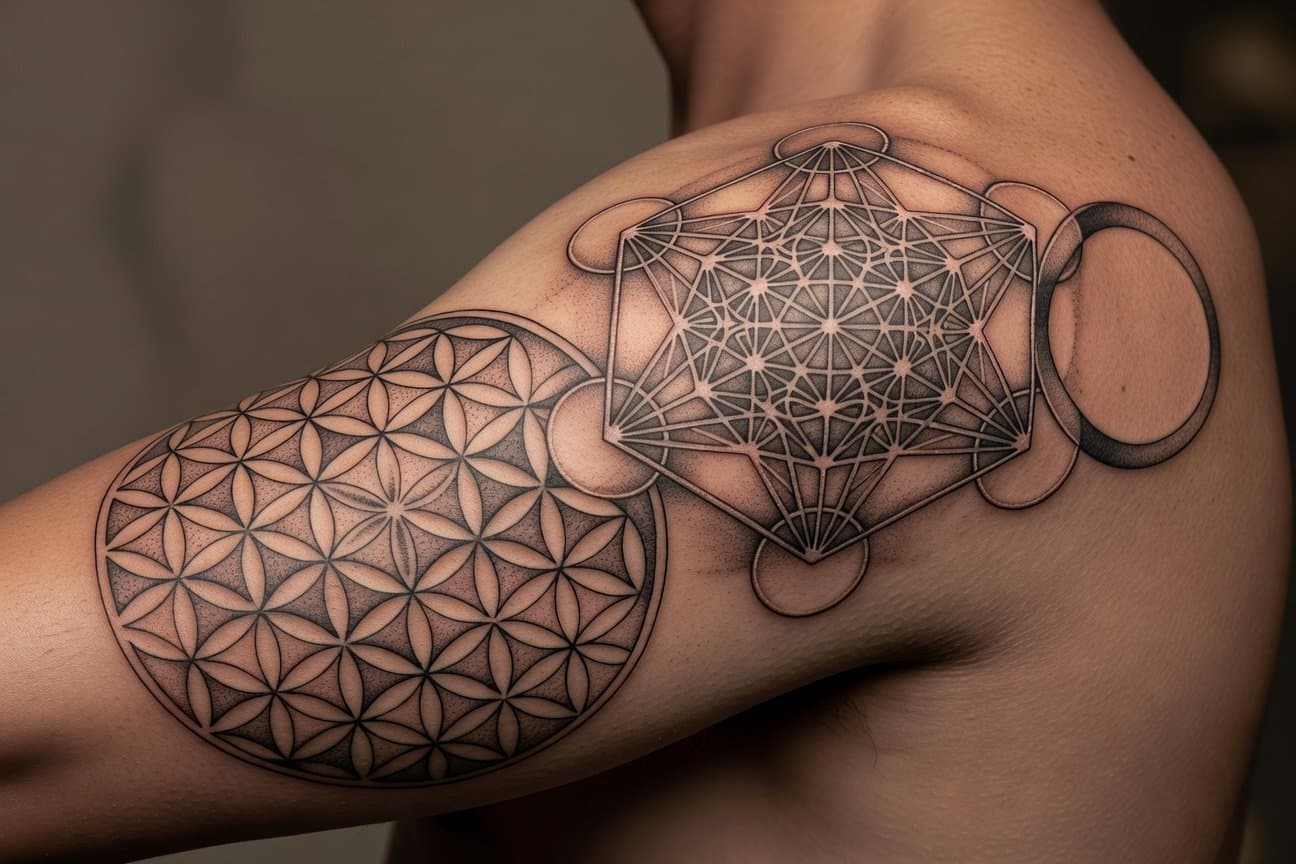
Precision geometric styles create specific compliance pressures that studios running shorter, simpler appointments don't face at the same intensity. Large back pieces in geometric or sacred geometry work can require 20 to 40 or more hours spread across multiple sessions. Dotwork shading alone demands sustained close contact, repeated repositioning, and constant handling of materials across a session that can run four to six hours.
Each disposable ink cap, each razor used in prep, each glove change, each surface the artist contacts while moving between the stencil and the client represents an exposure vector if protocols are lax. When session length increases, so does the cumulative opportunity for cross-contamination. A single deviation from sharps protocol at hour three of a five-hour mandala session carries the same biological risk as it would at hour one.
The guide makes a point that resonates specifically for studios building a reputation on high-investment geometric work: compliance isn't separate from craft quality. Clients booking complex, multi-session geometric pieces are making a significant financial and physical commitment. They are also, increasingly, asking about safety practices before they book. A studio that can articulate its exposure control plan, demonstrate its training cadence, and show a clean inspection history is not just legally protected; it is a more credible destination for the kind of work that demands precision and long-term healing confidence.
The Business Case Is the Safety Case
Studios that treat bloodborne pathogen compliance as a once-a-year certification checkbox rather than a daily operational practice are the ones most likely to face the consequences the guide is designed to prevent: fines, forced closures, and the reputational damage that follows a client infection event. The regulatory environment around tattoo safety is tightening, not loosening. The FDA's continued scrutiny of ink safety, combined with state and local health department attention to studio inspections, means that the gap between what the standard requires and what a studio actually does is increasingly likely to be examined.
The practical path forward is straightforward even if it requires genuine effort: write and maintain a current exposure control plan, document every training session, offer Hepatitis B vaccination and record the outcome, enforce PPE use and glove-change protocols through session length, handle sharps correctly at the point of use, and rehearse the post-exposure response so it isn't improvised under stress. For artists whose entire craft depends on precision, building that same discipline into safety practice isn't a compromise. It's the same standard applied to a different kind of linework.
Know something we missed? Have a correction or additional information?
Submit a Tip