Inked Mythos explains Flower of Life, Metatron’s Cube, Vesica Piscis
These three sacred-geometry staples look similar at a glance, but each carries a different read, and each needs different clarity before it hits skin.
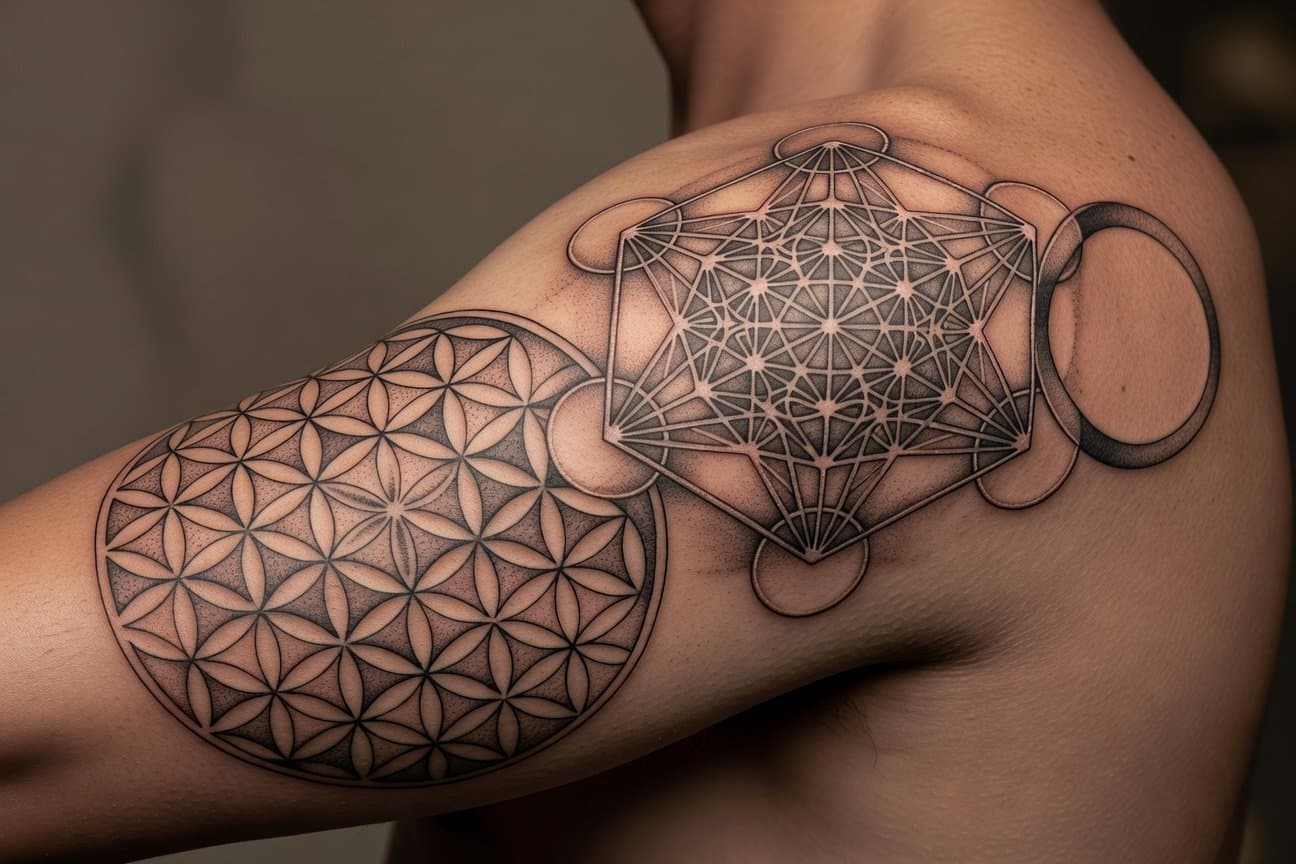
Flower of Life, Metatron’s Cube, and Vesica Piscis are not interchangeable. The trap with sacred-geometry tattoos is treating them like decorative fill when clients are usually choosing them for a reason: structure, symbolism, or both. The smarter consult starts with a simple test, what story does the shape tell before it ever touches skin?
Flower of Life: the dense lattice that needs room to breathe
The Flower of Life is the one clients often mean when they say they want something cosmic, orderly, and deeply patterned. It is commonly described as a design made from 19 intersecting circles, and popular sacred-geometry writing links it to creation, interconnectedness, unity, duality, and the cycle of life. That combination is exactly why it keeps showing up in bookings, because it feels expansive without needing to be loud.
What matters in the consult is variance. A client may love the idea of the Flower of Life, but the difference between a crisp lattice and a muddy tangle is often scale and spacing. At tattoo size, the repeating circles have to stay legible, or the pattern loses the very order that makes it attractive in the first place. If you squeeze it too hard, the design stops reading as sacred geometry and starts reading as a circular texture.
This is also where spiritual sensitivity comes in. The Flower of Life is often framed as an ancient sacred symbol, but modern interest in it is tied to a broader habit of reading flowers as signs of life, renewal, beauty, and the cycle of birth and death. If a client wants it because of the symbolic weight, say that plainly in the consult. If they want the geometry more than the metaphysics, that is a different brief and should be treated like one.
Metatron’s Cube: the architectural choice that shows every decision
Metatron’s Cube usually attracts a different kind of client. It is commonly described as a 13-circle figure connected by lines, and popular sacred-geometry sources link it to the five Platonic solids. That gives it a much more schematic feel than the Flower of Life. It reads less like a field of repetition and more like a diagram, which is exactly why some people love it. It feels mystical, but it also feels engineered.
That architectural quality is the point, and it is also the risk. Because the symbol depends on line relationships, symmetry, and intersections, sloppy placement is obvious fast. In clean geometric linework, Metatron’s Cube survives when the artist has enough space to keep the connections clear. It fails when it is forced too small or rushed into a spot that cannot support the structure.
Before booking, artists should clarify whether the client wants the full complexity or a pared-back version that only nods to the motif. That is not a minor design choice. With Metatron’s Cube, every line you remove changes the read, and every line you keep asks for more precision. If the client wants the symbol because they like sacred architecture, they need to know that the tattoo will only feel architectural if the geometry stays disciplined.
Vesica Piscis: the simplest symbol, and often the most misunderstood
The Vesica Piscis is the easiest of the three to explain visually. It is the lens-shaped overlap formed by two equal circles, and that simplicity is why it translates so cleanly into tattoo composition. Geometry, at its most basic, is the study of shapes and figures, and the Vesica is one of those rare forms that looks complete even when it is stripped down to its essentials.
Symbolically, though, it carries a lot. People read it as intersection, relationship, duality, connection, or shared origin, which makes it a strong option for someone who wants something minimal without giving up meaning. It also has a long life beyond tattoo culture, because religious symbolism and iconography have long been tied to myth and ritual. That matters if the client wants the symbol for spiritual reasons, not just because the shape looks elegant.
Here is the practical part: the Vesica Piscis is the safest of the three when the client wants a small, clean mark. The overlap still reads even when the design is reduced, while the Flower of Life and Metatron’s Cube can start losing clarity if they are compressed too much. But simplicity cuts both ways. If the client wants a heavyweight spiritual statement, the Vesica only carries that weight when the meaning is discussed openly instead of assumed.

What to clarify before you book
The best sacred-geometry consult is less about style and more about intent. Popular tattoo-education sources keep circling the same advice for a reason: research the symbol’s history, cultural context, and spiritual meaning before getting it tattooed. That is not a warning label, it is the difference between a design that feels deliberate and one that just borrows a vibe.
A useful consult usually covers these points:
- Do you want the symbol for its geometry, its spiritual meaning, or both?
- Are you asking for the exact form, or a stylized version that keeps the spirit but loosens the construction?
- How much detail can the tattoo actually hold at the size you want?
- Is this a standalone mark, or part of a larger sleeve, sternum piece, forearm emblem, or back-center anchor?
Those questions matter because sacred geometry is built on relationships. Change the spacing, the scale, or the level of symmetry, and you change the message. That is why this corner of tattooing keeps rewarding people who choose carefully instead of chasing a trend.
Why these three keep winning the booking conversation
There is a reason the Flower of Life, Metatron’s Cube, and Vesica Piscis keep showing up in the same conversation. They cover three very different moods inside the same visual language: dense repetition, structured architecture, and clean overlap. They also connect to a deeper tradition in which numbers and shapes have been treated as meaningful, not random. Britannica notes that the Pythagoreans, associated with Pythagoras of Samos around 525 BCE, invested numbers with mystical properties, and that old habit still shapes the way modern sacred-geometry tattoos are discussed.
That is the real value of the Inked Mythos guide. It does not just tell you what the symbols are supposed to mean. It helps you separate what you want from what the tattoo can actually carry. If the opening question is whether a motif is just pretty or genuinely chosen, the answer usually comes down to this: the best sacred-geometry tattoos still look clean at a glance, but they only work when the meaning survives the jump from idea to linework.
Know something we missed? Have a correction or additional information?
Submit a Tip