Think Tank Tattoo maps the hidden challenges of geometric back pieces
A full-back geometric piece lives or dies on mapping and healing, not just the sketch. Think Tank Tattoo turns back geometry into a planning problem with real symmetry, recovery, and budget stakes.
Body mapping comes first
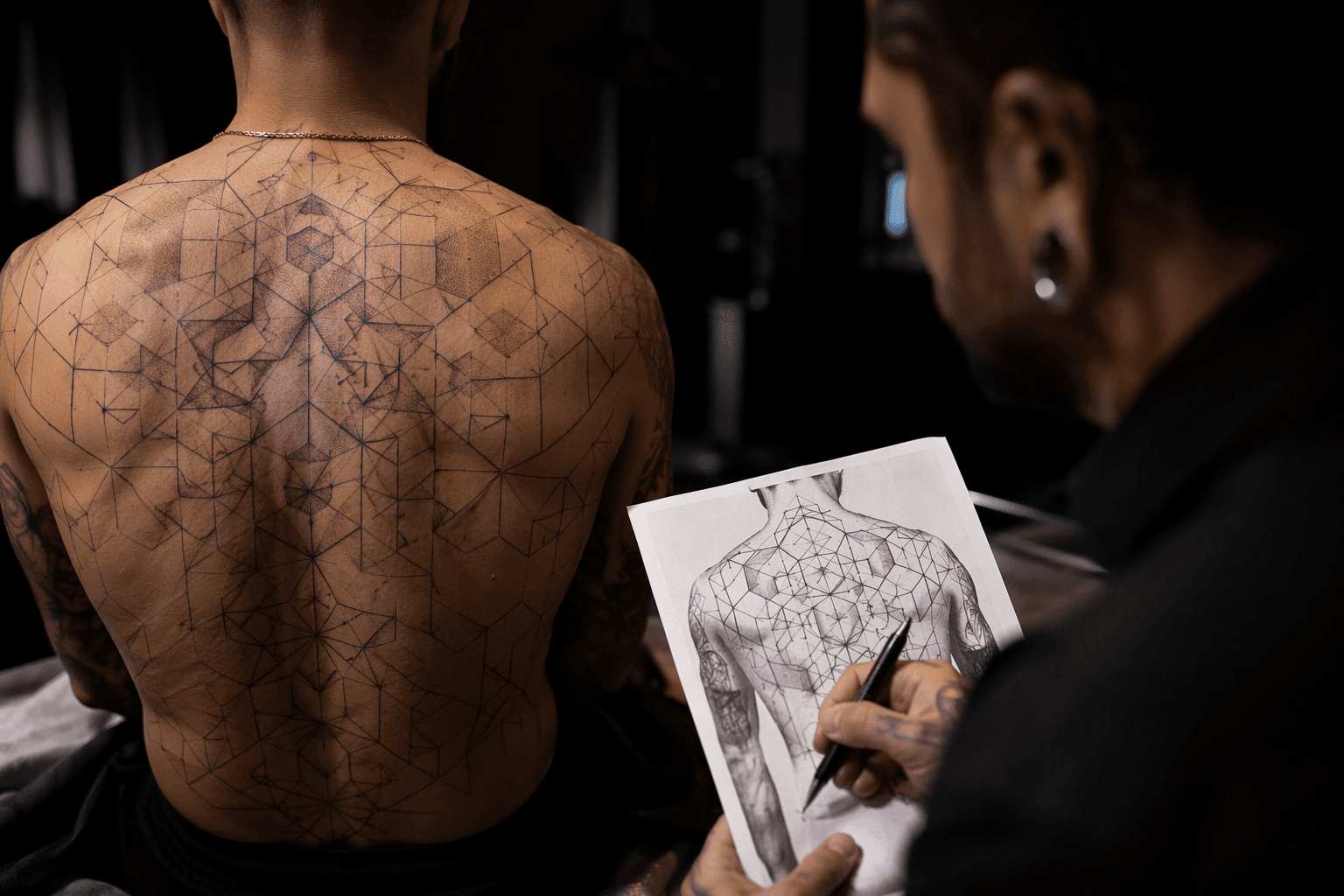
Think Tank Tattoo’s back-piece guide starts where good geometric work always starts: with the body, not the drawing. A design that looks perfectly centered on a screen can drift once it lands on a real back, because shoulder height is rarely even, the spine shifts the visual center, and existing tattoos may need to be worked around. That is the hidden test of full-back geometry: the image has to survive motion, posture, and the natural asymmetry of the person wearing it.
The guide’s practical warning is simple but easy to underestimate. The back is not a flat canvas, it is a moving, sweating, sun-exposed surface, so the decisions made before the first session matter as much as the artwork itself. If the body map is off by even a little, symmetry can start to feel strained once the client stands, turns, or raises their arms.
Scale creates more decisions, not fewer
The back gives artists room to think bigger, but the extra space multiplies the number of choices. Think Tank Tattoo frames the core questions around coverage, balance, and aging: should the design lock onto the spine or spread across the shoulder blades, how much negative space should stay open, and how will the composition read after the lines soften and the contrast settles? In large-scale geometry, the beauty of the first mockup is only the beginning.
That is why the guide treats a full back project as construction, not a single drawing exercise. The composition has to account for the way the back breathes and flexes, and it also has to remain legible as the tattoo matures. In other words, the strongest geometric back pieces are built with future movement in mind, not just the still pose used in the consultation.
Session sequencing is part of the design
A full back geometric tattoo usually means multiple appointments, especially when the piece depends on mirrored balance, dot saturation, or large zones of clean space. That makes booking cadence part of the design itself, because each session has to preserve symmetry while leaving enough room for the next pass. The more precise the geometry, the more carefully the project has to be staged.
This is also where budget and time become unavoidable parts of the conversation. More sessions mean more planning, and the spacing between appointments affects how the piece develops visually and physically. A back project that looks simple in a static mockup may demand a long booking schedule once the artist starts building out the structure in layers.
The style range is wider than most people expect
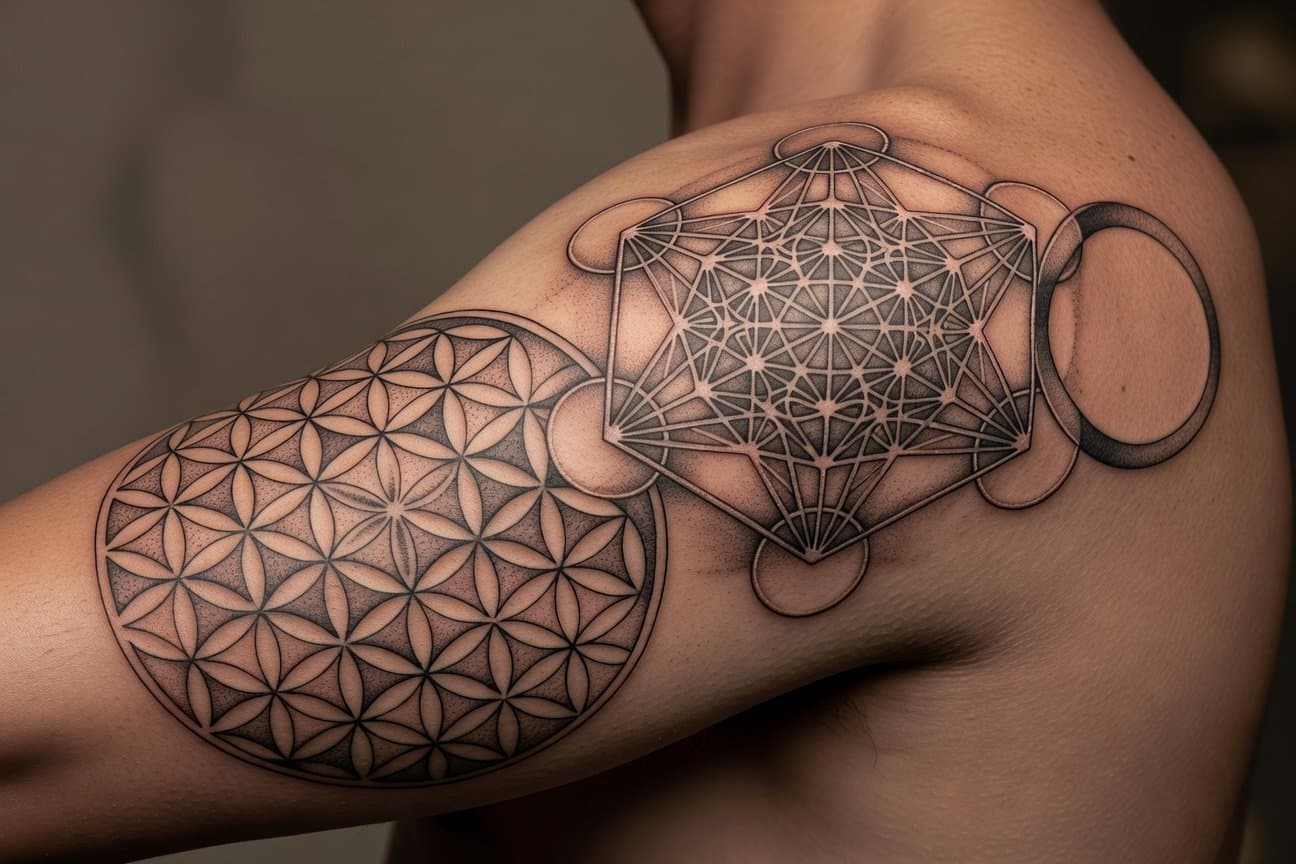
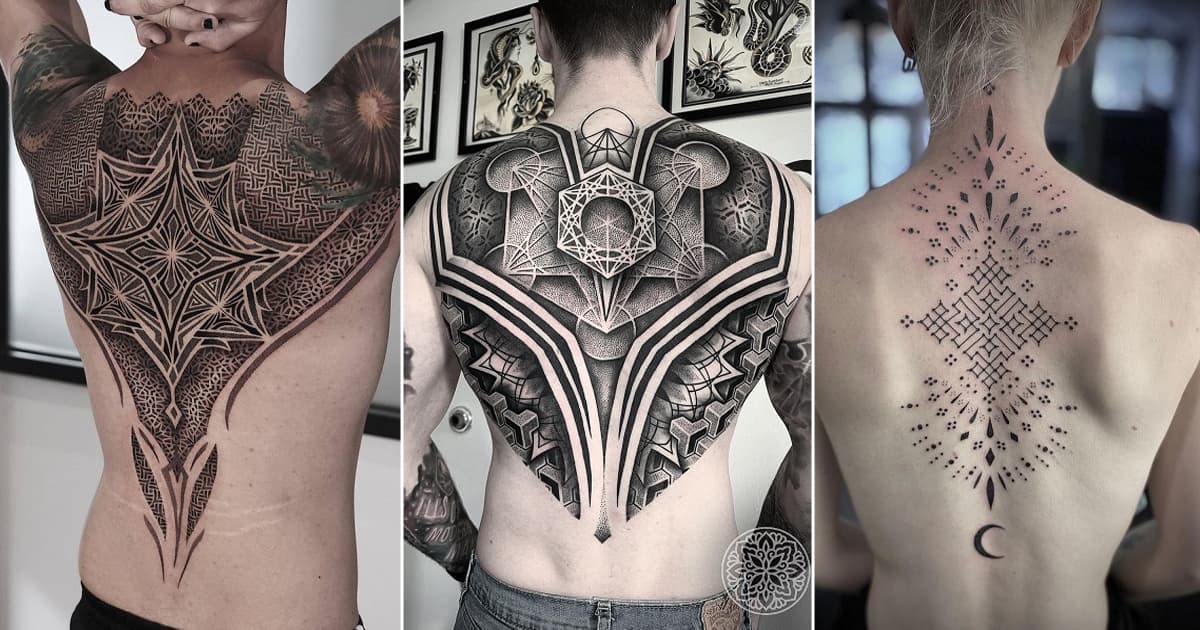
The guide’s table of contents makes one thing clear: “geometric back tattoo” is not a single style, but a family of body-aware strategies. It includes a full-back sacred-geometry mandala, an extended spine line-work piece, a sleeve-to-back transition, a biomechanical back design, a dot-work back tattoo, a negative-space concept, a watercolor fusion piece, and a 3D optical-illusion layout. Each one asks different questions about centering, flow, and how the eye moves across the body.
That range reflects the broader vocabulary of geometric tattooing today, where sacred geometry, dotwork, mathematical shapes, mandalas, platonic solids, and geometric animal designs all sit inside the same conversation. Ornamental tattoo coverage has also pushed mandalas and sacred geometry deeper into contemporary tattoo culture, which helps explain why back pieces now borrow so freely from both technical precision and symbolic patterning.
Where the body changes the art
The biggest mistake with large-scale geometry is treating the back like a poster. In reality, the spine, shoulders, and surrounding muscle groups all change how a design reads, which means final symmetry has to be judged in motion, not just in the stencil stage. A piece that is centered on paper may need to be rebalanced once it meets the person’s actual frame.
That is especially important when the design includes long vertical lines or mirrored elements. On a back, even slight shifts in posture can exaggerate differences between the left and right sides, so the planning has to anticipate how the work will look when it is alive on skin instead of frozen in place.
Healing is not a side issue
Medical guidance makes clear why large back pieces need conservative planning. Cleveland Clinic notes that larger tattoos can take a few months to fully heal, and that tattoos on the back may heal more slowly than smaller tattoos on the arms or wrists. Health guidance also shows that the outer skin layer may settle in 2 to 3 weeks, while the skin beneath can keep healing for up to a year.
That longer recovery window matters for scheduling as much as for comfort. Even when the surface looks calm, the deeper tissue is still doing repair work, which is why session timing, aftercare, and touch-up planning all belong in the original project strategy. Large geometric work is built over time, and the body needs time to catch up.
Sun, skin, and the long tail of aftercare
The aftercare story is more than moisturizing and waiting it out. A peer-reviewed study found that sun exposure during and after tattoo healing can contribute to skin-barrier dysfunction, fading, cracking, or abnormal pigmentation, which makes back pieces especially vulnerable because the area is often exposed in warm weather and outdoor settings. Dermatology guidance also warns that tattooed skin can react in unexpected ways, with reactions appearing immediately or years later.
There is also a medical visibility issue that cannot be ignored. Dermatologists warn that tattoos can mask moles or lesions and make skin cancer harder to detect, so skin monitoring remains part of the equation even after the tattoo is healed. Medical literature also notes that tattoos disrupt the skin’s physical and immune barrier, which helps explain why infection awareness and careful aftercare matter so much during the healing window.
Why the planning mindset fits the market
The guide lands at a moment when tattoos are a serious commercial industry, not a fringe luxury. Recent market research points to growth driven by social media and youth-led style trends, and that helps explain the rise of highly specialized custom work like geometric back pieces. As the market expands, collectors are getting more specific about what they want, and artists are being asked to solve more complex body-based problems.
That is the deeper appeal of the Think Tank Tattoo approach. It respects geometric back work as something engineered across anatomy, session cadence, healing time, and long-term skin care, with style choices that have to survive real life after the last appointment. A back piece succeeds when the symmetry holds up in motion and the healing plan is strong enough to let the design age into itself.
Know something we missed? Have a correction or additional information?
Submit a Tip