Princess Cruises Now Requires Crew to Cover Large Tattoos, Including Sleeves
Princess Cruises' fleetwide tattoo cover rule took effect April 2, hitting crew with sleeves hardest. For geometric work, the damage is both visual and physical.
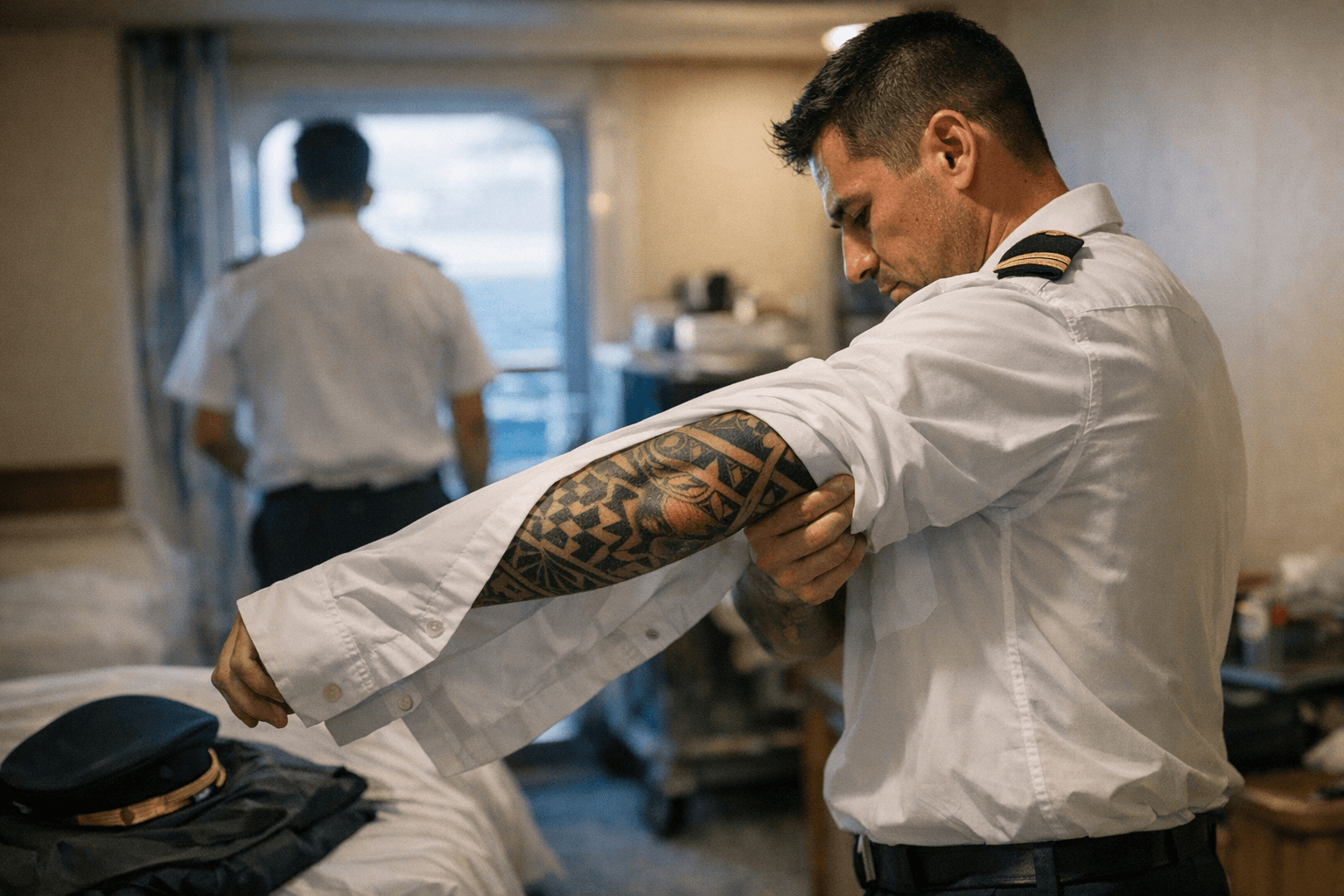
You're not starting clean when you pull a long-sleeve uniform over a healed geometric sleeve for an eight-hour shift. That's the reality now for Princess Cruises crew members, after the line's new tattoo coverage policy took effect fleetwide on April 2, 2026.
The rule is straightforward in its numbers but significant in its reach: any visible tattoo larger than 5 cm x 5 cm must be covered while crew are on duty or in guest-facing areas. Full sleeve tattoos are explicitly named in the policy. Compliance options include long-sleeve uniforms, tattoo-cover sleeves sold onboard, or other approved coverings. Supervisors received advance notice and are now checking compliance; non-compliance can lead to disciplinary action.
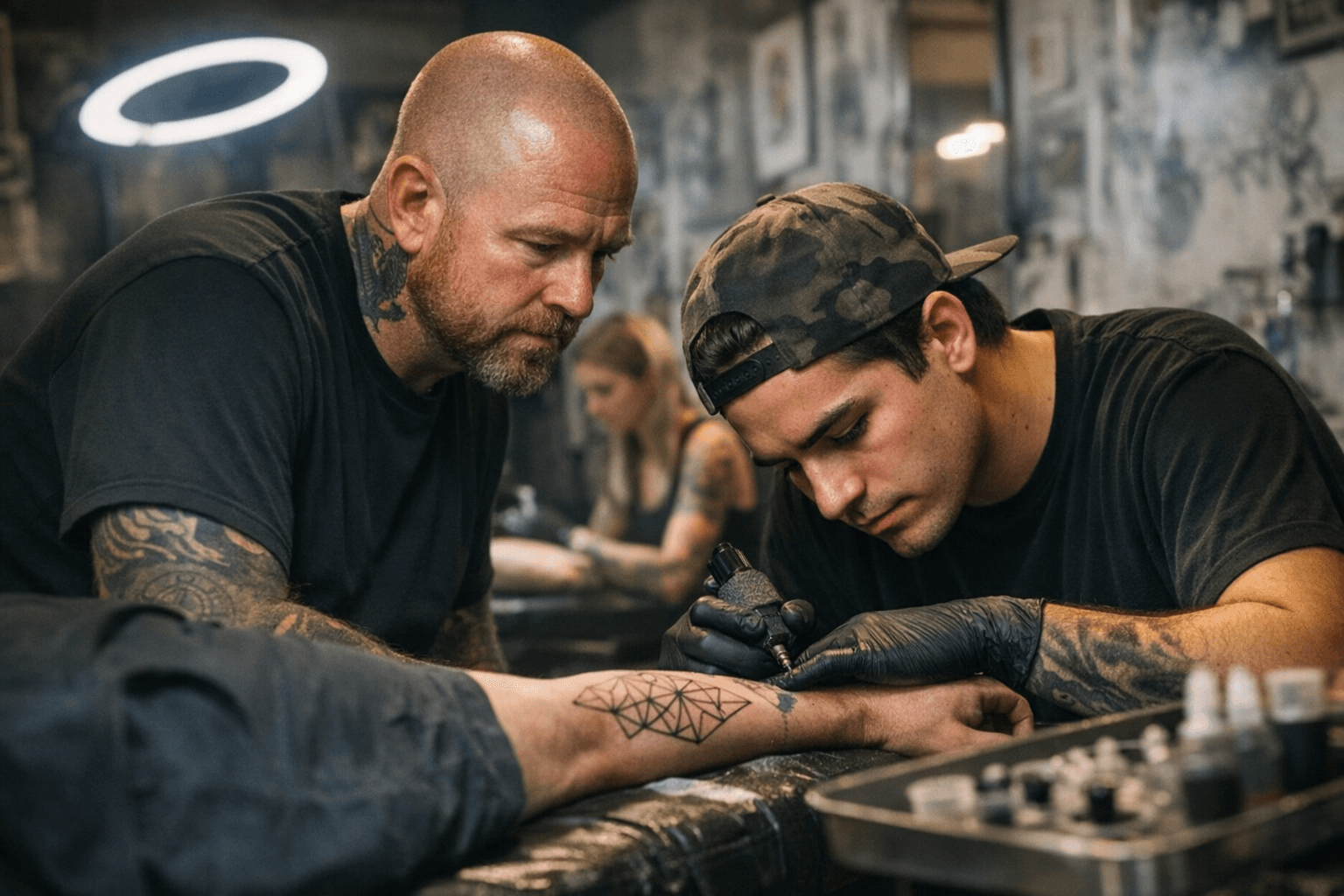
For crew carrying geometric work, the threshold matters in a specific way. A 5 cm x 5 cm patch of skin is roughly the size of a business card, generous enough to protect a small wrist sigil or a single sacred geometry symbol, but nowhere near enough to exempt a radial mandala spreading across the forearm, a dotwork sleeve wrapping from wrist to shoulder, or a continuous tessellation designed to flow with the elbow's articulation. Geometric pieces are built around symmetry and continuity; cover one section and the visual logic of the whole collapses.
The physical friction compounds the aesthetic loss. Dotwork and fine linework, the technical foundations of most geometric sleeves, are sensitive to repeated abrasion. A tattoo-cover sleeve or a uniform cuff dragging across healed linework across multiple shifts introduces friction that, over weeks, can accelerate fading and distort the crisp edges that define the style. Ships operate in high-UV, high-humidity environments, and any barrier layer traps heat and moisture against the skin, conditions that affect both comfort and ink longevity over long contracts.
Princess announced the policy through an internal Crew Center briefing published April 3, 2026. That the company is also commercially selling approved tattoo covers onboard says something about the operational planning behind the rollout: Princess anticipated the demand and built a compliance pipeline into the enforcement step. Crew Center reported mixed reactions from employees, which tracks with a policy that draws a hard line at a specific measurement. The crew member whose geometric forearm piece clears 5 cm x 5 cm by a centimeter faces the same requirement as someone with a full Japanese-scale sleeve.
The 5 cm x 5 cm carve-out does preserve some room. Small placement pieces, a sacred geometry symbol on the inner wrist, a minimal linework triangle at the ankle, sit comfortably under the threshold. For geometric artists with clients in the cruise and maritime industries, that exemption has become a practical design parameter overnight: keep a piece contained within roughly a business-card footprint and it stays visible on deck.
Hospitality employers across travel and tourism have been tightening visible appearance standards in public-facing roles for several years, and Princess's policy is one of the more explicit and measurement-specific versions to reach a major cruise line. For anyone currently under contract or considering crew work, the calculation is now concrete: sleeves cover up, or they stay off the ship.
Know something we missed? Have a correction or additional information?
Submit a Tip