Musician's Circle of Fifths Becomes Intricate Woven Star Geometric Tattoo
Pat Fish at LuckyFish built a woven ten-pointed star around a musician's Circle of Fifths brief, proving any system diagram can become precision geometric ink if the translation work is done right.
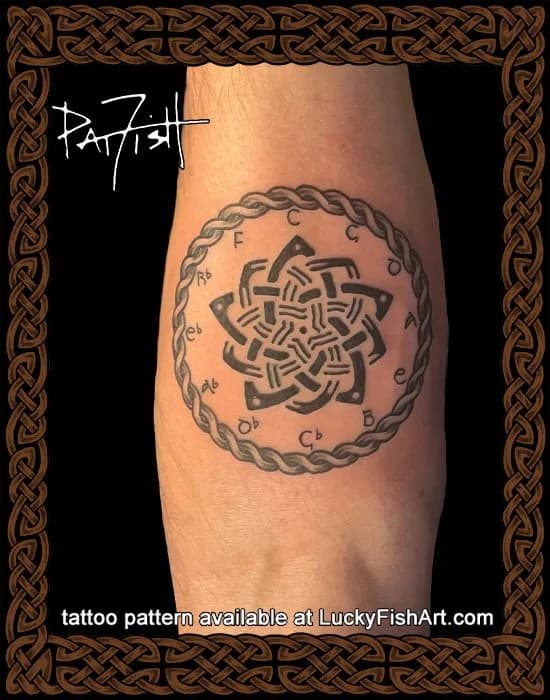
A musician walks into Tattoo Santa Barbara with a theory diagram instead of a reference photo. That's the brief Pat Fish of LuckyFish received: render the Circle of Fifths as a permanent geometric tattoo, preserving every relationship that makes the diagram useful to a working musician while producing something crisp, symmetrical, and built to last in skin. The result is a case study in what the geometric tattoo community calls "system tattoos" — designs sourced not from ornamental tradition but from information architecture, where the meaning lives in the structure itself.
The Source Material: Why the Circle of Fifths Is Hard to Tattoo
The Circle of Fifths is, as LuckyFish describes it, "a geometric tool of letters for organizing pitches, scales, and key signatures." Visually, it's a wheel with twelve segments arranged so that each adjacent key shares six of seven notes with its neighbors, producing a map of harmonic proximity. The diagram already has radial symmetry, which is a promising start. The problem is what fills those segments: letter names, accidental markings, and sometimes chord quality indicators that cluster into dense text rings. A literal transcription would read as a label, not a tattoo. Typography that works on paper at eight inches rarely survives the healing process at two, and text that small becomes illegible within years on living skin. The translation required stripping the diagram back to its underlying geometry and rebuilding it in a medium where line weight, spacing, and interlock determine longevity.
The Design Solution: Woven Star as Structural Core
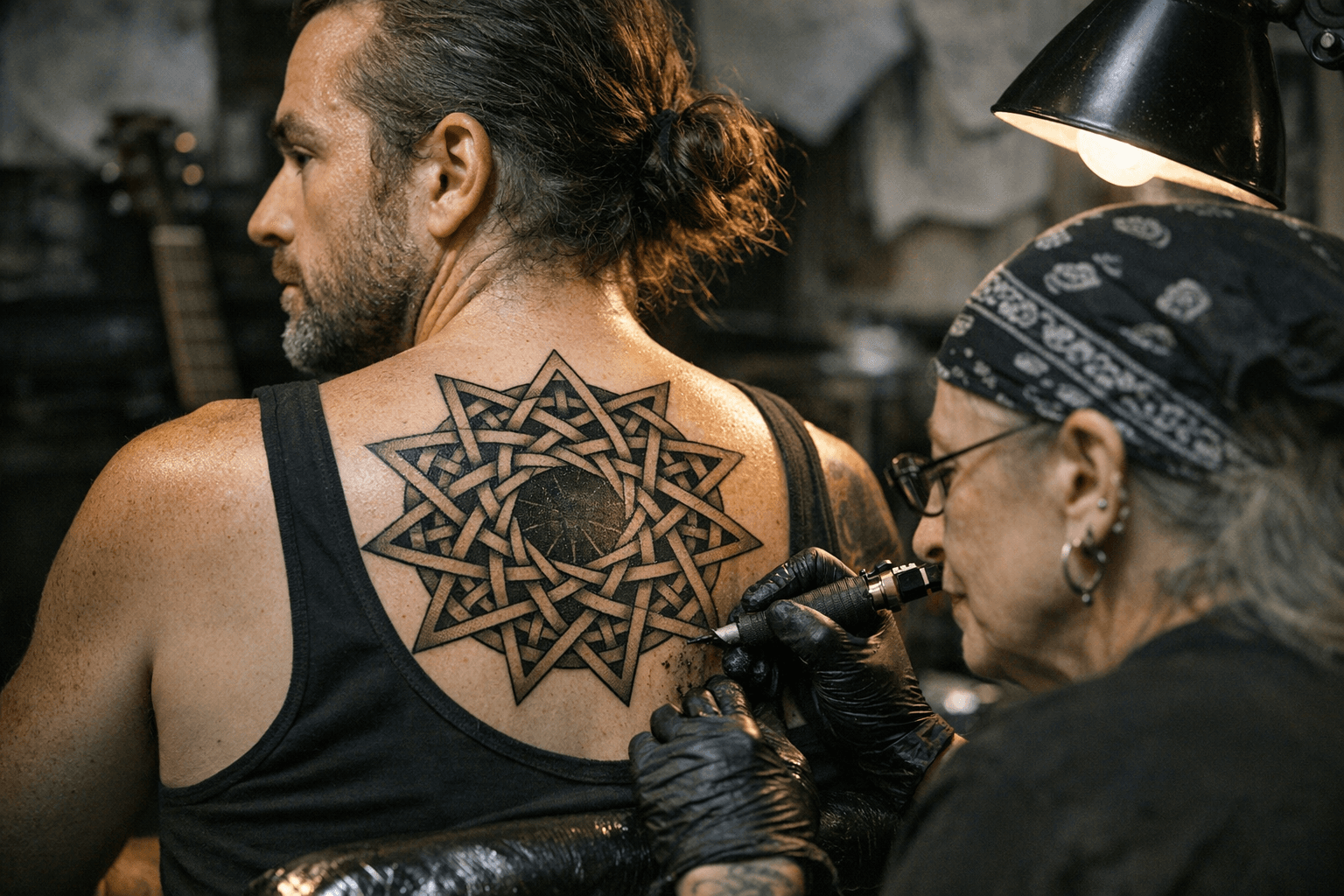
Rather than adapting the Circle of Fifths directly, Pat Fish proposed using a woven ten-pointed star by Siberian artist Sergey Arzamastsev as the centerpiece. The ten-pointed star, a decagram, maps cleanly onto the Circle of Fifths' structure: ten points can represent the ten unique pitch classes that don't include the two enharmonic pivot tones, and the woven interlace pattern gives each point a visual weight that anchors the composition without text. Arzamastsev's geometry is precisely drafted, which matters enormously at stencil stage. Woven stars live or die by the accuracy of their crossing points; a single misaligned crossing reads as a mistake rather than a deliberate interlace, and that error compounds as the tattoo ages. Using a source drawing with established mathematical precision meant the stencil could be scaled, plotted, and tested before a needle touched skin.
The woven quality of the star also solved one of the key visual challenges in system tattoos: distinguishing the design from a diagram. A flat decagram is a schematic. A woven decagram is an object, something with apparent depth and interlocking structure that rewards a close look. For a musician, that interlocking reads as a metaphor for harmonic interdependence; for anyone else, it reads as disciplined geometric art. The dual legibility is exactly what makes cross-disciplinary reference work in this format.
The Celtic Ring: Framing and Cultural Context
Once the star was established, Pat Fish added "a simple twist of a Celtic ring to enclose it all." That framing decision is doing significant structural work. A Celtic ring at the perimeter creates a contained composition, giving the eye a boundary to return to after tracing the star's crossings. It also connects the piece to LuckyFish's core expertise: Pat Fish has spent four decades working from Irish illuminated manuscripts and Scottish Pictish stone carvings, developing a technical command of knotwork interlace that very few artists match. The Celtic ring isn't decorative padding; it's the artist operating in her strongest domain, deploying a motif she can execute with the line consistency required for long-term legibility.
The combination of the star, the circle, and the ring also produces what the LuckyFish write-up identifies as multidimensional meaning: the Circle of Fifths structure remains readable to musicians, the geometric interlace speaks to the broader geometric tattoo tradition, and the Celtic frame connects the piece to a historical lineage of sacred geometry in body art. Each layer is independently coherent, so the tattoo doesn't collapse into visual noise when a viewer doesn't carry all three references.
Stencil Math and Placement: Where System Tattoos Succeed or Fail
The most technically demanding phase of a composition like this isn't the drawing; it's the stencil mathematics and placement testing. Radial symmetry that reads perfectly on flat paper can distort badly on a curved surface. A ten-pointed star placed on a shoulder, upper arm, or upper back needs its center point to sit on the apex of the curve, with the ten arms mapped outward against the body's actual topography. Pat Fish's process, documented across her Celtic sleeve work, involves a combination of computer-assisted grid plotting and direct adjustment drawn onto the body before the stencil is applied. For a design with this many crossing points, that adjustment phase is critical: each arm of the star has to reach its neighbor at the same apparent angle despite the skin's curvature, or the woven illusion breaks.
Line weight is the other variable that separates a system tattoo that heals well from one that muddies. The interlace crossings in Arzamastsev's star require slightly heavier weight at the "under" lines to read as passing beneath the "over" lines. Too fine, and the crossing becomes ambiguous after the first year of healing. Too heavy, and the star loses its delicate geometry. That calibration happens in the stencil phase, not during the tattoo, which is why the draft stage is where most of the actual artistic decisions get made.
A Template for Your Own System Tattoo
The Circle of Fifths commission maps onto a repeatable process that applies to any diagram-based tattoo brief, whether the source is a harmonic wheel, a mathematical constant, a coding flowchart, or an astrological chart. The workflow breaks down into four phases:
1. Strip to geometry first. Identify the structural relationships in the source diagram and ask whether they can be represented by point counts, angular spacing, or interlace patterns rather than text. If the meaning survives without labels, the tattoo will too.
2. Source a geometrically precise base drawing. Arzamastsev's star worked because its crossing points were mathematically clean. Whatever star, polygon, or radial motif you choose should have a drafting-quality source, not a freehand sketch, before you ever discuss stencil size.
3. Add a framing element from a tradition with line discipline. Celtic knotwork, Islamic geometric borders, and sacred geometry circles all have centuries of refinement behind them. Borrowing a framing convention from those traditions gives the piece a visual container and connects it to a lineage of precision ornament.
4. Plan stencil placement on the actual body surface before committing. Print the design at tattoo size, tape it in position, and photograph it from every angle you'd see it in daily life. Radial symmetry needs to read correctly from the primary viewing angle, which is rarely straight-on.
The LuckyFish Circle of Fifths tattoo proves that the most personally meaningful geometric work isn't always sourced from ornamental tradition. Sometimes it starts with a theory diagram on a music stand and ends with a woven star that will still be reading correctly fifty years from now.
This article was produced by Prism’s automated news system from verified source data, official records, and press releases, then run through automated quality and moderation checks before publishing. The system is built and supervised by the people who set the standards it runs under. Read our full AI policy.
Did this article answer your question?