Shark tattoos blend ancient strength, conservation urgency, and geometric design themes
Shark tattoos hit hardest when the body becomes a set of clean planes, with ancient symbolism and conservation urgency sharpening every facet.
Ancient power, but not brute force
A shark tattoo works because the animal already carries a rare mix of mythology and authority. NOAA says sharks have existed for more than 400 million years and now number more than 450 species, so the motif arrives with deep time built in before a single line goes down. That longevity is why the shark reads as strength, but the best versions do not lean on aggression alone. They treat the shark as a creature of precision, built to move efficiently and survive in a world that has kept changing around it.
That distinction matters on skin. A shark tattoo that only shouts danger can feel flat; one that suggests adaptation, speed, and control feels sharper and more durable. NOAA frames sharks as apex predators that help keep marine ecosystems healthy, feeding on animals lower in the food chain and helping maintain balance. For tattoo design, that ecological role gives the animal a different kind of power: not chaos, but structure.
The conservation story sits inside the symbol
The shark is not just an ancient survivor, it is also a modern conservation warning. The International Union for Conservation of Nature reported on December 2, 2024 that roughly one-third of sharks, rays, and chimaeras are threatened with extinction, based on work compiled by 353 experts from 115 countries and covering 158 countries and jurisdictions. Earlier scientific analysis found that one-quarter of the 1,041 chondrichthyan species assessed were threatened, and only one-third were considered safe. That turns a shark tattoo into something more layered than a nod to toughness. It becomes a symbol of vulnerability, pressure, and the urgency of protecting a lineage that is still here but not secure.
That conservation context changes how the image lands. A shark drawn with clarity and restraint can feel more honest than one overloaded with aggression cues, because the real story is about survival under strain. The tattoo becomes a reminder that iconic species are not protected by their fame alone. They need attention, and in a culture built on imagery, that attention often starts with a design that is memorable enough to be repeated.
Why the Pacific history gives geometric shark tattoos their depth
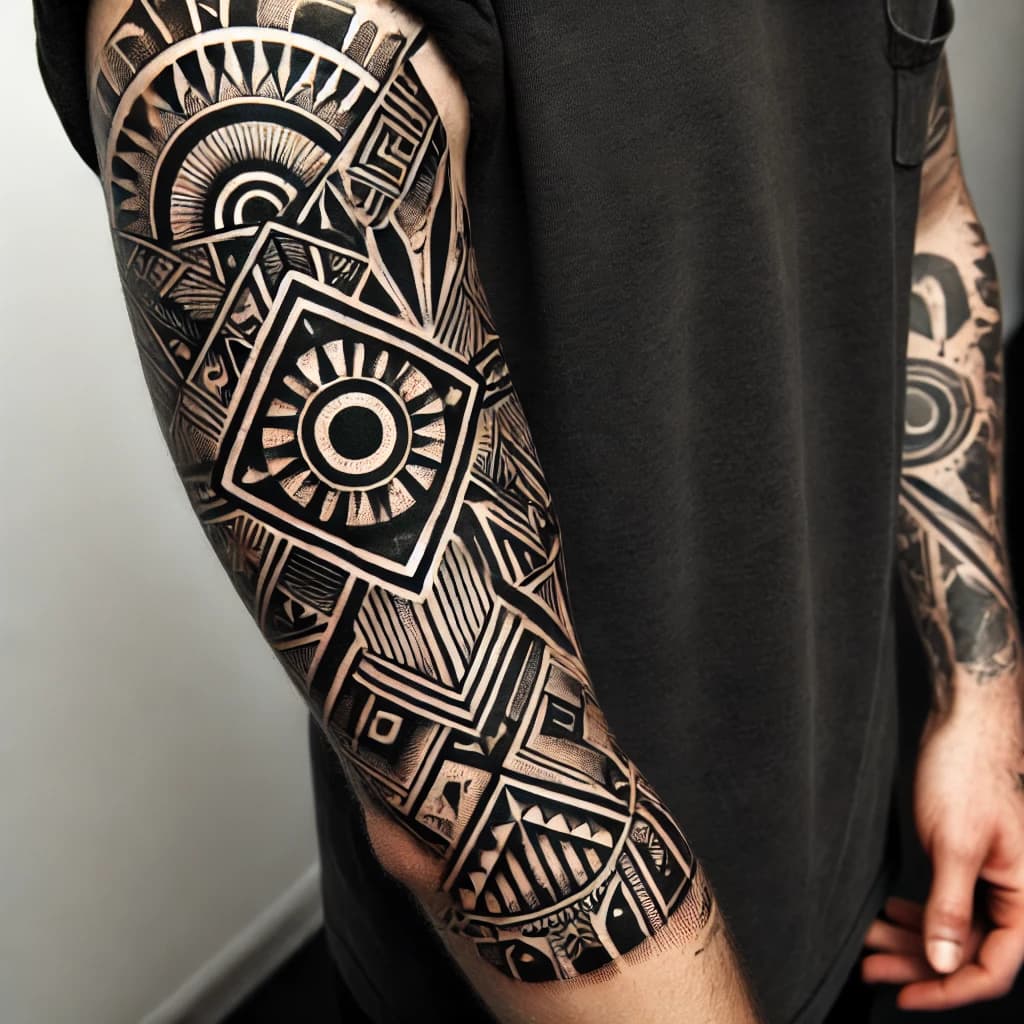
The strongest geometric shark ideas do not begin with abstraction for its own sake. They begin with cultural language. Tattoodo notes that Polynesian tattoos have long featured highly elaborate geometric designs, and that is exactly why the shark translates so naturally into those systems. The creature’s body already lends itself to rhythm, repetition, and bold structural forms, which makes it a natural fit for geometric treatment.
The Metropolitan Museum of Art’s Oceanic collection, with more than 2,800 works spanning more than 500 years, helps explain why this visual logic feels so grounded. The Met describes Pacific Oceanic art as a field shaped by origins, ancestral power, and ritual regalia. Its Solomon Islands shark reliquary was intended to safeguard the skull of a deceased chief and recent ancestor, and the museum notes that shark reliquaries in the eastern Solomon Islands reflect the shark’s privileged position there. In that setting, the shark is not merely decorative. It carries protection, chiefly status, and continuity with the dead.
That matters for geometric tattooing because a clean pattern can still hold spiritual weight. When a shark is translated into the bold geometry of Pacific Island tattooing, it can carry the same sense of guardianship and ancestry while looking contemporary on skin. The result is not a softened shark. It is a shark filtered through a visual language that has always understood symmetry, pattern, and symbolic force.
How to turn a shark into a geometric tattoo that still reads clearly
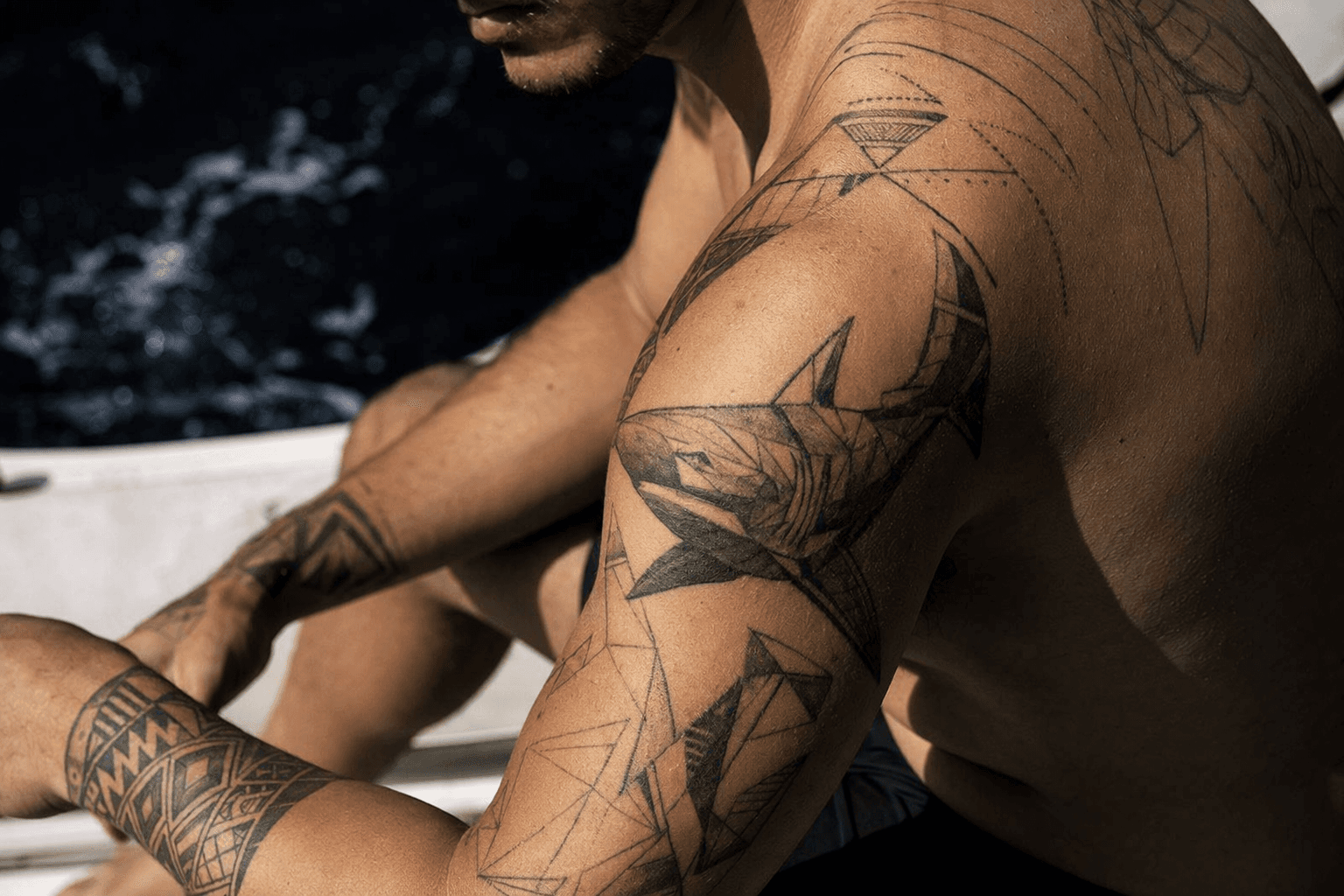
The trick is reduction without losing identity. A geometric shark works when the artist keeps the silhouette unmistakable, then rebuilds it from angular facets and mathematical planes. The body should still feel like a shark at a glance, which means the fin line, tail sweep, and head shape need to stay legible even after the anatomy has been simplified into clean shapes.
A good geometric shark usually depends on a few design decisions:
- Faceting: Break the torso into planes that follow the body’s movement, rather than scattering triangles randomly. The geometry should suggest motion, not just decoration.
- Symmetry: Use balance where the species supports it, especially around the head and jaw. A hammerhead shark can emphasize symmetry beautifully because the shape is already so distinct.
- Negative space: Leave breathing room around the belly, gills, and fin breaks so the design does not collapse into a dark mass. Negative space keeps the shark readable from a distance.
- Fin and jaw simplification: Reduce the dorsal fin, pectorals, and jawline to a few decisive cuts. In a shark jawbone concept, the anatomy itself can become the pattern, which lets the tattoo stay bold without needing extra detail.
- Body placement: Give the design enough uninterrupted skin to preserve its planes. A geometric shark needs room for its lines to stay crisp, because crowding the image can muddy the faceting and weaken the whole structure.
That last point is where geometric work rises or falls. The style depends on defined shapes, symmetry, and smart use of body space, and contemporary ornamental tattooing often reinforces that with black shading or delicate pointillism. If the skin location bends too hard, or if the composition is packed too tightly, the shark can lose the sharpness that makes the style feel intentional. The best placements let the body follow the design, not fight it.
Different shark compositions, same design logic
The appeal of shark imagery is how many directions it can take without losing impact. A hammerhead shark leans on silhouette and symmetry. A shark beneath the surface uses composition, waterline, and negative space to suggest motion and depth. A shark jawbone concept strips the animal down to anatomy and attitude, which can make a small tattoo feel surprisingly complete. Even realistic great whites and black-and-grey renderings can borrow from geometric thinking when the artist uses structure to control where the eye lands.
That flexibility is what makes the motif so useful for geometric tattoo readers. The shark can move from tradition to realism to abstraction, but the strongest versions always return to the same principles: clean planes, strong silhouette, careful spacing, and a body flow that reads instantly. In that sense, the geometric shark is not a trend piece. It is a clean demonstration of how an animal motif becomes more durable when it is reduced with discipline, then rebuilt with purpose.
This article was produced by Prism’s automated news system from verified source data, official records, and press releases, then run through automated quality and moderation checks before publishing. The system is built and supervised by the people who set the standards it runs under. Read our full AI policy.
Did this article answer your question?