Tattoo aftercare market grows as skin care and sustainability rise
The aftercare boom is now part of tattoo planning, and geometric work feels it first. The right balm, film, and sun routine help lines stay crisp as packaging gets louder.
Accio’s June 20 estimate puts the global tattoo aftercare market at about $4.44 billion in 2025 and $4.9 billion in 2026, a 10.4% compound annual growth rate. For anyone healing a mandala, grid, or fine-line geometric piece, that scale changes the conversation.
What the 2026 market is really rewarding
Three themes are shaping what gets bought: natural ingredients, healing ointments, and sustainable packaging. Clients are not only asking whether a product supports healing, but also whether it fits their skin-care habits and their values around waste and presentation.
For geometric tattoos, the practical question is simpler than the branding around it: does the aftercare help the skin settle cleanly enough to preserve symmetry, line clarity, and dotwork? A product can look premium and still be the wrong choice if it leaves the skin too greasy, too dry, or too irritated for a design built on precision.
Balm, film, and the moisture balance that protects linework
The decision between balm and film matters because geometry shows every small healing mistake. A light balm or healing ointment can keep the skin flexible during the early peel without turning the tattoo into a slick surface that smears against clothing. Film can be useful when the bigger threat is friction, but it only helps if it is clean, properly fitted, and removed on schedule.
The goal is not maximum moisture. It is controlled moisture, because over-moisturized skin can stay puffy longer and make crisp edges look softer than they really are. That matters most on pieces where negative space, straight-line spacing, and dot density all have to read evenly once the tattoo settles.
The healing clock also matters here. Initial tattoo healing commonly takes about 2 to 4 weeks, with full healing taking longer depending on size, complexity, and placement. A small wrist piece, a dense mandala across the sternum, and a large calf composition do not heal on the same timeline, so the aftercare routine has to match the work rather than the product label.
Sun, friction, and the parts of aftercare that actually move the needle
The easiest way to lose sharpness on a geometric tattoo is to treat the first few weeks casually. Fresh work needs to stay out of harsh sun, because ultraviolet exposure can stress healing skin and make black ink look flatter before the tattoo has even finished settling. It also needs protection from rubbing, especially on placements that catch sleeves, waistbands, straps, or repetitive motion.
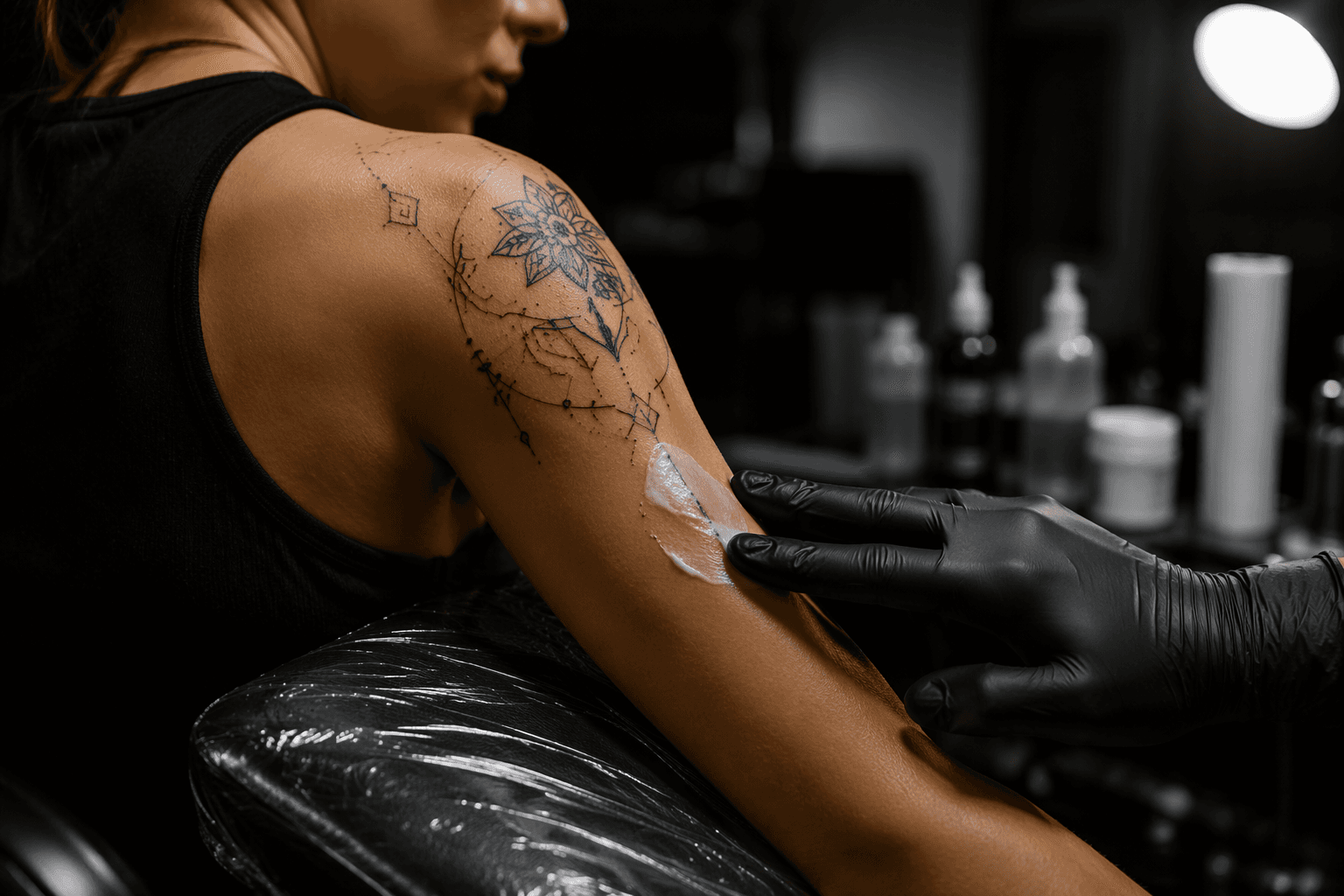
That is where the daily routine matters more than the aesthetic promise on the jar. Clean hands, thin application, and restraint keep the skin from being flooded with product. For fine-line geometry, less handling usually means less distortion, because every extra pass across the tattoo increases the chance of irritation or scab damage.
The American Academy of Dermatology is seeing more patients ask dermatologists for advice on keeping tattoos healthy and vibrant, which fits the broader move toward treating tattoo care like skin care. Tattooed skin can react in unexpected ways even when the artist is licensed and the aftercare is followed.
Why the safety story still drives the category
The Centers for Disease Control and Prevention has documented tattoo-associated methicillin-resistant Staphylococcus aureus skin infections among 44 tattoo recipients linked to 13 unlicensed tattooists in three states, along with nontuberculous mycobacterial skin infections tied to contaminated inks and nonsterile water used for dilution. The CDC’s prevention advice is plain: sterile ink products, sterile water, and hygienic practices.
A 2024 review in The Lancet Microbe found that the incidence of microbial infections related to tattoos has increased since 2000, even as public-health awareness has grown.
What is worth trusting in the new product wave
Natural ingredients and sustainable packaging are real trends, but they do different jobs. Packaging is mostly about waste and brand values. Ingredients are the part that can actually affect how the skin feels while it is healing, which is why the formula matters more than the marketing language on the outer box.
That does not mean anything labeled natural is automatically better. Gentler-looking products can still irritate some people, and a formula that works on one person’s calf piece may not behave the same way on another person’s rib or ankle tattoo.
This article was produced by Prism’s automated news system from verified source data, official records, and press releases, then run through automated quality and moderation checks before publishing. The system is built and supervised by the people who set the standards it runs under. Read our full AI policy.
Know something we missed? Have a correction or additional information?
Submit a Tip