How GTA’s wanted level turns every crime into a chase
GTA’s wanted level is less a punishment meter than a moving escape puzzle. From GTA III’s six stars to GTA V’s five, it trains you to plan routes, break sightlines, and improvise under pressure.
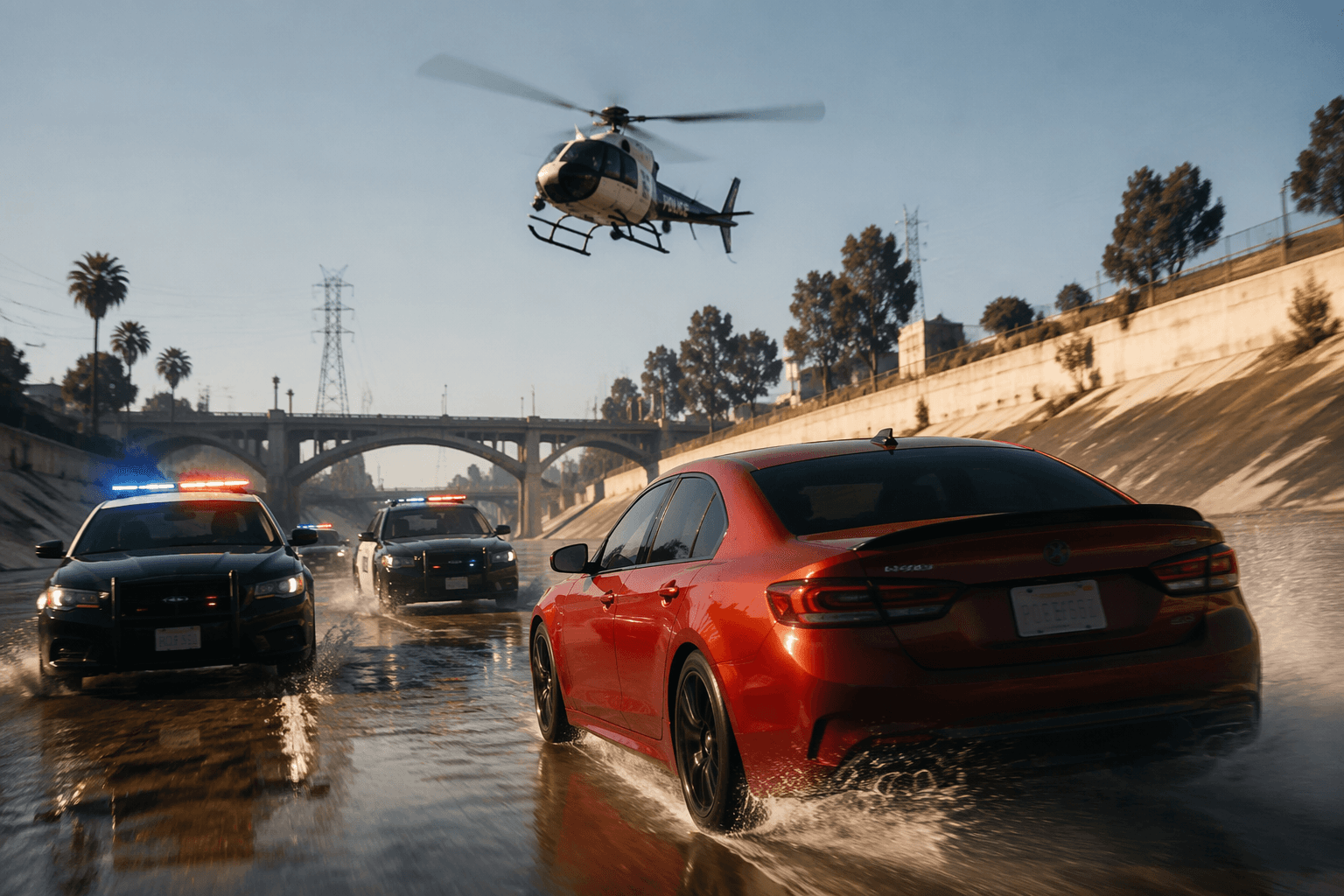
GTA’s wanted level works because it never treats crime as a single moment. In GTA V and GTA Online, the star meter is the game’s way of tracking how much attention Los Santos and Blaine County law enforcement are giving you, and that attention changes the second you move. A quick robbery, a stolen car, or a messy getaway is really a routing problem in disguise: you are not just surviving the first response, you are solving the next block of the map before the police close it off.
The wanted level is a chase system, not a combat meter
At its best, the mechanic teaches you that escalation is spatial. One or two stars usually feel local and reactive: officers close distance, try to spot you, and move in for a hands-on stop if they can. By the time the stars climb, the game stops behaving like a patrol response and starts behaving like a coordinated manhunt, with helicopters, tactical units, roadblocks, and spike strips entering the picture. That is why the system stays readable even when chaos ramps up, because every new star is adding pressure through geography, not just through damage numbers.
That design is why line of sight matters so much in GTA V. The moment you can break visual contact, cut down an alley, or swap to a less obvious vehicle, you are no longer just fleeing, you are manipulating the search pattern. Map awareness becomes as important as aim, because the city itself turns into cover, and the best escapes usually come from reading where police will look next rather than trying to outshoot them head-on.
What the stars teach at each level
The early stars are where GTA teaches the basics of criminal movement. If you steal a car in a busy street or hit a store and linger too long, the first response is about identifying you and pinning you in place. That is the game’s way of forcing you to stop thinking like a shooter and start thinking like a driver, because even a basic escape is about choosing the right turn, the right lane, and the right moment to disappear from view.
Higher wanted levels push that lesson harder. Once helicopters are overhead and tactical units start showing up, the obvious route is usually the wrong one, because the game is already accounting for roads, chokepoints, and open sightlines. A clean escape now depends on improvisation: taking alleys instead of boulevards, switching vehicles when a damaged car becomes a liability, or using the terrain to cut pursuit speed before the stars have time to fade.
By the final stars in GTA V’s five-star framework, the player psychology changes too. You are not just reacting to police anymore, you are planning around the pressure they create, which is why the same city block can feel safe in free roam and dangerous during a chase. The best chases happen when the player is forced to make split-second tradeoffs between speed, visibility, and route certainty.
From GTA III’s six stars to GTA V’s five-star clarity
The modern wanted system took shape with Grand Theft Auto III, which released on October 22, 2001 and is closely tied to the series’ current identity. GTA III-era games used a six-star wanted scale, and that six-star cap continued through GTA: Vice City and GTA: San Andreas. Older entries also leaned more openly into militarized pursuit at the extreme end, which made the system feel like a ladder of increasingly dangerous jurisdiction as much as a simple alarm.
That earlier structure mattered, but GTA IV and GTA V tightened the idea into a five-star framework that is easier to read at a glance. The change did not weaken the mechanic, it sharpened it: fewer stars meant clearer escalation, faster recognition, and a cleaner link between your crime and the response it triggered. That clarity is a big reason the wanted level remains one of the most recognizable systems in open-world gaming, because you always understand where you stand and how much trouble you have created.
The mechanic was already central to player skill by the early 2000s. IGN published a GTA III law-evading guide on November 5, 2003, which shows how quickly wanted-level evasion became a core part of the way people played the series. Players were not treating it as background noise even then. They were studying it as a system to beat.
Why GTA V and GTA Online still build around it
GTA V and GTA Online keep the wanted level alive as a living design tool, not a leftover HUD element. Rockstar’s support notes for Title Update 1.73 specifically mention fixing an issue that affected players trying to override wanted levels with specific rules in Mission Creator, which tells you the system still matters inside custom content. When a game allows mission rules to override wanted behavior, it is making a direct statement that police pressure is part of mission design, not just the sandbox around it.
Rockstar’s ongoing Newswire posts and GTA Online updates also keep circling police and law-enforcement-related content, which reinforces the same point from another angle. The wanted system is still being treated as part of the live game’s vocabulary, especially in content that asks players to fight, flee, or build around law enforcement behavior. That continuing support is why wanted-level stories never go stale, because the system is still active in the way the game is built and updated.
For players, the practical lesson is simple: every star is a planning problem. A stolen car is not just transportation, a backstreet is not just scenery, and a helicopter overhead is not just spectacle. GTA’s wanted level turns all of that into a single question, how do you get out of sight, get onto a better route, and keep the chase from becoming a trap? That is the real genius of the system, and it is why the next crime in Los Santos always starts with the same thought: where do you run now?
This article was produced by Prism’s automated news system from verified source data, official records, and press releases, then run through automated quality and moderation checks before publishing. The system is built and supervised by the people who set the standards it runs under. Read our full AI policy.
Did this article answer your question?