California Craft Brewers Face Growing Economic Pressures Reshaping the Industry
Russian River draws 25,000 visitors for its Pliny the Younger run even as California's craft brewing industry faces its worst closure rate in modern history.
Hundreds of beer geeks queued outside Russian River Brewing Company's Windsor taproom recently for a pour of Pliny the Younger Triple IPA. The brewery expects more than 25,000 visitors across its two locations during the beer's annual two-week release. The crowd looked like a boom-era scene. The numbers behind it do not.
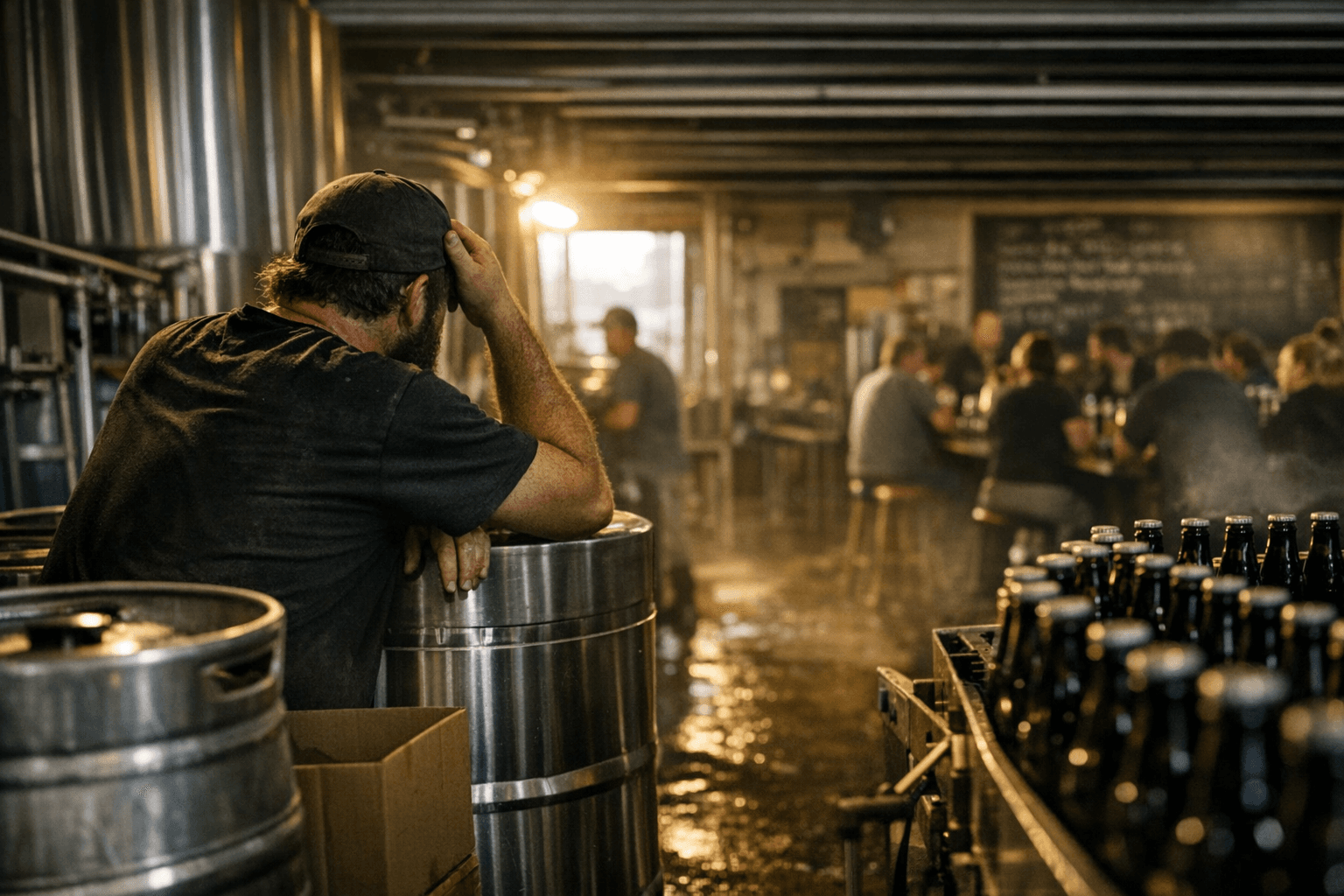
The Brewers Association tracked 434 U.S. craft brewery closures in 2025 against just 268 openings, the second consecutive year in which closures outpaced new starts. Craft beer volume fell an estimated 5% year over year, accelerating from a 4% decline in 2024. Bart Watson, Brewers Association president and CEO, noted that closure rates run highest in states with the largest brewery counts, with California leading that list alongside Pennsylvania.
Natalie Cilurzo, Russian River's co-founder and president, says the California shakeout was foreseeable. "This was expected," she said. "And so now we're at this point where this double-digit growth that we all knew was unsustainable. It's here." Between 2010 and 2018, the number of craft breweries in California spiked from roughly 300 to more than a thousand. The state now carries all the weight of that expansion with none of its tailwind.
The cost stack hitting producers today is layered and simultaneous. A 25% tariff on imported aluminum and steel has pushed can costs up 5% to 10%, translating to $0.01 to $0.025 per can. That matters because aluminum cans now account for 75% of packaged craft beer's volume and revenue, according to the Brewers Association. Canadian barley faces the same 25% tariff, squeezing the grain bill on every batch. Cilurzo put the equipment problem in plain terms: "Whenever we need parts for our brewhouse or tanks or a mill or something, we have to buy it from the manufacturer in Germany, and it's a 50% tariff right now."
Ball Corporation announced that its 2026 can production is already sold out, adding supply pressure on top of price pressure for breweries that rely on metal packaging. The retail shelf is tightening in parallel. Retailers are reducing craft SKU counts in favor of core brands, and craft singles alone declined 8.5% or more than 500 SKUs over a 52-week period.
The margin math is reshaping style choices at the brew kettle level. Breweries with well-run taprooms post gross margins of 60% or higher, compared with 20% to 30% on wholesale. Taproom operations offer a fundamental buffer that distribution-heavy producers simply do not have. Some brewers, responding to higher packaging costs, are concentrating production on larger, cheaper flagship runs rather than smaller niche releases, a direct squeeze on the seasonal rotation and limited-release culture that built many California reputations. On-site menus increasingly anchor around lower-cost lagers as a value tier, with hazy IPAs and barrel-aged pours pushed above the $8 psychological breakpoint where margins hold up.
Kelsey McQuaid-Craig, head of the California Craft Brewers Association in Sacramento, described the adaptation playing out across the state: "You'll see a lot of breweries who have their own food truck now or add in a kitchen because, really, they're looking to bring people in and have them stay for longer, create an experience. It's not just come for the beer and drink anymore. It's about hospitality."
Distribution-centric breweries have been disproportionately affected by the contraction, while taproom-focused venues and brewpubs demonstrated modest growth of 1 to 2 percentage points above their distribution-heavy peers. The breweries still opening new lines of taps in 2026 are the ones that started treating the pint-in-hand experience as their primary product long before the tariffs arrived.
This article was produced by Prism’s automated news system from verified source data, official records, and press releases, then run through automated quality and moderation checks before publishing. The system is built and supervised by the people who set the standards it runs under. Read our full AI policy.
Did this article answer your question?