UK Cruise Ship Brews Craft Beer Using Desalinated Seawater Onboard
Three beers, one blank-slate base: MSC World Europa brews Oceanic Pils, Wheat, and Bitter from desalinated seawater, proving mineral profile beats water origin every time.
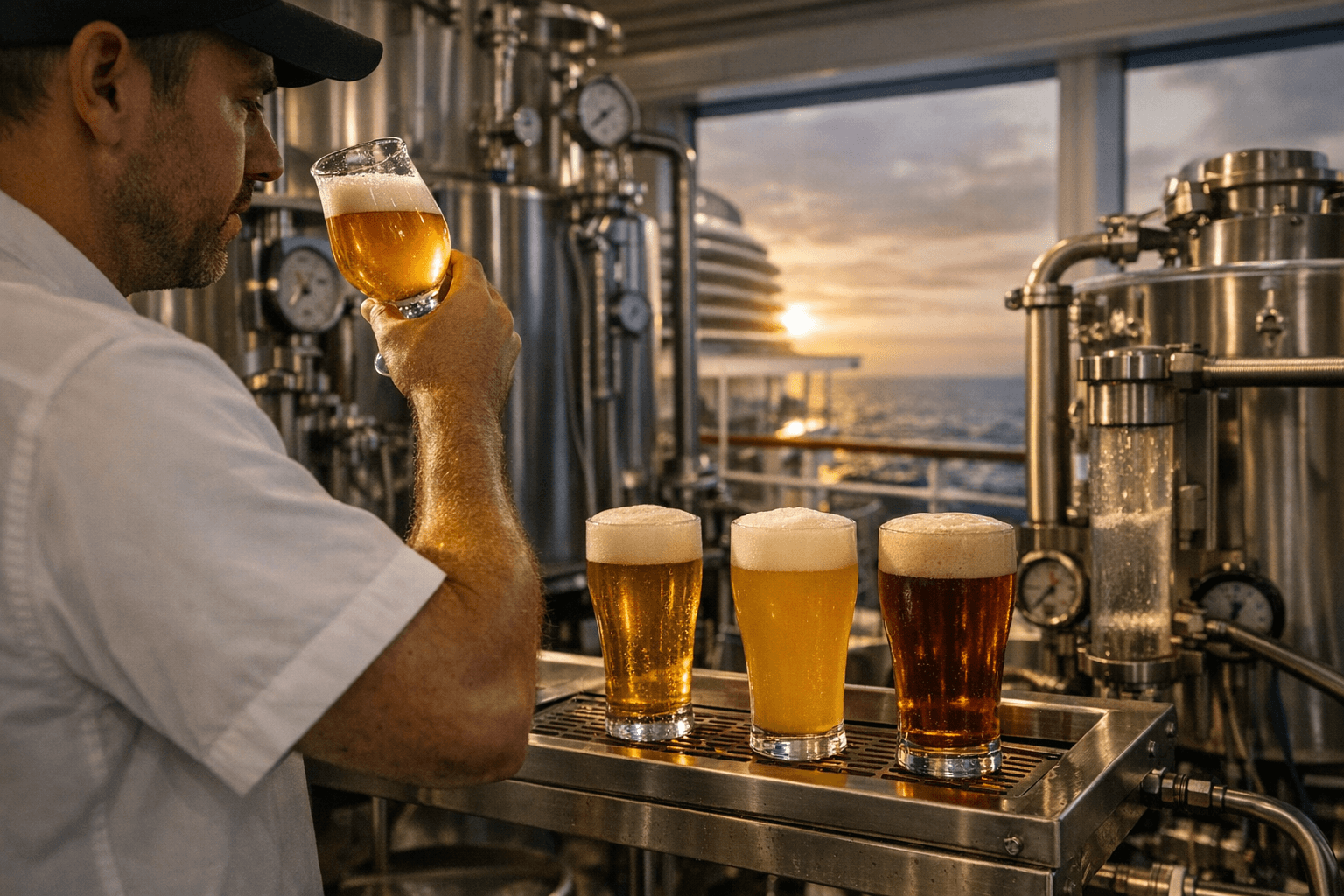
The microbrewery on deck eight of the MSC World Europa doesn't pipe in mineral water or haul freshwater tanks to port. It starts with the Atlantic itself. Bar manager Giulio Giannini explains the process: "Basically, we desalinate seawater through osmosis. The resulting water is pure H2O, nothing more. From there, the entire brewing process begins." Three beers come off that system every day while the ship is underway: Oceanic Pils, Oceanic Wheat, and Oceanic Bitter, ranging from 4% to 4.5% ABV, in what has been called a world first for the cruise sector.
For homebrewers, that phrase "pure H2O, nothing more" is the most important sentence in the story. Desalinated seawater via reverse osmosis is functionally indistinguishable from what you get out of a countertop RO filter or a grocery-store jug of distilled water: dissolved solids stripped to near zero, a blank mineral slate. Once every ion is gone, the water's origin, whether ocean, municipal tap, or mountain spring, becomes irrelevant. What defines the finished beer is what the brewer adds back.
Replicating that blank canvas at home anchors a useful three-way experiment. Start with RO or distilled water, then build a coastal profile: roughly 0.75 grams of non-iodized table salt per gallon pushes sodium to around 78 ppm and chloride to about 120 ppm, rounding out malt character without any perceptible saltiness. Pair that with calcium chloride to bring calcium to 50-75 ppm for yeast health, and hold sulfate below 75 ppm to keep bitterness soft.
Then brew the same base recipe two more ways. A Burton-on-Trent profile, built with gypsum additions targeting 300-350 ppm sulfate, sharpens bitterness and dries the finish sharply, the minerality behind classic English pale ales. A soft NEIPA profile, with chloride at 150 ppm and sulfate under 50 ppm, takes the same hops into entirely juicy, round territory. Same grain bill, same yeast, same hops. The water alone drives the difference. Tasting all three side by side makes the case for water chemistry faster than any written explainer.
The cruise ship story lands alongside a parallel development that raises a related structural question: what happens when a botanical becomes the architectural center of a recipe rather than an add-on? Austin-based Ceremony Botanical Brewing, founded by Jens Stoelken and developed with Hi Sign Brewing owner Mark Phillippe and master brewer Kevin Decoud, debuted April 4 with a Matcha Botanical Pilsner and a Hibiscus Botanical beer, positioning botanical brewing as "a new category of functional beer that starts with the botanical as the architect."
For brewers tempted by that approach, survivability through fermentation is the central variable. Hibiscus added at flameout retains its tartness cleanly. Matcha, treated like a dry hop addition in secondary, gives earthy character without bitterness overload. Lemon zest, outer peel only, stays bright at modest doses. Lavender and chamomile cross into soapy or pharmaceutical territory above 0.1 ounce per gallon and rarely recover from it.
Giannini noted that passengers initially assume the deck-eight setup is decorative. "At first, visitors think it's just for show. But we produce beer on board every day." The same oversight applies to water chemistry until you taste a Burton pale, a soft NEIPA, and a sodium-forward coastal bitter all brewed from the same recipe, in the same session, from the same zero-mineral starting point.
This article was produced by Prism’s automated news system from verified source data, official records, and press releases, then run through automated quality and moderation checks before publishing. The system is built and supervised by the people who set the standards it runs under. Read our full AI policy.
Did this article answer your question?