Cambridge Study Finds Golden Retrievers Share Genetic Roots for Behavior With Humans
Cambridge researchers found 12 genes golden retrievers share with humans for anxiety, intelligence, and depression — including ROMO1, which drives trainability and emotional sensitivity in both species.

University of Cambridge researchers analyzed the DNA of 1,300 golden retrievers and found that twelve of the genes shaping canine behavior also influence human traits like anxiety, depression, and intelligence, according to a study published in the Proceedings of the National Academy of Sciences. The finding marks the first time scientists have demonstrated that specific genes linked to dog behavior are also associated with those same emotional and cognitive traits in people.
"The findings are really striking," said Dr. Eleanor Raffan, the study's leader and a neuroscientist at Cambridge. "They provide strong evidence that humans and golden retrievers have shared genetic roots for their behavior."
The research team matched genetic data from each of the 1,300 dogs against behavioral profiles built from detailed owner questionnaires. That process identified gene variants tied to four core traits: trainability, energy levels, fear of unfamiliar people, and aggression toward other dogs. The team then ran a parallel genetic analysis on human data to see where the canine and human findings overlapped, and landed on those twelve shared genes.
The specific gene examples in the study are where things get interesting for anyone who has ever puzzled over why their golden acts the way it does. The gene ROMO1, associated with trainability in golden retrievers, is linked in humans to intelligence and emotional sensitivity. That connection prompted the researchers to argue that training is not purely a mechanical reward-and-response process: there is an emotional layer involved that owners need to account for. The gene PTPN1, linked to aggression toward other dogs in goldens, maps in humans to depression and intelligence. A third gene, ENOSF1 on chromosome 7, previously associated with energy level, also appeared in connection with fear and anxiety.
That last cluster of associations carries particular weight for owners of high-energy or reactive goldens. The PNAS paper states directly that dogs carrying certain risk alleles may have "a genetically driven tendency to emotional states that make them vulnerable to developing these undesirable behaviors," and flags clinical implications for how those dogs are managed.
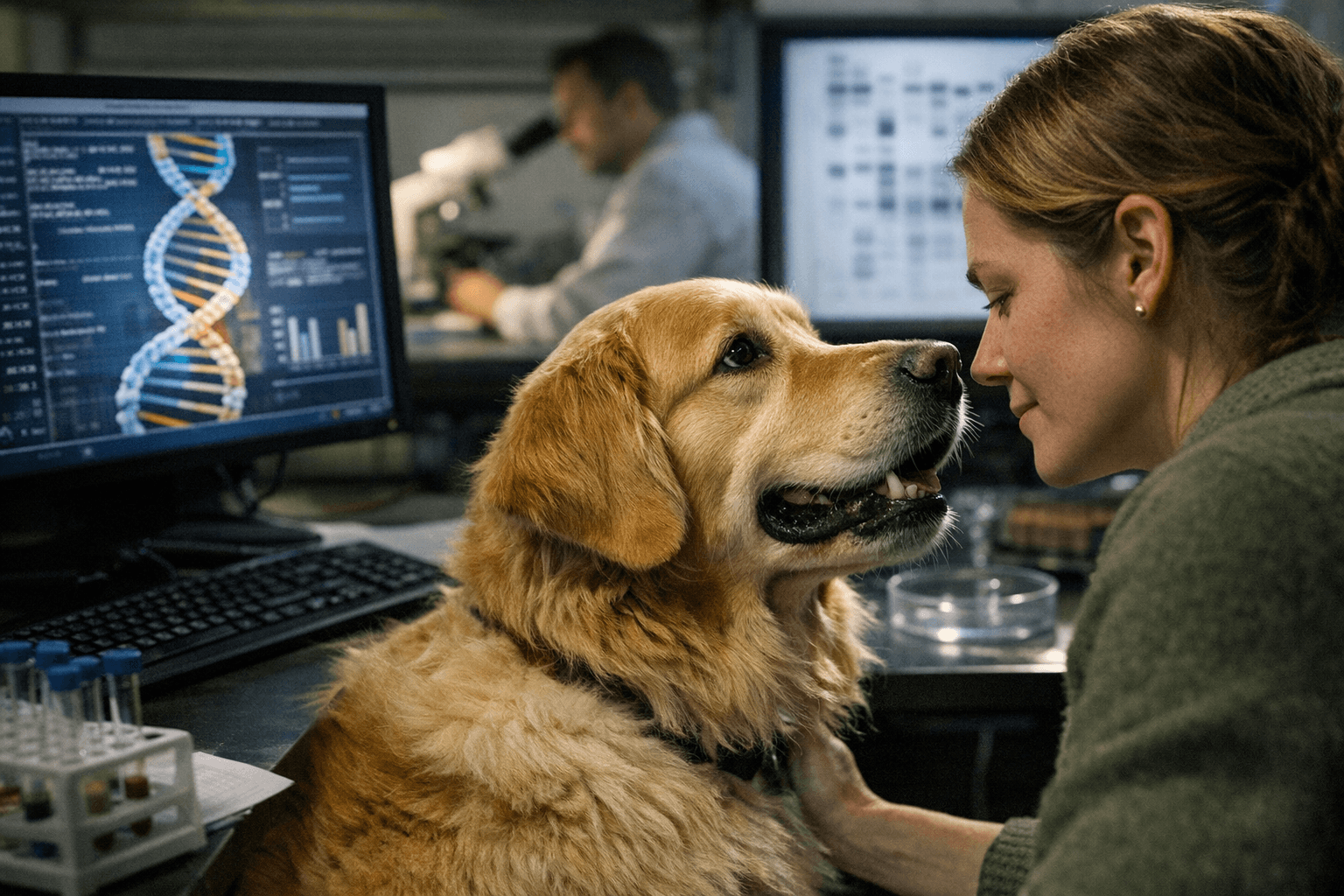
Study coauthor and neuroscientist Enoch Alex put it plainly: "These results show that genetics govern behavior, making some dogs predisposed to finding the world stressful. If their life experiences compound this, they might act in ways we interpret as bad behavior when really they're distressed."
The researchers noted that the findings could support pharmacologic intervention: because fearfulness in a golden retriever may be driven by a gene tied to human anxiety, anxiety-reducing medication could be a legitimate management tool, not just a last resort. The PNAS paper frames this as a hypothesis, not a concluded therapy, but the direction is clear.
For golden owners already deep in training, desensitization work, or trying to figure out why their otherwise social dog shuts down around strangers, this study adds a hard genetic framework to what many have suspected through experience: some of this behavior is baked in, and the dog is not simply being difficult.
Know something we missed? Have a correction or additional information?
Submit a Tip