Fort Knox K-9 teams train for bomb, drug detection and vet care
Diesel the mock dog took the worst of it at Fort Knox as police K-9 teams drilled bomb, drug and field care skills with Army handlers.
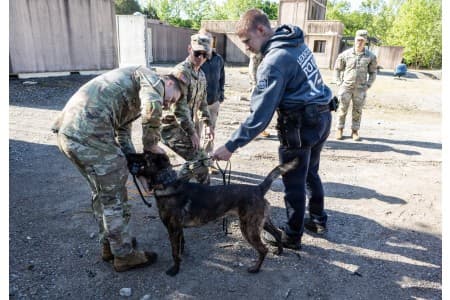
Diesel took simulated wounds at Fort Knox while handlers from Lexington, Scott County and Jessamine County worked through bomb detection, drug detection and canine first aid in the kind of drill that matters when a dog goes down on a real call.
The April 30 joint training exercise at Fort Knox brought together the U.S. Army’s 905th Military Working Dog Detachment with local law enforcement K-9 teams from the Lexington Police Department and the Scott County and Jessamine County sheriff’s departments. The session was built around practical work, not classroom theory. Dogs worked in a different location, and handlers got reps on the same kinds of detection and emergency tasks they would face on patrol, at a search site or during a high-risk response.
The veterinary piece made the day stand out. Officers learned common triage tactics, then had to identify and care for simulated injuries on Diesel, the Army’s advanced canine medical training tool. Diesel can mimic breathing patterns, broken limbs, amputations and other trauma, which gives handlers a chance to practice under pressure before a real emergency. Charles Sexton of the Lexington Police Department said the class made his unit far more capable of providing first aid if a canine partner is injured, and that is the point of the whole exercise: a K-9 that can find contraband or clear a room is only as useful as the people who can keep it in the fight.

Fort Knox is built for this kind of crossover. The 905th Military Working Dog Detachment was constituted in 2014 at Fort Knox, and Army material says its handlers have rotated through CENTCOM missions in Syria, Iraq, Afghanistan and Kuwait. The Fort Knox Directorate of Emergency Services Law Enforcement Division, established in May 2010, provides the policing backbone that makes joint training like this possible. It also is not the first time the post has opened its dog program to outside agencies. In August 2020, Fort Knox hosted an Advanced Bite Building seminar for multiple Kentucky law-enforcement K-9 units, and Sgt. 1st Class Richard McNulty called that kind of outside participation “shared learning.”
That broader training culture has shown up outside the kennel too. Fort Knox working dog teams were deployed on Feb. 22, 2024, to assist the Hardin County Sheriff’s Office during a bomb-threat response at the BlueOval SK battery park in Glendale. The April 30 drill followed the same logic as that real-world call: high-drive dogs need precision, environmental stability and handlers who can work as a unit when the pressure spikes. Diesel got the worst of the simulation so a real dog does not have to.
This article was produced by Prism’s automated news system from verified source data, official records, and press releases, then run through automated quality and moderation checks before publishing. The system is built and supervised by the people who set the standards it runs under. Read our full AI policy.
Did this article answer your question?