Rescued from years on a chain, Scooby celebrates freedom at 13
Scooby turned 13 with grass under his paws, not chain around his neck. His freedom now looks like sleeping on a sofa, sprinting in a field, and finally acting like a dog.
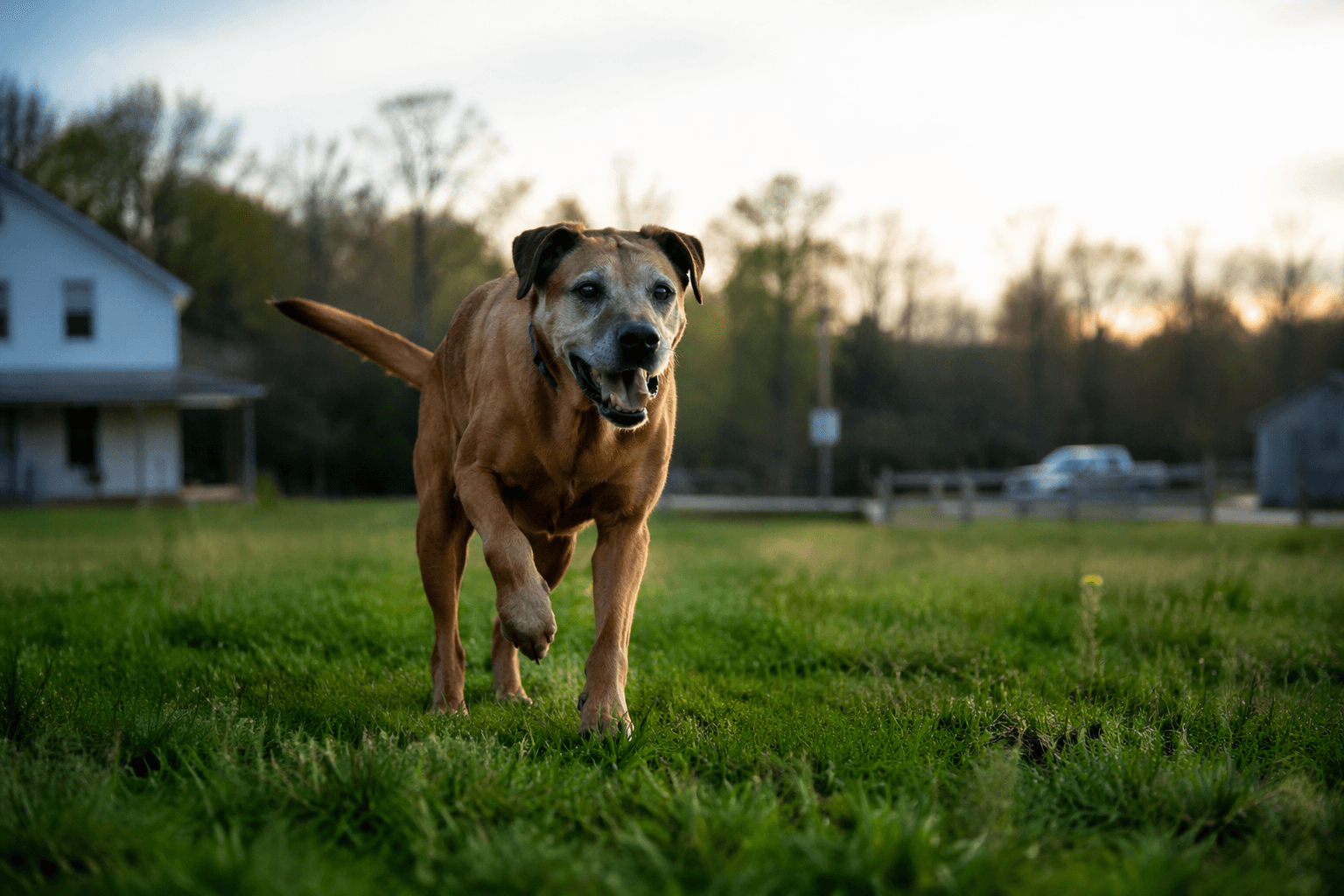
Scooby’s first birthday as a free dog was a small scene with a big meaning: open grass, a secure dog-friendly field, special treats, and a dog who knew exactly how to use his body again. At 13, he ran, played, and settled into the kind of easy movement that comes only after deprivation ends. The change is not just that he survived. It is that freedom has started to rewrite how he behaves.
What changed when the chain came off
Scooby spent virtually his entire life chained outside a terraced property in an urban area of northern Portugal. By the time he was finally freed, he was badly neglected, starved, covered in severe mange, and had also been beaten by drunken neighbours. That history matters because it explains why his birthday looked less like a novelty outing and more like a recovery milestone.
Once he could move, explore, and decompress, the dog that had known only confinement began to show normal preferences. He now chooses between the sofa, an armchair, and his own bed, and he has become affectionate enough to demand morning belly rubs. That is the kind of behavioral reset you expect when a hyper-alert, over-restricted dog finally gets safety, routine, and room to decide where his body wants to go.
The rescue that took persistence
Scooby did not walk straight from a chain into a new life. Rescuers Joana Faria and La Salete Gomes of Famalicão Sem Correntes spent nearly two years persuading his owners to surrender him, which shows how stubborn chronic tethering cases can be even when the cruelty is obvious. Eduardo Gonçalves helped coordinate the rescue, and Scooby eventually went home with Eduardo and his wife, Marisa, in Hampshire.
That long delay is part of the lesson. In tethering cases, the visible suffering is often only the starting point. The harder work is breaking through years of habit, denial, and neglect until the dog can actually be removed and rehabilitated.
Scooby’s emotional reunion earlier in the year brought that recovery into focus in a different way. When he returned to Portugal and saw the women who rescued him, he sprinted toward them with obvious delight. The speed of that greeting said as much as any clinical description could: once the chain was gone, his energy did not disappear, it finally had somewhere to go.
Why tethering keeps producing these cases
Scooby’s story lands inside a wider welfare problem in Portugal, where tethering remains a live issue rather than a closed chapter. A 2026 peer-reviewed study in Forensic Sciences examined veterinary professionals’ perceptions of dog tethering in Portugal and found the practice remains common. The study also looked at health, behavioral, welfare, and regulatory impacts, including attitudes toward criminalizing the practice.
Portugal-focused legal summaries add an important detail: chaining is not automatically illegal, but it can breach animal welfare rules if it restricts welfare or creates a threat. That distinction helps explain why campaigners treat tethering cases as both cruelty and enforcement failures. In practice, a chained dog can sit in a legal gray zone until the harm becomes impossible to ignore.
Older enforcement reporting in Portugal has also treated chained dogs as both a welfare contravention and a neighborhood nuisance issue. That combination matters because it shows how these dogs are often seen only when the problem spills beyond the property line. By then, the animal has already paid the cost.
Freedom is not a luxury in fire season
Scooby’s story carries extra force in Portugal because tethering becomes even more dangerous during heat, fire risk, and wildfire season. Civil-protection and fire-mapping systems in the country track active blazes and ongoing wildfire threats, which is exactly the kind of emergency a tethered dog cannot escape from.
That is why the image of a chained dog is not just an animal-welfare symbol. In a fast-moving fire, the chain becomes a trap. A dog that cannot run, hide, or follow people to safety is not merely deprived of comfort; it is denied survival options.
Unchained turns one dog into a campaign
Scooby is now the first ambassador for Unchained, the initiative Eduardo founded to end the practice of permanently chaining dogs and to push for companionship, proper care, and freedom. The campaign says it works with registered charitable groups to rescue chained dogs, change and enforce the law, and support rehabilitation and rehoming.
Unchained formally launched with an Unchained Freedom Walk on 4 April 2026, designed to raise funds and awareness for dogs tethered for life. The timing matters because Scooby’s progress now serves as proof of concept for what the campaign says is possible: rescue, rehabilitation, and a life built around movement instead of restraint.
Eduardo’s background gives that campaign added weight. His own bio identifies him as the founder of Pup Aid, a leader of the Lucy’s Law puppy-farming ban campaign, and a co-founder of APDAWG, the All-Party Parliamentary Dog Advisory Welfare Group. Scooby’s rescue is not an isolated act of sympathy. It sits inside a longer record of animal-welfare campaigning that has already helped change how the public talks about exploitation.
What Scooby’s recovery shows in real terms
Scooby’s first free birthday is a reminder that neglected dogs do not just need removing, they need time to rebuild the habits deprivation stripped away. The dog who once lived on a chain now makes choices, claims furniture, and runs across grass with the confidence of an animal that understands he can stop when he wants. That is what recovery looks like when the body is no longer braced for the next bad thing.
The chain kept him small, but freedom has given him back his range. At 13, Scooby is not only celebrating a birthday. He is showing exactly what a dog can become when the most basic need, the right to move, is finally restored.
This article was produced by Prism’s automated news system from verified source data, official records, and press releases, then run through automated quality and moderation checks before publishing. The system is built and supervised by the people who set the standards it runs under. Read our full AI policy.
Did this article answer your question?