Unstable Exercise Platforms Show Promise for Improving Dog Postural Control
Nine dogs standing on a FitPaws TRAX Peanut showed measurably more thoracolumbar and abdominal muscle activation than on stable ground, per a new VCOT study.

A new study published in Veterinary and Comparative Orthopaedics and Traumatology has delivered some of the clearest biomechanical evidence yet that the wobbly gear filling canine fitness studios actually does what practitioners have long believed: it forces dogs' spines and core muscles to work measurably harder.
The study evaluated the effects of three commonly used postural exercise platforms on the stability of the thoracolumbar and lumbosacral regions and the activity of key muscles, including the biceps femoris, epaxials, medial gluteal, rectus abdominis, and triceps, in dogs. Nine dogs were assessed while standing across two stable platforms, two K9FITbones, and a FitPaws TRAX Peanut.
To measure spinal stability and muscle activity, angular velocities in three anatomical planes and surface electromyography were recorded using Delsys Trigno Sensors. The design created a clear hierarchy of instability from stable ground to the K9FITbones and finally the Peanut, letting researchers track how each step up in wobble translated to changes in muscle recruitment.
The results were unambiguous. Significant incremental stability challenges were observed across all platforms, and thoracolumbar region activity increased in the sagittal, coronal, and transverse planes as platform stability decreased. Similarly, lumbosacral region angular velocity increased in the coronal and transverse planes, with the sagittal plane only increasing on the Peanut. In practical terms, the Peanut demanded the most from the spine in every direction.
The muscle data offered a more nuanced picture. Compared with the unstable stance, biceps femoris and medial gluteal activity was actually greater during stable stance and on the Peanut, while rectus abdominis activity was greater on the Peanut than during stable stance, suggesting increased abdominal muscle recruitment at that highest level of instability.
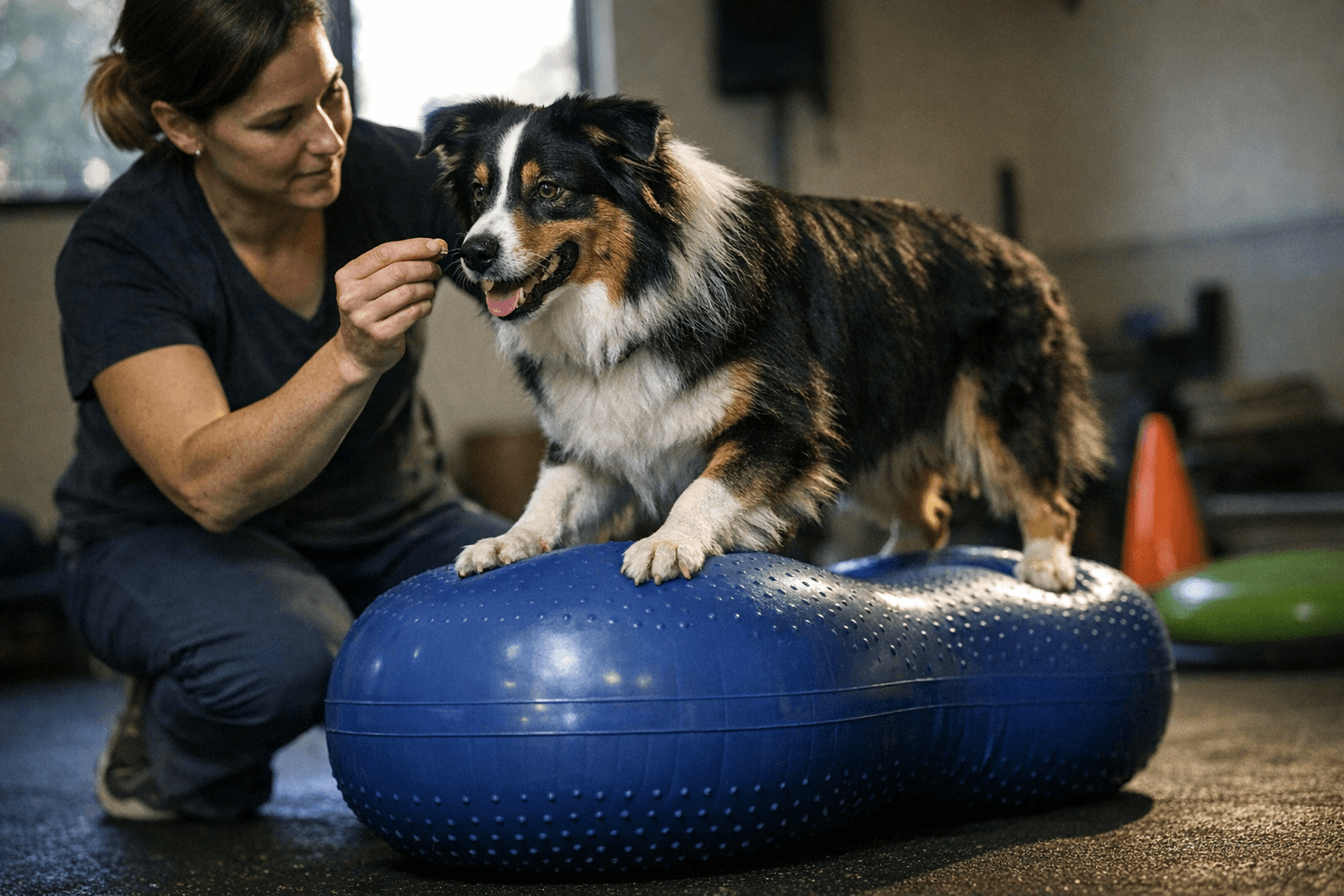
That last point matters for anyone using these platforms specifically for core conditioning. The Peanut appears to be the configuration that most reliably recruits the abdominal muscles, which is precisely the outcome canine rehabilitation practitioners are often chasing when they prescribe balance work for dogs recovering from spinal or orthopedic injuries.
The study's authors concluded that challenging standing postural control with unstable platforms provides substantial and incremental increases in spinal movement and offers insights into muscle activation within progressive rehabilitation exercises.
For the hyperenergetic dog community, the findings carry a practical implication that goes beyond rehab. Postural control and rehabilitation are emerging areas of study in veterinary medicine, and the effects of rehabilitation-based balance exercises on postural control in dogs remain understudied. This VCOT study narrows that gap considerably, giving conditioning coaches and owners a measurable framework for why a structured progression from stable platforms to the K9FITbone to the Peanut is a scientifically grounded sequence, not just conventional wisdom. Dogs with the drive and energy to handle high-intensity training now have peer-reviewed evidence backing the balance work that keeps their bodies sound enough to sustain it.
This article was produced by Prism’s automated news system from verified source data, official records, and press releases, then run through automated quality and moderation checks before publishing. The system is built and supervised by the people who set the standards it runs under. Read our full AI policy.
Did this article answer your question?