Cold Plunge Water Quality Guide: Filtration, Sanitation, and Maintenance Steps
Stagnant cold water isn't safe water: the bacteria, pH levels, and chiller cycles that separate a clean plunge from a health hazard.

Why Water Quality Is the Real Foundation of Cold Plunge Practice
Step into a commercial cold plunge and the temperature gets all the attention, but the invisible chemistry keeping that water safe does the heavier work. Whether you're running a boutique wellness studio with six units booked back-to-back or managing a single home tub that sees daily use, water quality is not a passive byproduct of cold temperatures. Cold water slows bacterial growth, but it does not stop it, and the combination of biofilm-forming organisms, body oils, dead skin cells, and inadequate disinfectant residuals can quietly turn a therapeutic vessel into a microbial risk. What follows is an operational guide covering filtration, sanitation chemistry, testing protocols, chiller maintenance, drain cycles, and regulatory readiness, built around technical guidance and environmental-health briefs on cold-plunge tank considerations.
Filtration and Circulation
The mechanical backbone of any safe cold plunge is a filtration system correctly sized for both the tub's volume and its expected occupancy load. Multi-stage filtration, typically combining a mechanical filter with an ozone generator or UV sterilization module, handles the physical and microbial removal that chemicals alone cannot accomplish. UV-C systems operating at 254nm damage microorganism DNA and prevent reproduction, while ozone systems oxidize contaminants and eliminate odors; each technology is most effective when water is continuously or regularly cycled through the treatment train rather than sitting between sessions. Running circulation for a minimum of four hours daily is a practical baseline for home units; commercial settings with high bather turnover benefit from systems that achieve a full water turnover every three to five minutes.
Key mechanical habits to build into weekly routines:
- Inspect and clear intake strainers every week to prevent flow restriction
- Record pump run times and flag any unexplained drops in run duration
- For 20-micron cartridge filters, plan replacement every three to four weeks under daily use, and rinse filters weekly between changes
- Keep spare filters, belts, and fittings on hand so a failed component doesn't mean shutting down the unit for days
Stagnant water neutralizes the benefit of any filtration investment. If a pump is offline for maintenance, treat that interval as a risk period and test water chemistry before the unit returns to use.
Sanitation: Why Cold Temperature Changes the Chemistry
Cold water fundamentally alters how disinfectants perform. Several compounds that work efficiently at 78°F lose measurable efficacy as water drops toward the 50°F to 55°F range common in most cold plunges. This makes a multi-modal sanitation approach the practical standard: pairing ozone or UV treatment with a low-level chemical residual provides overlapping layers of protection that neither technology delivers alone.
For target chemistry, maintain pH between 7.2 and 7.6 and total alkalinity between 80 and 120 ppm. Free chlorine residuals of 1 to 3 ppm or bromine residuals of 3 to 5 ppm are the accepted ranges for shared-use water. Ozone and UV systems sanitize effectively but leave no residual protection in the water between circulation cycles, which is why commercial settings serving multiple users per day should not rely on those technologies alone.
For home users running a single-occupant, well-filtered unit, the risk calculus is different and some operators choose to run without chemical additions. For any public or commercial venue, however, documented chemical residuals are not optional: they are the paper trail that protects users and operators alike. Ad hoc approaches that skip validation can allow opportunistic pathogens to persist even when water appears visually clear.
Testing Frequency and Log Management
Testing is how you confirm the sanitation system is actually working, not just running. For commercial operations, the minimum standard is daily testing of four parameters: pH, total alkalinity, sanitizer residual, and water temperature. Logs should be dated, signed, and kept in a format accessible to health authority inspectors without advance notice.
Weekly microbiological testing, including heterotrophic plate counts and targeted pathogen screens for high-occupancy venues, is the recommendation from several environmental-health briefs on public-use cold-plunge installations. These tests take time to return results, so they function as a lagging indicator: consistent chemistry and filtration logs are your real-time signal, and micro testing confirms the system is performing as intended over time.
A practical log structure for commercial settings covers:
- Daily: pH, total alkalinity, free sanitizer residual, water temperature
- Weekly: filter inspection notes, pump run-time totals, strainer condition, microbiological sample submission
- Monthly: chiller service check, heat-exchanger fin inspection, full system review against manufacturer specifications
Home users testing every one to two weeks, or whenever they change water, can operate with a lighter schedule, but keeping even a simple notebook record makes diagnosing problems far faster.
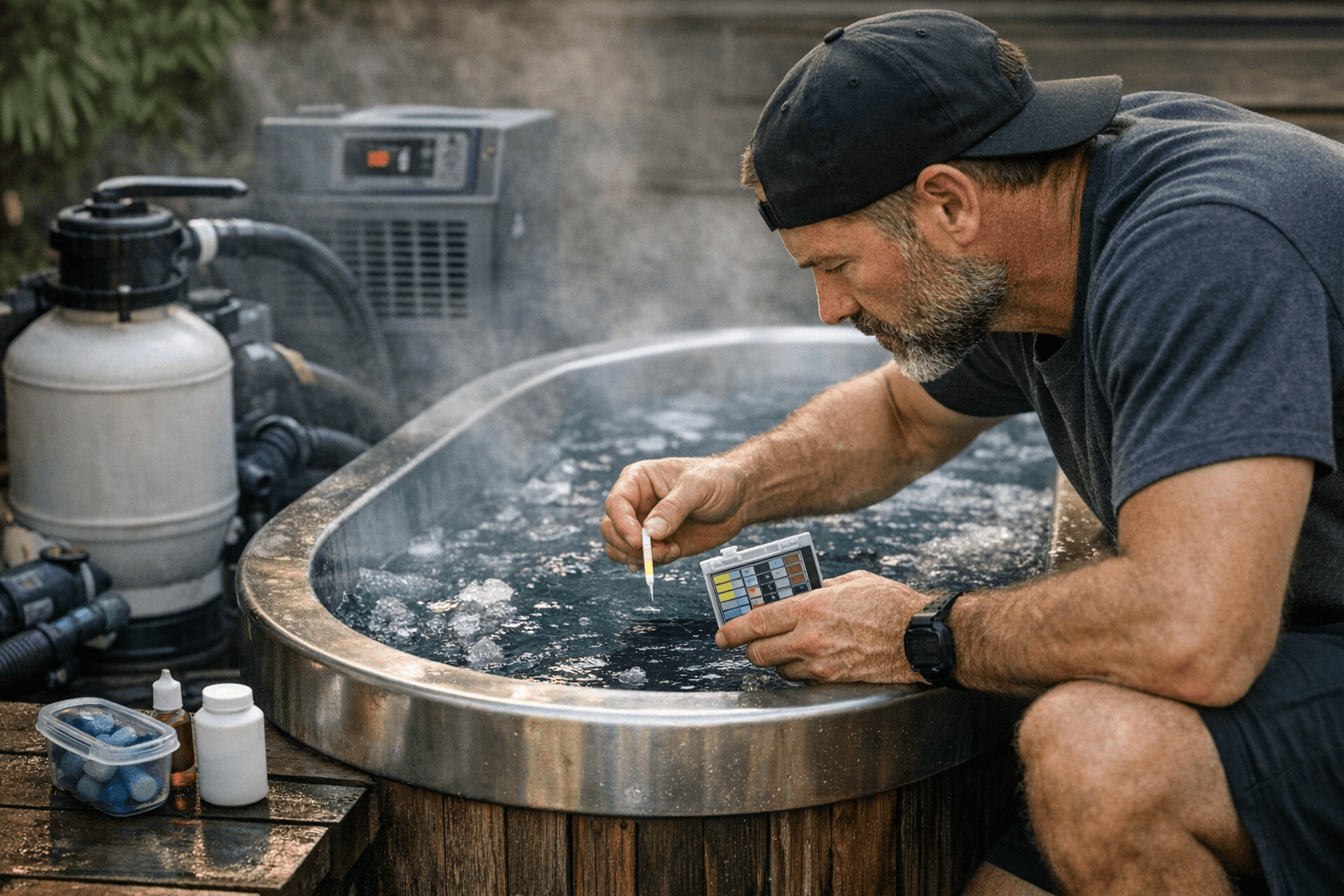
Chiller Maintenance and Condensation Control
The chiller is the most mechanically complex component in a cold plunge system and the one most likely to cause downtime if neglected. Chillers should be rated for the ambient conditions where they operate, since a unit specified for a cool indoor spa room will struggle and wear faster if relocated to a hot outdoor deck in summer. Service intervals set by the manufacturer are not suggestions; they are the intervals at which the system is designed to run reliably, and skipping them typically accelerates wear on compressors and heat-exchanger components.
Monthly inspection of heat-exchanger fins catches early fouling before it compounds into efficiency loss. Insulated tub walls and anti-condensation surface finishes reduce two overlooked problems: water loss from temperature differential and surface corrosion that can eventually compromise structural integrity. Recording chiller load cycles over time also creates a baseline: a system that suddenly logs significantly more cycles to reach the same target temperature is usually signaling a refrigerant issue, airflow blockage, or fouled exchanger that needs attention before it becomes a failure.
Drain, Refill, and Cleaning Protocols
Even the best filtration and sanitation system has a ceiling beyond which the accumulated total dissolved solids, bather load byproducts, and chemical residuals in the water require a fresh start. For high-occupancy commercial units, partial or full water changes on a weekly or biweekly cycle are the recommended cadence depending on usage volume and local code. Mixed-use public venues with multiple users throughout the day are safest with documented cleaning procedures between users and more frequent full changes.
Single-user home units with robust filtration can extend water-change intervals substantially, but a documented sanitation program remains essential regardless. When draining, always:
1. Shut down the chiller and allow the system to complete its cycle before draining to prevent compressor damage
2. Drain fully and clean interior surfaces with a diluted, manufacturer-approved sanitizer
3. Allow adequate contact time before rinsing thoroughly
4. Refill and run the filtration system through a complete cycle before the unit returns to use
5. Test all chemistry parameters and confirm they are within range before the first post-refill session
Local codes govern minimum change frequencies for public venues; when in doubt, consult your environmental-health authority directly rather than extrapolating from pool or hot tub standards, which are calibrated for different temperature ranges and occupancy patterns.
Emergency Signage and Exposure Protocols
Water quality management protects users from microbial risk, but physical cold-exposure risk requires its own operational layer. Post clear, permanent signage at every cold plunge unit that includes maximum recommended immersion times, contraindications (cardiac conditions, pregnancy, uncontrolled asthma), and instructions specifying who to alert and what steps to take if a user shows signs of cold shock, loss of coordination, or cardiac symptoms.
Commercial venues should maintain either a trained attendant present during operating hours or a written emergency-response plan that accounts for the venue's size and the profile of its clientele. A boutique studio serving mostly healthy adults has different planning requirements than a hotel spa where elderly guests or those with undisclosed conditions may use the unit independently.
Regulatory Readiness and Inspection Preparation
Public venues operating cold plunges should align maintenance practices with the Model Aquatic Health Code (MAHC) guidance issued by the CDC, or with the applicable local pool and spa codes in jurisdictions that have adopted their own standards. The MAHC provides a technical reference for sanitizer residuals, filtration turnover rates, and bather-load calculations that translates well to cold-plunge contexts even where specific cold-plunge language is absent from local code.
Inspection readiness means having documentation immediately available: sanitizer logs, pH test records, microbiological results, chiller service records, and drain-and-refill dates, organized chronologically and legible. For new installations, the highest-value investment of time is a pre-construction conversation with local environmental-health officials. Discovering a code requirement after concrete is poured or plumbing is fixed is among the most expensive problems in aquatic facility development, and regulators generally prefer early engagement to after-the-fact compliance negotiations.
The standard for well-run cold plunge operations is not perfection on any single test result. It is consistency: documented, repeatable procedures that demonstrate a system managed by people who understand what the water needs and check whether it's getting it.
This article was produced by Prism’s automated news system from verified source data, official records, and press releases, then run through automated quality and moderation checks before publishing. The system is built and supervised by the people who set the standards it runs under. Read our full AI policy.
Did this article answer your question?