Cold Plunging Becomes a Standard Recovery Tool Across NFL Teams
NFL teams are making cold plunging a permanent fixture in their training facilities, not just a post-practice afterthought, as player buy-in and facility investment converge.
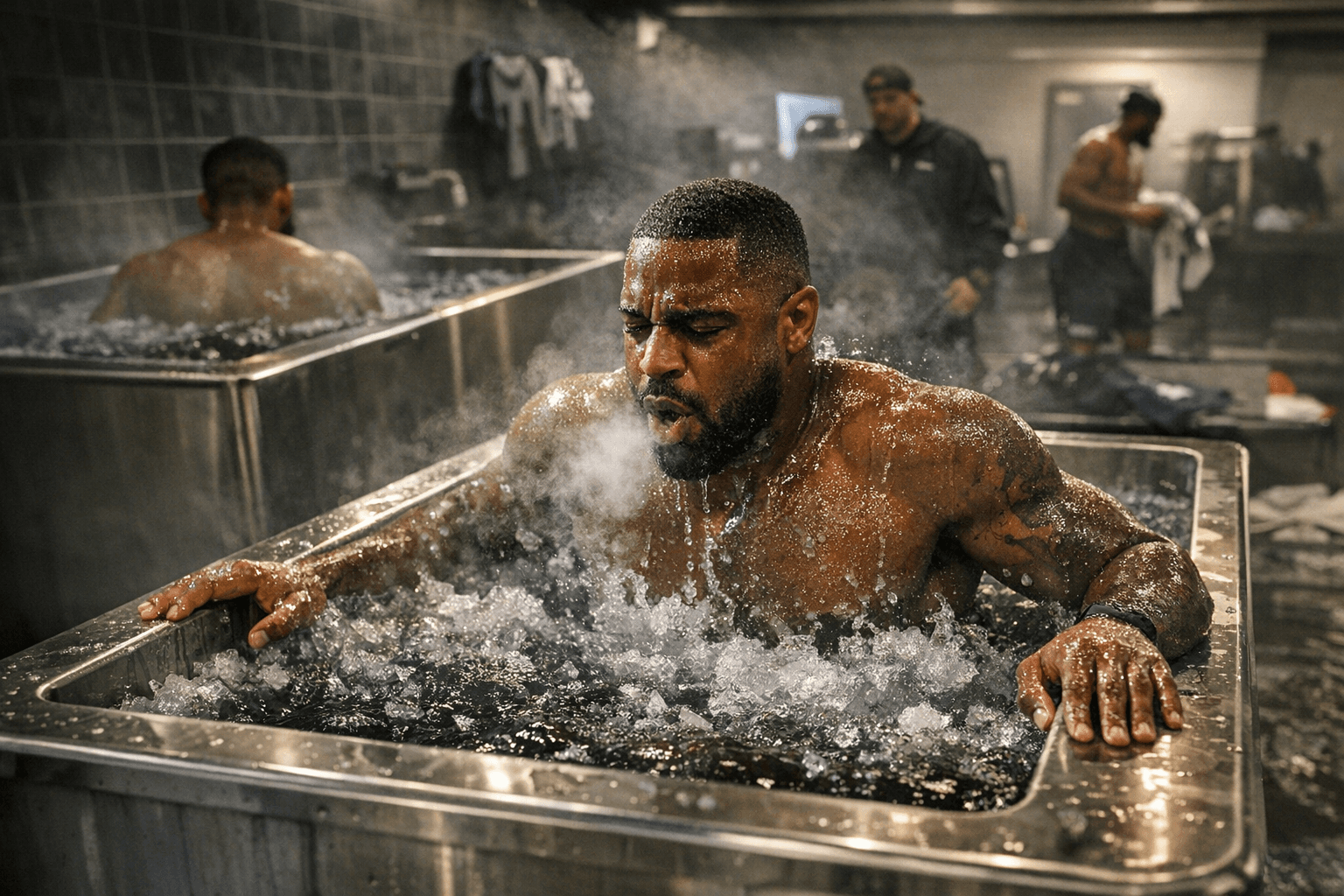
Walk through any NFL training facility on a practice day and you'll likely spot the same scene: a line of players, pads stripped off and still sweating, waiting to drop into a cold plunge tub. What was once a niche ritual for the most recovery-obsessed athletes in the locker room has crossed over into something entirely different. Professional football players now routinely use cold tubs after games and practices to combat inflammation from repeated impact, and many teams have built dedicated cold plunge areas into their training facilities, making post-game immersion part of the standard cooldown.
The shift didn't happen overnight, but the momentum behind it has become undeniable.
From Bucket of Ice to Built-In Infrastructure
The origins of cold-water immersion in NFL locker rooms were decidedly low-tech. Even with advances in technology, teams long relied on the cold tub, the ice bath, cold-water immersion, and cold therapy as foundational recovery tools, and players could agree on at least one thing: the experience can take your breath away. Early setups were as simple as dumping bags of ice into portable tubs. Seven bags of ice would be loaded into a tub aiming for a target temperature around 40 degrees.
Today, the infrastructure has caught up with the commitment. New NFL training facilities are being designed with a significant expansion of "hydro" capabilities, explicitly including hot tubs, cold plunge tubs, a pool, and underwater treadmills. The New England Patriots' new training facility, targeting a Spring 2026 completion, is a direct reflection of this new standard. The new facility will include expanded training room facilities with hot tubs, cold plunge tubs, and a pool, along with an enlarged open-space locker room connected to an expanded weight room. Notably, the project was prompted in part by players grading their existing facilities poorly in NFLPA surveys, which signals how central recovery infrastructure has become to player expectations.
The San Francisco 49ers took a similar path, identifying a need for ice baths with a compact footprint that could still fit massive NFL players' bodies, ultimately commissioning custom-built XL units for their locker room. Several players on the 49ers, including Nick Bosa, Fred Warner, Mitch Wishnowski, and Christian McCaffrey, had already purchased ice baths for their own homes, and even General Manager John Lynch bought a unit for his backyard. When the people running the organization are buying the same recovery equipment as the players, the cultural signal is hard to miss.
What Training Staffs Are Actually Selling
The cold plunge's rise in NFL facilities isn't just about players choosing to hop in. Training staffs have built deliberate rationale around it, anchoring the practice in specific physiological outcomes they can communicate directly to players.
Cleveland Browns star Myles Garrett put it plainly: "It helps with cramps, helps with muscle swelling and tightness. So I might as well use what they give me." That pragmatic buy-in from a player of Garrett's caliber carries weight throughout a locker room. Joe Sheehan, the Browns' Vice President of Player Health and Development, framed the physiology in terms players can feel: "By creating that pumping mechanism, you're creating circulation throughout the body. You're flushing bad toxins out. You're bringing new blood back in."
The cold causes constriction of blood vessels, which has been suggested as a mechanism for flushing waste products like lactic acid from affected tissue. Cold temperatures also reduce the metabolism and slow physiological processes, which in turn reduces swelling and tissue breakdown. On the neurochemical side, cold exposure triggers the release of dopamine, norepinephrine, and endorphins, which not only elevate mood and reduce mental fatigue but may also enhance focus and resilience over time. That last point matters in a sport where focus lapses cost games.
The Denver Broncos' athletic training staff has consistently seen the benefits of regular icing after injury and throughout the healing process, and cryotherapy continues to be an important element of the recovery methods the Broncos use on a daily basis.
Contrast Therapy: The Cold Plunge's Partner
Many NFL teams aren't using cold immersion in isolation. The more sophisticated protocol pairs it with heat in a deliberate sequence. The contrast bath alternates hot and cold: hot water dilates muscles and increases blood flow while cold constricts blood vessels, creating what trainers describe as a synthetic pump of blood. The Browns, for example, use contrast baths in addition to cold tubs, though contrast baths operate inside the facility while the cold tubs are visible out under the stands on the practice field.
The standard practice ratio for contrast therapy is normally 3:1 or 4:1 warm to cold, with hot baths ranging from 37 to 43°C alternating with cold baths at 12 to 15°C, with sessions usually lasting 20 to 30 minutes repeated twice daily. This level of specificity reflects how far NFL training staffs have moved from the "dump some ice in a tub" era into something resembling a clinical protocol.
Players Taking It Home
One of the clearest indicators that cold plunging has moved from team mandate to personal conviction is how many NFL players have brought it into their own homes. Washington Commanders wide receiver Jahan Dotson heads into the team's training center the morning after a game for cold therapy, either in an ice bath or for a few minutes in a cryotherapy chamber, to reduce inflammation. While some players rely on the team's facilities, others spend on their own: Commanders wide receiver Terry McLaurin recently got an in-home sauna, and others have purchased their own cold tubs and compression boots.
As Dillon Balkin, a chiropractor who works with multiple NFL players, described the mindset: "They're looking for whatever they can do naturally to get a competitive edge. Whoever can train and then recover the quickest is going to be the best on game day and is going to have the best longevity."
NFL star CeeDee Lamb, among the highest-paid non-quarterbacks in the league, has publicly committed to cold plunging for its recovery benefits. When players at the pinnacle of the salary structure are vocal advocates, rookies and younger players take notice fast.
The Protocol Behind the Plunge
What distinguishes NFL-level cold plunge use from casual wellness culture is precision. Many athletes opt for a 10 to 12 minute cold plunge right after a high-intensity session to prevent excessive muscle inflammation and burnout, which can help reduce microtrauma in muscle fibers and limit soreness the next day.
Cold-water immersion is a powerful tool when used for the right reasons, at the right times, and with the right dose. Sports rehabilitation specialists have seen ice baths shorten turnarounds during congested schedules and ease the worst post-competition soreness, but have also seen them blunt training adaptations when applied indiscriminately after lifting blocks meant to build size and strength. NFL training staffs have become attuned to this nuance: in team settings, a light cooldown, breathing drills, and nutrition are often paired with an optional plunge when the schedule is dense, while on lifting days targeting growth, the plunge is moved to off-days or skipped entirely.
A review of recovery strategies found that "cold water immersion is effective during acute periods of match congestion in order to regain performance levels faster and repress the acute inflammatory process." In a league where teams can play three games in less than two weeks, that distinction between congested and non-congested scheduling has real consequences for how training staffs deploy the tub.
The cold plunge's journey from a bucket of ice at the edge of a practice field to a line item in NFL facility construction budgets tells you something important: recovery is no longer the afterthought it once was. The teams building dedicated hydrotherapy suites and the stars buying units for their own homes are operating on the same logic. In a league where the difference between available and injured decides championships, the coldest room in the building has become one of the most important.
This article was produced by Prism’s automated news system from verified source data, official records, and press releases, then run through automated quality and moderation checks before publishing. The system is built and supervised by the people who set the standards it runs under. Read our full AI policy.
Did this article answer your question?