Sauna, Cold Plunge, and Red Light Therapy Stack Promises Full Recovery Protocol
Three tools, one sequence: red light first, then sauna, then cold plunge forms a recovery stack that Peak Primal Wellness calls near-clinical in its reach.

Step into any serious recovery setup right now and you're increasingly likely to find three pieces of equipment sitting side by side: a red light panel, a sauna, and a cold plunge tub. The question that's been circulating in biohacking circles isn't whether each tool works in isolation, it's whether stacking all three in a specific order unlocks something fundamentally different. According to Peak Primal Wellness, the answer is yes, and the protocol they've mapped out makes a compelling case for why sequence matters as much as the tools themselves.
Why Ice Baths Alone Aren't the Full Picture
If you've been relying exclusively on cold plunges for recovery, you're capturing only part of what's physiologically available. Cold water immersion is genuinely effective for reducing acute inflammation, and biohacking writer Timothy Munene lists its benefits as reduced inflammation, increased focus, fat loss, and faster muscle recovery. But Peak Primal Wellness is direct about the ceiling that cold-only approaches hit: "Ice baths alone are effective for reducing acute inflammation, but without the heat component, you miss out on the growth hormone surge, heat shock protein production, and cardiovascular conditioning benefits that the hot phase provides."
That's not a knock on cold plunging. It's an argument for contrast therapy, the deliberate alternation between hot and cold environments that triggers a physiological response neither modality produces alone. The rapid temperature shifts cause blood vessels to dilate and constrict in sequence, which Peak Primal Wellness describes as "dramatically improving circulation, lymphatic drainage, and nervous system adaptability." Munene's framework puts it more simply: alternating cold and heat trains the vascular system, reduces muscle soreness, and improves cardiovascular resilience.
What makes contrast therapy structurally different from passive recovery methods is scope. "Contrast therapy is unique because it simultaneously addresses vascular, hormonal, and nervous system recovery pathways in a way that passive methods like massage or compression cannot replicate on their own." That's a broad claim, but it maps onto what each phase of the protocol is actually doing to the body.
Where Red Light Therapy Fits In
The addition of red light therapy to a heat-and-cold protocol is where this stack moves beyond contrast therapy into something more comprehensive. RLT's mechanism is photobiomodulation, a process by which specific wavelengths of light penetrate tissue and interact with mitochondria at a cellular level. According to Peak Primal Wellness, "adding red light therapy to the equation introduces a cellular energy dimension that no purely mechanical recovery tool can match, making the full stack one of the most comprehensive recovery protocols available outside of a clinical setting."
Munene's piece on biohacking notes that sauna red light therapy solutions have become increasingly popular for enhancing skin health, collagen synthesis, and blood flow, producing clearer and more radiant skin as a byproduct. Athletes specifically are drawn to RLT for faster muscle recovery and joint pain reduction. Layered with both heat and cold exposure, the cumulative benefits extend to cognitive function as well, with Munene identifying sharper cognitive function, improved sleep quality, and better mood regulation as downstream effects of the full three-way combination.
The Sequence: Why Order Is the Protocol
This is where Peak Primal Wellness's guide gets specific in a way that most general wellness content doesn't. The recommended order isn't arbitrary; it's built around how each modality primes the body for the next phase.
1. Red Light Therapy (5-15 minutes): Start here, before any temperature stress.
The logic is mitochondrial receptivity: before heat or cold has altered your core physiology, your cells are at baseline and maximally responsive to photobiomodulation. Peak Primal Wellness frames this as warming up the cellular engine before loading it with stress. RLT at this stage pre-loads ATP production and reduces baseline inflammation, giving your cells a head start on the demands the next two phases will place on them.
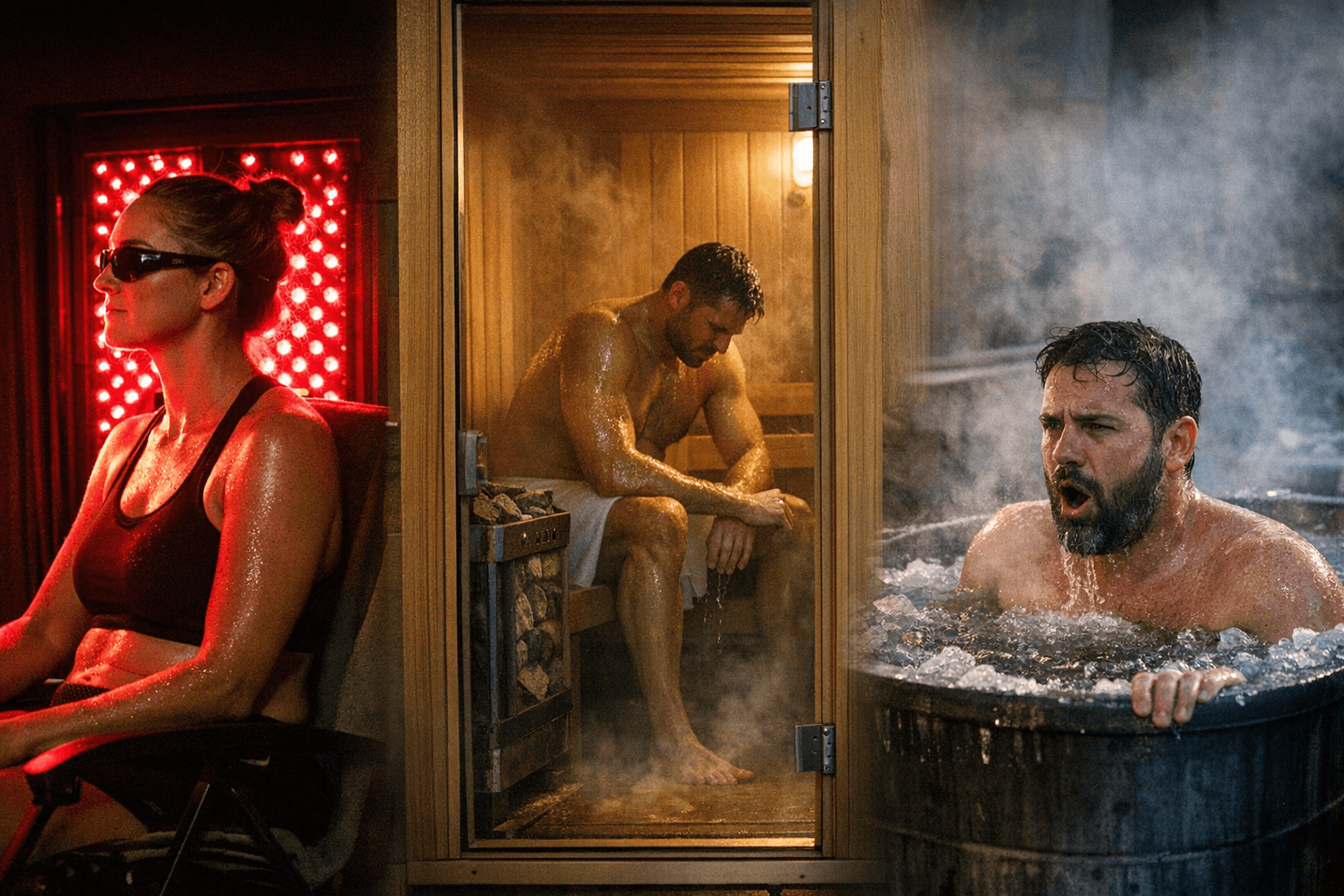
2. Sauna (15-25 minutes): With cellular energy systems primed by the red light session, the body is better positioned to manage heat stress and produce heat shock proteins efficiently.
The cardiovascular system gets a full workout, growth hormone rises, and the body is, in Peak Primal Wellness's words, "thoroughly prepped for the cold shock to follow." Infrared saunas are explicitly part of the equipment conversation here, with Munene noting that home infrared saunas deliver heat-induced detoxification and muscle repair through hyperthermic conditioning and enhanced circulation.
3. Cold Plunge: The cold plunge closes the loop on the contrast cycle, capitalizing on the vasodilation created by the sauna phase and triggering the vasoconstriction that drives lymphatic drainage and the acute anti-inflammatory response.
One notable gap in the current protocol documentation: neither Peak Primal Wellness nor Munene's piece provides an explicit duration recommendation for the cold plunge phase. The research notes that question was raised directly in the Peak Primal Wellness FAQ but the numeric answer wasn't included in the available material. Community consensus on cold plunge durations varies widely, typically ranging from one to five minutes depending on water temperature and individual tolerance.
The Combined Stack: What You're Actually Building
When the three modalities run in sequence, the cumulative effect is what Peak Primal Wellness describes as "significantly more effective than any single tool used in isolation." The combined protocol is explicitly positioned as addressing recovery across multiple biological systems simultaneously: vascular (circulation and lymphatic drainage), hormonal (growth hormone, heat shock proteins), cellular (ATP production via photobiomodulation), and neurological (nervous system adaptability).
Munene's key takeaways synthesize the full-stack benefits concisely: strategic use of light, cold, and heat amplifies sleep quality, mood regulation, energy, and overall results for athletes and wellness enthusiasts. That's a broader claim than pure athletic recovery, and it's part of why this protocol is catching traction beyond the performance crowd and into general wellness and biohacking communities.
Building the Stack at Home
The equipment footprint for this protocol is three distinct categories: a red light therapy panel or device capable of full-body exposure, a sauna (infrared or traditional, indoor or outdoor), and a cold plunge or ice bath. All three categories are increasingly available as home setups. The tip from Munene's piece is practical: accelerate tissue repair and post-workout regeneration by pairing a sauna red light therapy kit alongside heat or cold exposure rather than treating them as separate sessions.
One thing worth noting: the sources behind this protocol are consumer-facing and product-forward. Peak Primal Wellness describes its guide as aimed at "wellness-minded consumers and home users," and the content carries that orientation. Independent clinical citations for the specific magnitude of claims, the growth hormone surge figures, the precise ATP loading effects of RLT, and optimal cold plunge durations are not included in the available material and would be worth seeking from sports medicine or photobiomodulation research before treating the protocol as clinically validated guidance.
What is clear is that the sequencing logic holds up mechanistically, and the cold plunge community has been running variations of contrast therapy long enough that the heat-cold cycle is well-established territory. Adding red light as the opening phase is the newer element, and it's the part of this stack that's generating the most conversation right now.
This article was produced by Prism’s automated news system from verified source data, official records, and press releases, then run through automated quality and moderation checks before publishing. The system is built and supervised by the people who set the standards it runs under. Read our full AI policy.
Did this article answer your question?