Kombucha cellulose becomes stronger, recyclable non-woven material
A UMass Amherst preprint showed kombucha cellulose could be tuned into stronger non-wovens, then enzymatically broken down and remade into fresh nanofibers.

Kombucha’s pellicle just moved from brewing nuisance to materials platform. A June 12, 2026 preprint from the University of Massachusetts Amherst showed that kombucha-derived cellulose can be grown into thicker, more uniform non-woven mats, then recycled and remade into new nanofibrous textiles after enzymatic breakdown and electrospinning.
The work came from Luying Louise He, Julia Lopez, and Jessica D. Schiffman, whose lab at UMass Amherst focuses on green chemistry, renewable polymers, and microbial interactions with materials. In the preprint posted to bioRxiv, the team tested how fermentation settings changed the sheet that forms on top of kombucha: inoculum density, carbon-source loading, temperature, and pH all mattered. The best results came under mildly acidic conditions with a moderate inoculum and carbon loading at 30 C, where the culture produced thick, uniform non-wovens instead of a sloppy, uneven film.
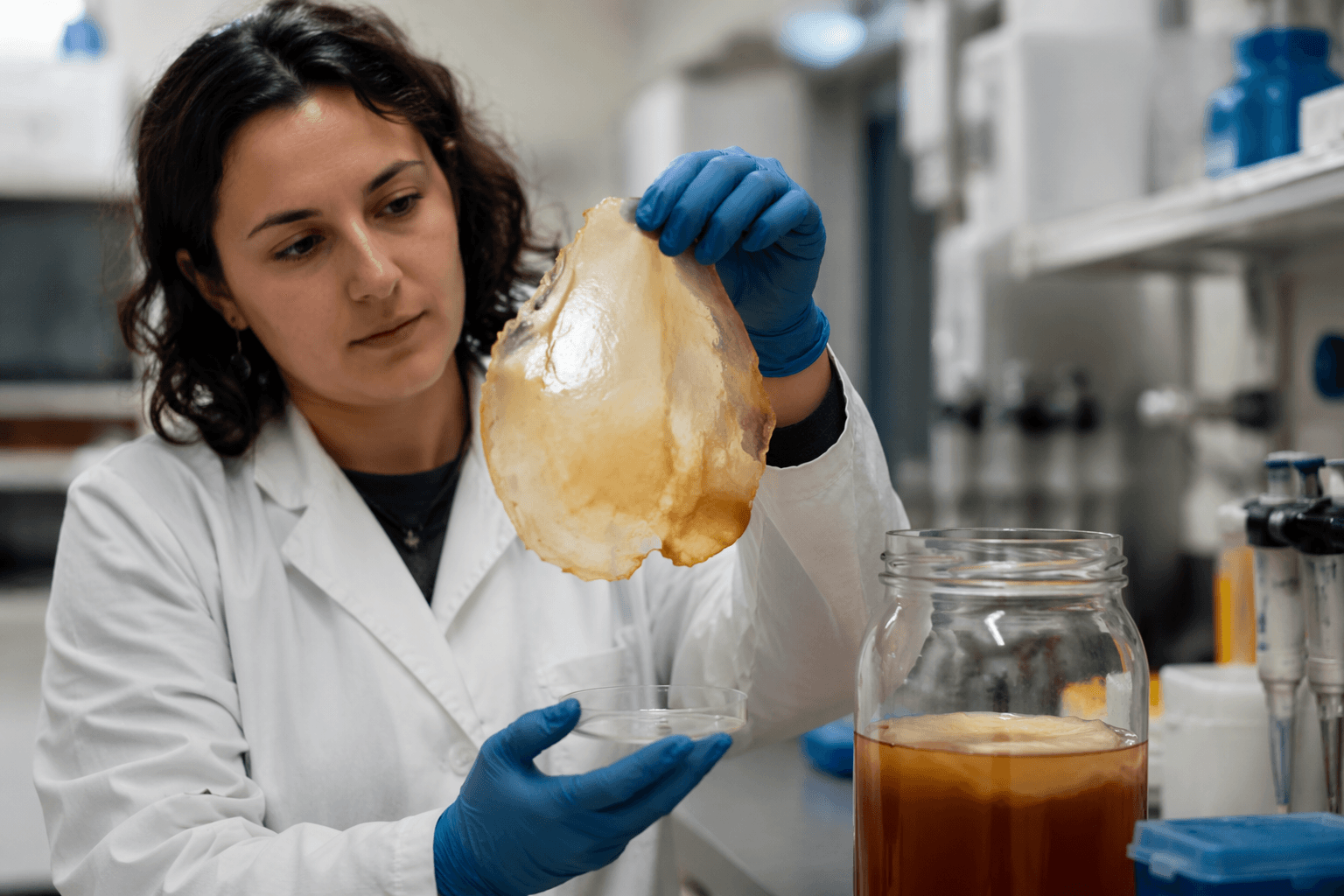
That tuning matters because the post-processing made an even bigger difference. The authors compared the as-produced wet material with oven-dried sheets and lyophilized sheets, and the freeze-dried version came out on top. According to the abstract, lyophilized non-wovens reached an ultimate tensile strength of 15 MPa and an elongation at break of 25 percent. The oven-dried version measured 2.5 MPa and 6.0 percent, while the wet material came in at 1.7 MPa and 9.4 percent. In plain brewer terms, the way you handle the cellulose after it leaves the ferment changed whether it behaved like a promising material or a fragile curio.
The recycling step is what gives the paper its real bite. Instead of treating spent cellulose as a dead end, the team enzymatically degraded used non-wovens and rebuilt them into fresh nanofibrous textiles by electrospinning. That circular pathway fits a larger body of kombucha and bacterial-cellulose research that already treats SCOBY pellicles as useful coproducts, not trash. Recent reviews have pointed to packaging, food-contact films, and textile applications, and they highlight bacterial cellulose’s purity, mechanical strength, biodegradability, and structural tunability.
For kombucha brewers, the takeaway is not that a home jar is about to become a textile mill. It is that the SCOBY you already grow is making a cellulose structure with real engineering potential, and the exact ferment conditions shape what that structure can become. That is a much bigger story than another fizzy batch.
This article was produced by Prism’s automated news system from verified source data, official records, and press releases, then run through automated quality and moderation checks before publishing. The system is built and supervised by the people who set the standards it runs under. Read our full AI policy.
Did this article answer your question?