Kombucha joins India’s summer drink revival with local flavors
Kombucha fits India’s summer-drink revival by borrowing the logic of kanji, kokum sherbet, and regional coolers, and home brewers can copy that seasonal playbook.

Kombucha lands differently when you put it beside kanji, neer mor, sambaram, panakam, kokum sherbet, sol kadhi, bel sherbet, sattu sherbet, and neera. In Nishant Choubey’s June 28 column in The Tribune, it stops looking like a standalone wellness import and starts reading like part of India’s broader summer-drink table, with Prime Minister Narendra Modi’s 134th Mann Ki Baat episode giving that conversation national oxygen.
Why this lineup makes sense in summer
The grouping tells you what hot-weather drinkers actually want: sharpness, softness, salt, fruit, herbs, and something cold enough to reset the body after a dry afternoon. Kokum sherbet, especially in the Konkan region of Maharashtra, Goa, and Karnataka, carries the authority of a centuries-old regional cooler, and Indian sherbet traditions more broadly have been built around fruit, flowers, and herbs for generations.
That is why kombucha fits the frame so neatly. It is lightly sparkling, fermented, and bright in the glass, so it can sit with the tart edge of kanji, the cooling comfort of buttermilk drinks like neer mor and sambaram, and the more restorative feel of panakam, bel sherbet, sattu sherbet, and neera. The drinks are different in texture and function, but they all solve the same summer problem: how to make heat feel manageable without losing flavor or cultural character.
What kombucha brings to the table
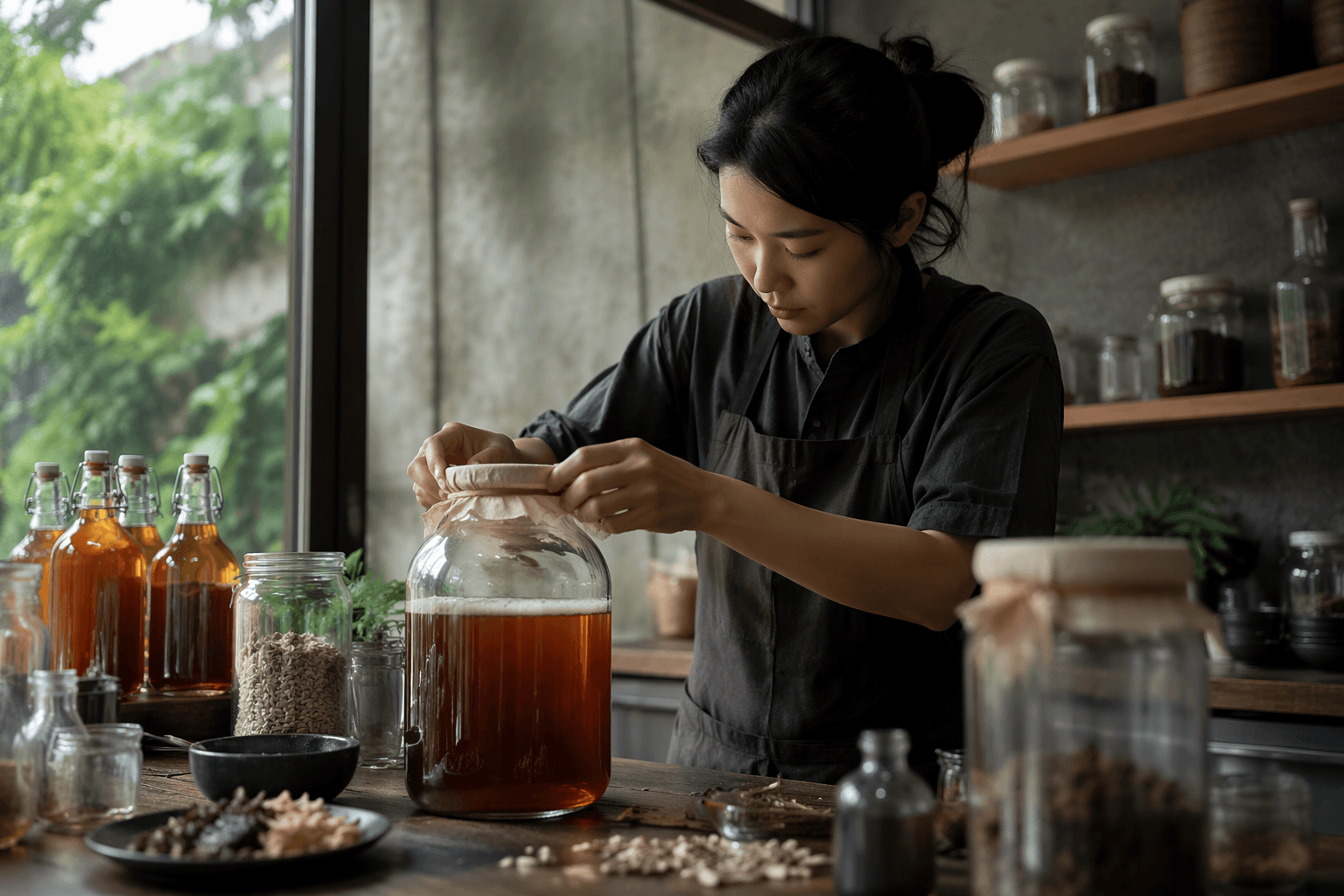
At its simplest, kombucha is fermented tea, made from steeped tea, sugar, and a culture of yeast and bacteria. In practical terms, that means it behaves more like a live ferment than a soft drink, and it can keep changing in bottle if you are not watching the fermentation closely. U.S. federal guidance notes that some kombucha products may reach 0.5% alcohol by volume or more, which matters for both home brewers and commercial makers because the beverage can move into a tighter regulatory lane depending on how it is made.
That technical detail is also the reason kombucha has room to become a true summer base instead of a fixed flavor. If the tea is the canvas, then sugar, fermentation time, and whatever you add later decide whether the drink leans brisk, fruity, floral, or herbal. For anyone brewing at home, the useful lesson is simple: treat kombucha as a living base that can be tuned for season and setting, not as a one-note bottle of “healthy fizz.”
How Indian makers are making it local
The most useful part of Choubey’s column is not the definition of kombucha, but the way it places the drink inside Indian ingredient logic. Indian innovators are already building versions with jamun, kokum, hibiscus, butterfly pea flower, tulsi, mango, and seasonal berries, and each of those choices gives the ferment a different summer identity. Jamun and kokum push the drink toward dark, tangy fruit; hibiscus and butterfly pea flower add color and a floral cue; tulsi makes the glass feel herbal; mango and seasonal berries anchor it to what is actually ripening now.
That is the move home brewers can steal without overcomplicating the batch. One plain tea kombucha can become several seasonal expressions if you split it at secondary fermentation and let one ingredient lead. The point is not to hide the kombucha character, but to let local produce speak first so the bottle tastes like the place and month it came from.
A practical way to think about it:
- Use one fruit or herb as the headline flavor, not four competing add-ins.
- Match the ingredient to the season, so the drink feels current rather than generic.
- Build for color as well as taste, because hibiscus, butterfly pea flower, jamun, and mango all change how the drink reads before the first sip.
- Serve it cold and visibly finished, because kombucha sells best when it looks like something you would want to pour for a guest, not just stash in a pantry.
Why the cultural cue matters as much as the flavor
Modi’s reference to traditional summer beverages in the 134th Mann Ki Baat episode matters because it turned these drinks into part of a larger conversation about India’s culinary heritage and regional diversity. That matters for kombucha makers too, because the successful versions are not trying to imitate a Western wellness shelf. They are borrowing the logic of Indian cooling drinks, where local ingredients, seasonal timing, and recognizable flavors do as much work as the fermentation itself.
Kokum sherbet shows how long that logic has been around. The drink’s place in Konkan kitchens gives it a regional identity that feels rooted rather than trendy, and that is exactly the kind of cue kombucha can borrow when it uses mango in Delhi, kokum on the coast, or tulsi in a summer batch meant to feel especially homegrown. The drink becomes shareable when it stops acting like an imported category and starts behaving like something that belongs on a real Indian table.
The market signal is moving in the same direction
The business numbers back up the cultural shift. One 2025 estimate places the India kombucha market at USD 119.89 million and projects it to reach USD 462.19 million by 2034. A separate 2025 estimate is even larger, at USD 181.44 million today with a projection of USD 902.75 million by 2034. The exact models differ, but both point to the same thing: demand is rising fast around probiotic and functional drinks, and kombucha is one of the category’s clearest beneficiaries.
That is why the drink keeps showing up in the same conversation as kanji and kokum sherbet. India’s summer drink revival is not about choosing tradition over modern fermentation. It is about making room for both, so a bottle of kombucha can taste local, look seasonal, and still carry the living fizz that makes it feel alive in the glass.
This article was produced by Prism’s automated news system from verified source data, official records, and press releases, then run through automated quality and moderation checks before publishing. The system is built and supervised by the people who set the standards it runs under. Read our full AI policy.
Did this article answer your question?