Researchers brew kombucha-style drink from Chenopodium formosanum leaf by-product
Researchers turned Chenopodium formosanum leaf waste into a kombucha-style ferment, after finding a 90 C, 20-minute brew gave the best phenolic and antioxidant profile.

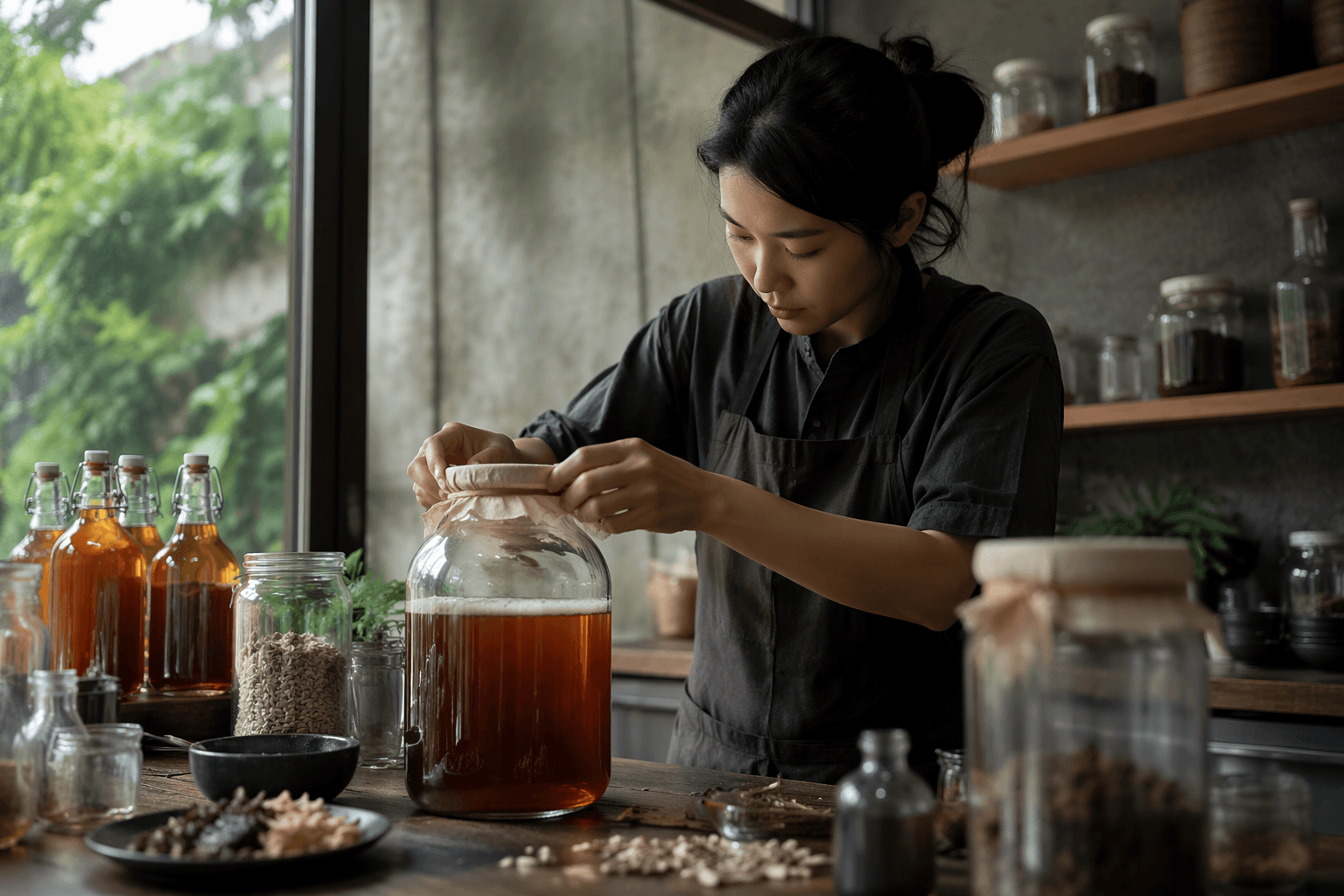
A kombucha-style drink built from Chenopodium formosanum leaves started with a simple but telling choice: the researchers picked a 90 C, 20-minute brew because it performed best on phenolic-related measures and antioxidant activity.
The June 22, 2026 study from Springer focused on brewed Chenopodium formosanum leaf infusion, or CFLI, and tracked how its composition shifted through a defined kombucha-type fermentation. The leaves are not the usual tea base kombucha brewers know from sweetened Camellia sinensis, but an underused agricultural by-product rich in phenolic-related constituents. That made the material worth testing as a fermentation substrate before the culture ever got to work.
For kombucha people, the important part is not the novelty of swapping in a different leaf. It is the process logic. A 2024 review of alternative substrates found that kombucha-analogous beverages most often use sucrose, are commonly prepared with infusions brewed at 90 to 100 C, and typically ferment for 14 days at 25 to 28 C. The Chenopodium formosanum work fits squarely inside that framework, which means it reads less like a lab gimmick and more like a controlled example of how far the kombucha platform can stretch.
That matters because djulis, another name for Chenopodium formosanum, has been treated increasingly as more than a seed crop. A 2025 review described it as an endemic cereal plant to Taiwan cultivated by Taiwanese aborigines for hundreds of years, while a 2025 antioxidant study said djulis leaves are often discarded as biowaste after harvesting and may be useful in functional products. A 2021 Materials paper made the waste stream even clearer: during harvest, the seeds are collected while the roots, stems, and leaves remain in the field as agricultural waste.

The new paper is also part of a visible research line. National Chung Hsing University listed a 2025 thesis titled “Development of Chenopodium formosanum Koidz. Leaf Kombucha: Analysis of Bioactive Compounds and Evaluation of In Vitro and In Vivo Antioxidant Activity.” A 2023 Applied Sciences study also showed that extracting and fermenting Chenopodium formosanum leaf extract with Aspergillus oryzae could improve physiological activities. Taken together, the work points to a crop whose leaves are being pushed from waste to functional input, first in enzyme-assisted systems and now in kombucha-type fermentation.
For home brewers, the practical takeaway is straightforward: alternative plant materials can work when the substrate is screened for extractability, phenolic retention, and fermentation behavior first. The caution is just as clear. A good result in a lab brew, especially one optimized at 90 C for 20 minutes, is not a plug-and-play recipe for the kitchen jar. It is a signal that the material has promise, provided the process is controlled as tightly as the research did.
This article was produced by Prism’s automated news system from verified source data, official records, and press releases, then run through automated quality and moderation checks before publishing. The system is built and supervised by the people who set the standards it runs under. Read our full AI policy.
Did this article answer your question?