How security pins create false sets in pin-tumbler locks
Security pins make a pin-tumbler lock feel alive: the click, the soft give of a false set, and the snap back all come from binding under tension.
A spool or mushroom pin can drop a pin-tumbler lock into a strange half-open state where the core seems ready but is not actually clear. One stack sticks, another gives a little, and then the plug seems to turn farther without truly clearing. That is the false set, and it is the moment when geometry, not guesswork, takes over.
What tension is really telling you
The first lesson in security pins is that the lock is not being read from top to bottom, pin by pin, in a neat sequence. Once tension is applied, the plug, cylinder, and pin stacks bind in a particular order, and some pins prefer to set front-to-back, which is why a lock can feel like it is progressing in a pattern rather than randomly.
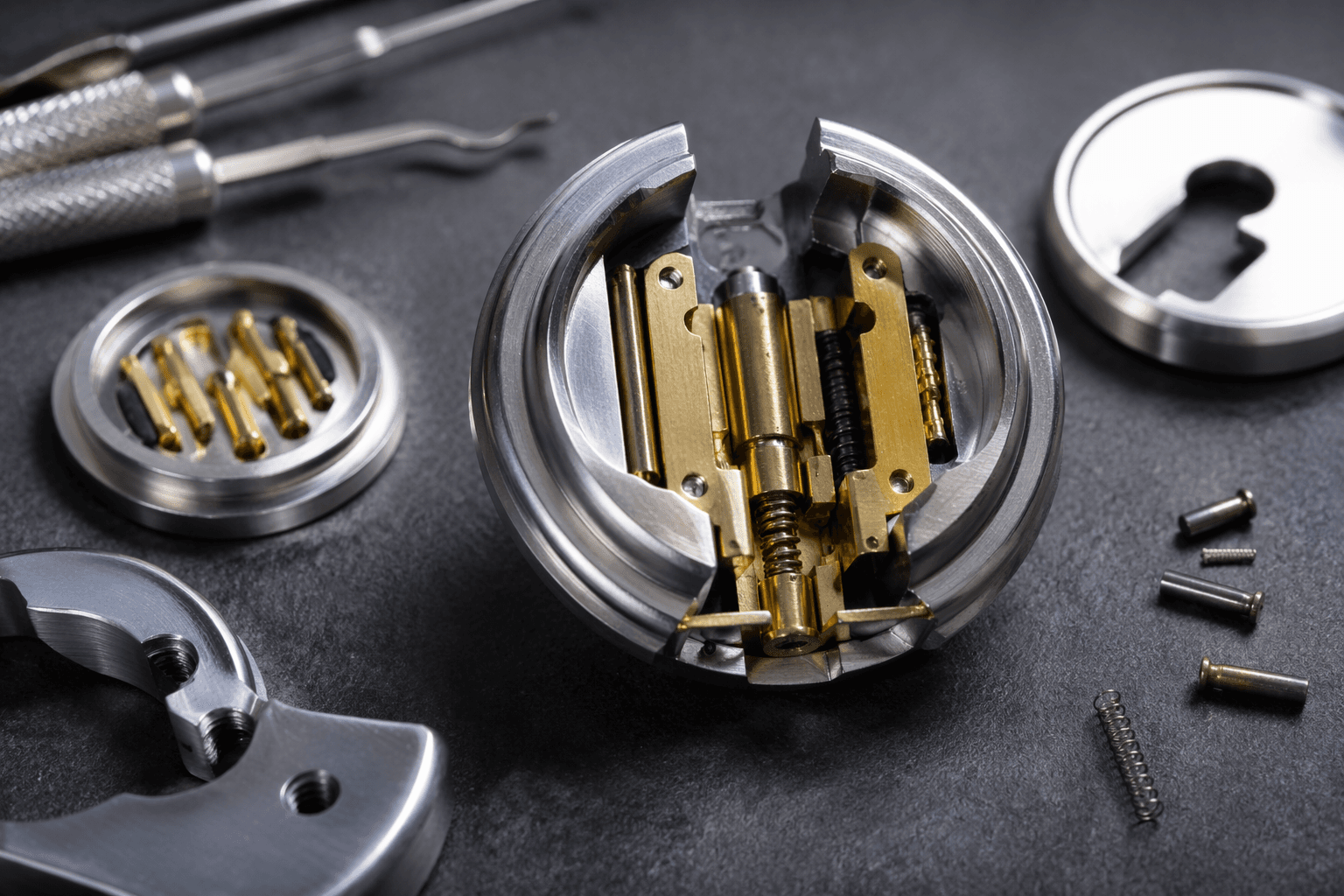
That is why security pins matter so much. Security pins are modified driver or key pins built to make manipulation harder. They are meant to resist lockpicking, impressioning, decoding, key bumping, and related compromise methods. In practice, they do not just block movement. They distort feedback, so the hand has to learn the difference between a pin that is truly set and one that is only pretending to be.
Why spools, mushrooms, serrations, and hybrids feel different
A standard pin stack wants to be simple: one cut line, one shear line, one clean transition. Security pins complicate that by changing how the stack catches on the edge of the plug. The most common shapes are spool, mushroom, serrated, and hybrid designs, and each one changes the feel under tension in a slightly different way.
A spool pin narrows in the middle, so when it starts to bind it can create a shelf-like catch that mimics success. That is why so many pickers describe a false set as a gentle but misleading give. Serrated pins can create several tiny sticking points instead of one clean one, while mushroom shapes can produce a similarly deceptive hang before the stack finally settles. Hybrids combine features, which makes the feedback even less linear and turns each pin chamber into its own little puzzle.
The lock’s response changes because the geometry has changed. A pin that feels dead one moment and suddenly springy the next is usually not being dramatic, it is showing you where the stack is binding and how far it has moved.
False sets are not failure, they are information
A false set is a state where the plug seems to rotate farther than before, the core may feel looser, and the tension wrench can even make the lock feel almost open. But the shear line is still blocked because one or more security pins are caught in a way that holds the stack in place until tension is reduced.
Under tension, components bind one at a time, which lets the picker isolate them. A spool or mushroom pin takes that same principle and bends it back on itself, creating a state where one stack appears solved while another is still trapping the plug.
Once you know that the order matters, the false set becomes a checkpoint. The question is which stack is still trapping the plug.
Why the old Yale architecture still matters
This entire feedback loop sits on a very old foundation. Linus Yale Jr. filed his pin-tumbler patent on January 29, 1861. The design used a smaller flat key with serrated edges and a spring-loaded driver above the tumbler. That is the core architecture that still defines many pin-tumbler locks today.
Security pins are not a separate system bolted onto modern hardware. They are an evolution of the same mechanism Yale helped standardize in the 19th century. The basic idea remains the same: the key aligns the stack, the plug turns, and the shear line clears. Security pins simply make that old arrangement less forgiving when the wrong tool is trying to do the job.
A familiar training lock: the Master Lock No. 140
The Master Lock No. 140 is a useful example because it sits right at the intersection of accessibility and complication. It is a 40 mm pin-tumbler padlock with four pin stacks. Older examples often contain a spool pin, while some newer ones may have the spool moved or removed. Master Lock’s 140 series literature lists a 4-pin cylinder and markets the lock as helping prevent picking.
That mix explains why the No. 140 shows up so often in locksport. It gives you a real chance to feel what a security pin does without burying the lesson in a deep stack count. At the same time, low pin count and poor manufacturing tolerances can make the lock easier to open than the security language suggests.
When manufacturers build the same idea into bigger families
The same anti-picking logic shows up across broader commercial padlock families. The American Lock 1100, 1200, and 1300 family uses APTC12 cylinders that are drilled for six pins even when keyed for five, which makes the platform easy to convert. The 5200 series uses standard and serrated key pins, plus driver pins in spooled, serrated, and hybrid forms.
Security pins are part of the mainstream language of higher-security pin-tumbler hardware, especially in industrial and commercial padlocks. Extra geometry in the stack creates extra feedback and changes how the lock answers under tension.
This article was produced by Prism’s automated news system from verified source data, official records, and press releases, then run through automated quality and moderation checks before publishing. The system is built and supervised by the people who set the standards it runs under. Read our full AI policy.
Did this article answer your question?