LockCon 2024 expands lockpicking contests beyond padlocks and pin tumblers
LockCon 2024 turned competition into a versatility test, sending pickers from pin tumblers to disc detainers, lever locks, impressioning and safe work.

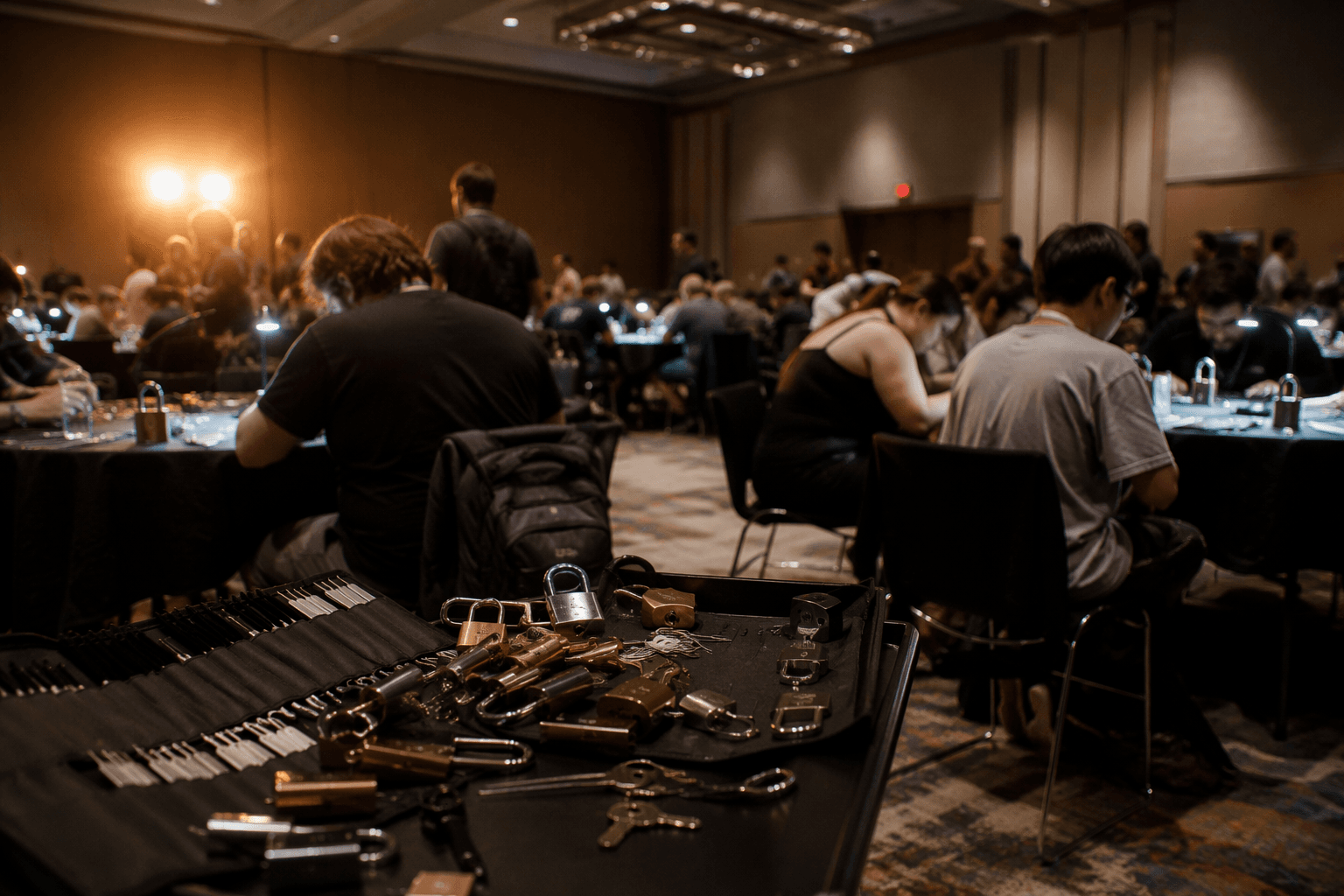
Competitive locksport at LockCon 2024 was never just a race to crack one padlock fastest. The event was built as a broad test of feedback, tool control, and lock knowledge, with pin tumblers sharing space with impressioning, disc-detainer picking, safe manipulation, lever lockpicking, and Foxpicks games.
A competition built to reward range
LockCon itself is framed as an international conference about locks, and that scope matters. Mechanical and electrical locks sit alongside lockpicking, impressioning, safe locks, lever locks, old and new locks, and new developments, which tells you the contest side is meant to stretch beyond a single comfortable category.
The weekend structure reinforced that idea. Thursday was the first day of the event, tickets were still available as of September 20, 2024, and registration closed on September 25. The smaller competitions ran from Friday evening through Sunday, giving the gathering the feel of an open, multi-round locksport meet rather than a single bracket where one mistake ends the day.
That format is important because it rewards the kind of picker who can switch gears. A strong pin tumbler hand is useful, but LockCon asks for more: the patience to read a safe dial, the sensitivity to build a working key through impressioning, the mechanical intuition for lever locks, and the discipline to handle disc-detainers that rely on a very different internal logic.
What the Dutch Open lockpicking contest measured
The Dutch Open lockpicking competition showed how serious the scoring can get. It was described as one of the largest lockpicking competitions of its kind, and its qualifier alone had six tables with ten participants at each table.
Each table ran ten rounds of five minutes each, which meant the contest measured repeatable performance under time pressure rather than a single lucky solve. The best three competitors from each table, 18 in total, advanced to the quarter-finals, so the format rewarded consistency, adaptability, and the ability to reset mentally from one lock to the next.
That matters in a way pin-tumbler specialists recognize immediately. Five minutes is enough to show whether your tension, picking, and lock-reading are sound, but it is also short enough to punish tunnel vision, which is why a broad competition structure like this pushes you to train on more than one lock family.
Why impressioning sits next to picking
The Dutch Open impressioning competition made the same point from a different angle. It is traditionally the first of the large competitions at LockCon, and 40 people joined in 2024, which is a healthy sign that the craft is still a major draw.
Impressioning is its own kind of problem-solving. You make a working key by reading feedback from the lock, adjust the key until it opens, and then the opening time is registered. The most consistent and fastest competitors then get another six locks in the finals, which means the event measures both initial accuracy and the ability to repeat that accuracy across a deeper run.
That is a very different skill profile from brute-force speed on a familiar cylinder. In impressioning, the lock tells you what to change, and the competition rewards the picker who can listen to that feedback, refine the blank, and stay calm through tiny mechanical corrections until the key turns cleanly.
Disc-detainers, lever locks, and safe manipulation push the edges
LockCon 2024 also brought back disc-detainer picking, and that return matters because disc-detainers have become an advanced benchmark in modern locksport. They are not pin tumblers with a different shell, but a separate challenge class that asks for a different mental model, often closer to sidebar-style reasoning than classic pin-by-pin feedback.
Safe manipulation sat alongside it, which broadens the event even further. A 2024 Hackerhotel workshop taught safe cracking to a group of eleven attendees, showing that this side of the hobby is practiced and taught in small, hands-on settings as well as in competition. That combination of workshop culture and contest culture is one of the clearest signs that the hobby values understanding over spectacle.
The lever lockpicking competition, organized by Nigel Tolley, added yet another discipline to the mix. Lever locks force you to think about gate alignment, lever lift, and the mechanical logic of a very different lock family, so their inclusion makes the weekend less like a series of padlock races and more like a survey course in practical lock manipulation.
The social layer matters too
Foxpicks games rounded out the schedule and kept the event from feeling purely formal. That detail is easy to skip past, but it tells you how locksport communities keep people learning: through playful challenge design, informal repetition, and the chance to compare approaches without the pressure of a pure championship format.
That wider community also shows up in Toool’s long-running competition culture. The Toool NL Competition has been held yearly since 2004, uses about twenty locks, and awards points on a sliding scale, with the fastest time earning ten points, the second-fastest nine, and so on. It is a scoring style that values depth across a lock set, not just one standout solve, and it fits the same philosophy LockCon 2024 put on display.
Seen together, the event design makes the lesson plain. LockCon 2024 did not ask who could pick one padlock the fastest. It asked who could move from a five-minute qualifier table to an impressioning run, from a disc-detainer to a lever lock, and from a safe dial to a Foxpicks challenge without losing the thread, which is exactly what serious locksport training is supposed to build.
This article was produced by Prism’s automated news system from verified source data, official records, and press releases, then run through automated quality and moderation checks before publishing. The system is built and supervised by the people who set the standards it runs under. Read our full AI policy.
Did this article answer your question?