Lockpicking belt levels explained, from white to black rank
The belt ladder is less about status than diagnosis, showing exactly what each picker can do, what they still miss, and which lock type should come next.
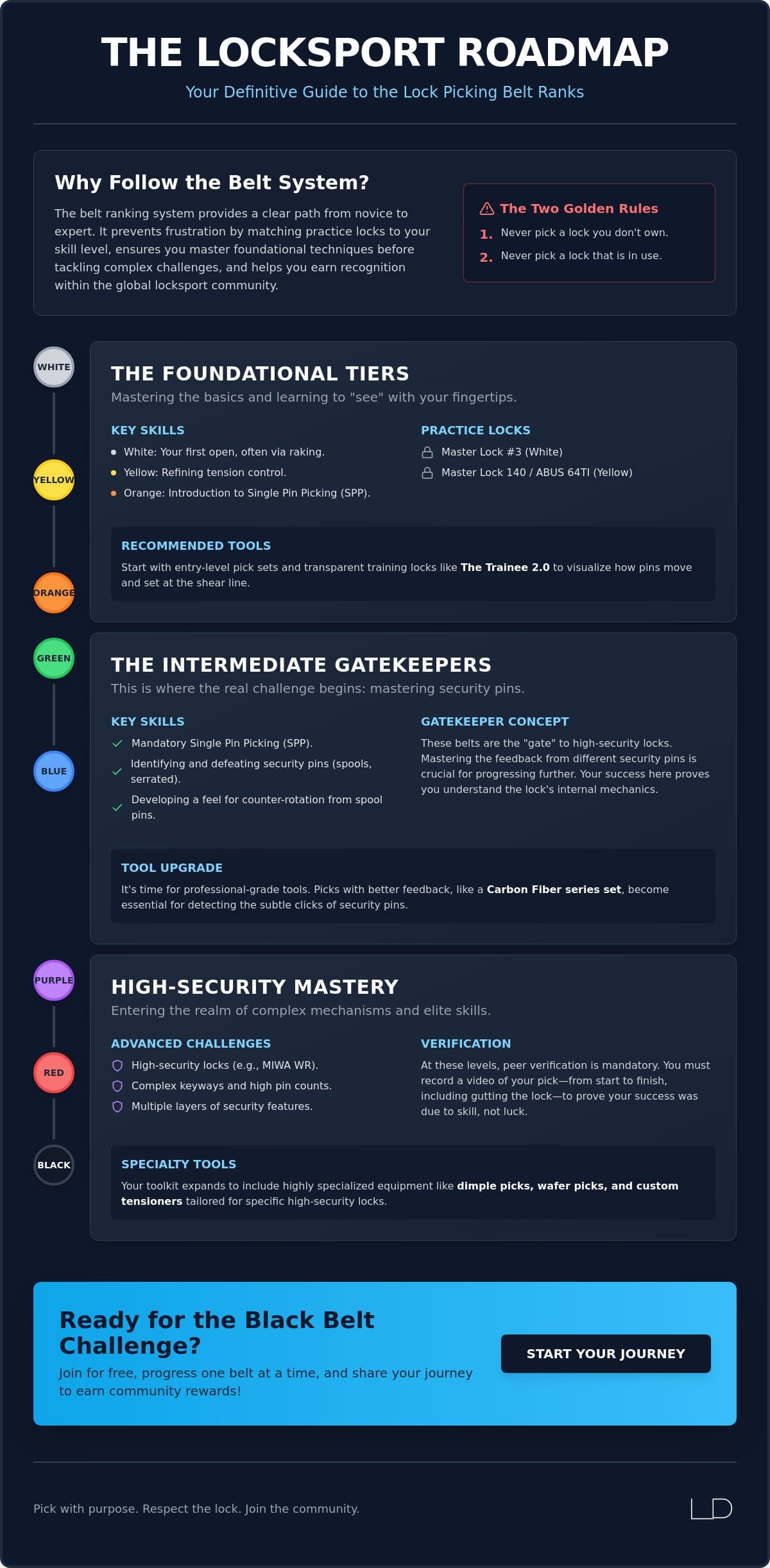
The belt ladder in locksport is not a trophy case. It is a roadmap that starts with a simple White Belt open and climbs toward black-rank work that demands documentation, specialized skill, and tougher mechanisms. Lock Pickers United treats the system as a tiered classification that quantifies progress, not a self-declared badge, and its Belt Explorer now catalogs detailed information for nearly 900 locks.
Why the belt system feels intimidating, and why it helps
The structure looks formal because it is formal. LPU awards ranks only after moderators review submitted documentation, and the system uses colored belts to codify achievements in lockpicking and related skills. That matters in a hobby where the same lock can feel easy one day and opaque the next, because the belt label gives the scene a shared shorthand for difficulty, progress, and what still needs work.
That shared language sits on top of a long locksport tradition. Lockwiki traces the hobby’s roots to public lock-picking competitions in the 1850s and 1860s, while TOOOL, founded in the Netherlands in 2002, grew into a nonprofit focused on teaching, research, and competition. LPU’s own community history is younger, with origins in r/lockpicking in 2014 and a move onto Discord in 2017, which helps explain why the belt system feels like a modern standard rather than an old certification regime.
White, yellow, and orange: the first real bottlenecks
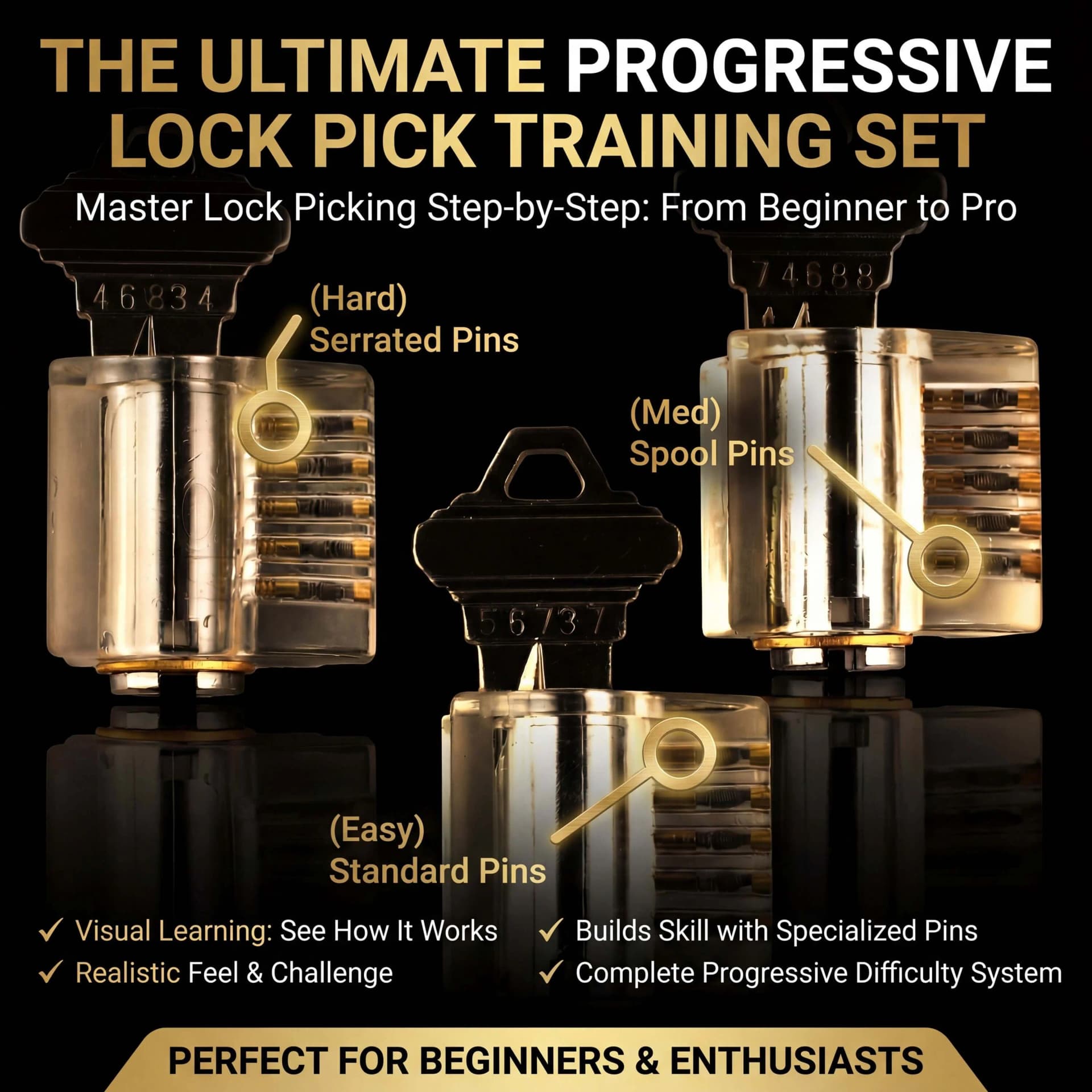
White Belt is as forgiving as the system gets. The current LPU explorer says the requirement is simply to pick any lock with any tool, and photos or video showing the turned core are accepted as evidence. That is why beginner-friendly practice pieces such as acrylic padlocks appear so often in White Belt materials: the first test is whether you can get a lock open at all and prove it cleanly.
Yellow and Orange are where the hobby begins testing repeatability instead of luck. LPU’s reference list places familiar models such as ABUS 55/30, Master Lock No. 140, and Kwikset Classic at Yellow, then moves up to ABUS 65/40, Master Lock No. 150, and FAB 100 at Orange. If White is about getting a first open on the board, these levels expose whether tension is controlled, feedback is being read correctly, and the picker can work a basic pin-tumbler without fighting the core every time.
Green is where handling starts to matter as much as picking
Green Belt is a major checkpoint because LPU ties it to both harder locks and a maintenance skill: the ability to gut and reassemble locks. The reference examples include ABUS 72/40, Master Lock No. 410, and American Lock 1100, which means the picker is no longer just proving that an open is possible, but that the lock can be serviced and understood well enough to be taken apart and put back together correctly.
That is the point where a lot of people stall. If a lock opens but springs, pins, and drivers become a mess the moment it comes apart, the bottleneck is not brute force or tool choice, it is mechanical handling and basic lock literacy. Green is where the belt system begins rewarding not just the hand on the pick, but the hand on the tray, the follower, and the plug.
Blue and purple push you out of solo mode
Blue Belt changes the question again. LPU lists examples such as ASSA 700, DOM Plura, and Medeco BiLevel, and also requires a challenge lock project, which LPUinfo describes as a custom-pinned lock shared with another picker, with lock write-ups also accepted as a community project. The bottleneck here is broader exposure: security pins, challenge locks, and the habit of documenting what a lock is doing instead of just forcing it to open.
Purple Belt adds a social test to the technical one. The examples shift to ASSA Desmo, Mul-T-Lock Interactive, and Schlage Everest, but the additional requirement is to demonstrate a history of helping new pickers. At this level, the system is checking whether technique has become stable enough to teach, whether lock exposure has broadened past one favorite brand, and whether you can explain the process without hand-waving.

Brown, red, and black are about tools, mentoring, and mastery
Brown Belt asks for still more range. LPU’s examples include ASSA d12, KABA Gemini, and WEST 916, and the additional requirement is to make at least one specialized tool. That is a clear signal that hand skills alone are no longer enough; the picker needs to understand how a tool is shaped for a specific problem and to build something that solves it.
Red Belt adds another community test: mentor another advanced picker in opening a difficult lock. LPU pairs that requirement with examples such as Abloy Classic, ABUS EC700, and EVVA 3KS. By this point the bottleneck is less about finding the right lock and more about proving that your method holds up when the lock is awkward, the mechanism is unfamiliar, and someone else is watching for clean technique.
Black Belt is where the explorer and the Dan System start to show just how deep the framework goes. LPUinfo says Master’s Projects, also called Epic Quests, are an integral part of Black Belt requirements and Dan System advancement, and the Belt Explorer’s black-rank entries show the sort of hardware that lives there: Abloy Sentry at Black 1 with rear tension, a disc steering system, and false gates; Clavis Q-18 at Black 1 with high pin count; Kaba Star at Black 2; and Opnus MMXII at Black 4 with a lever/sidebar mechanism. Abloy Protec, ASSA Twin 6000, and Goal V18 also sit in the black tier, which makes the message plain: at the top end, the belt is testing mastery across very different lock families, not just one favorite pin stack.
That is why the belt ladder is so useful for a picker who feels boxed in by rank envy. White proves you can turn a core at all; the middle belts test whether you can read feedback, gut and rebuild, and handle broader lock families; black rank asks whether you can work at the edge of the hobby and help move it forward. In a scene that grew from 1850s competition culture into LPU, Discord, and a maintained explorer with nearly 900 locks, the colors are not a scoreboard. They are the cleanest way to see the next bottleneck.
This article was produced by Prism’s automated news system from verified source data, official records, and press releases, then run through automated quality and moderation checks before publishing. The system is built and supervised by the people who set the standards it runs under. Read our full AI policy.
Did this article answer your question?