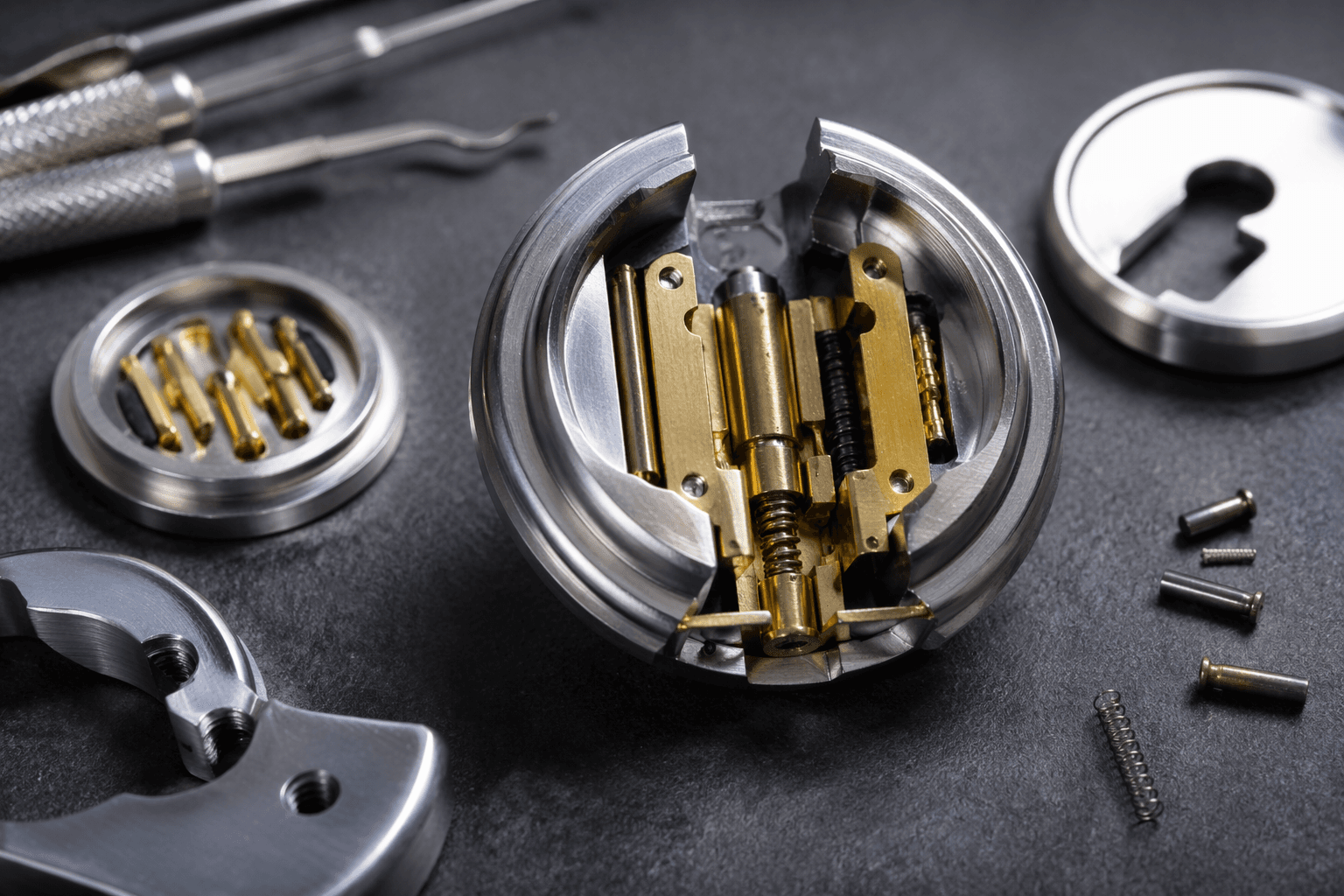
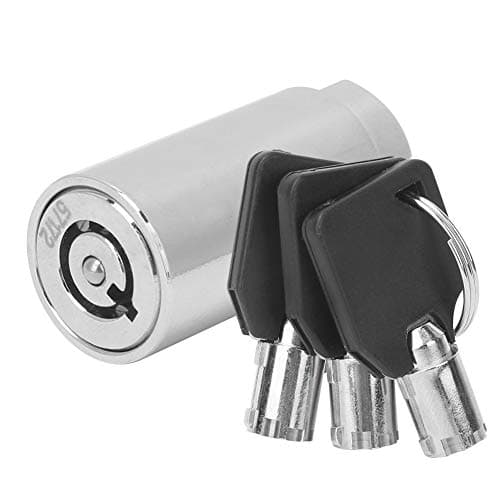
Mastering dimple locks, why flag geometry and tension matter
Dimple locks demand a new map, not just a new pick. Flag orientation, rotational control, and feedback matter more than pin-tumbler habits once you move up the security ladder.
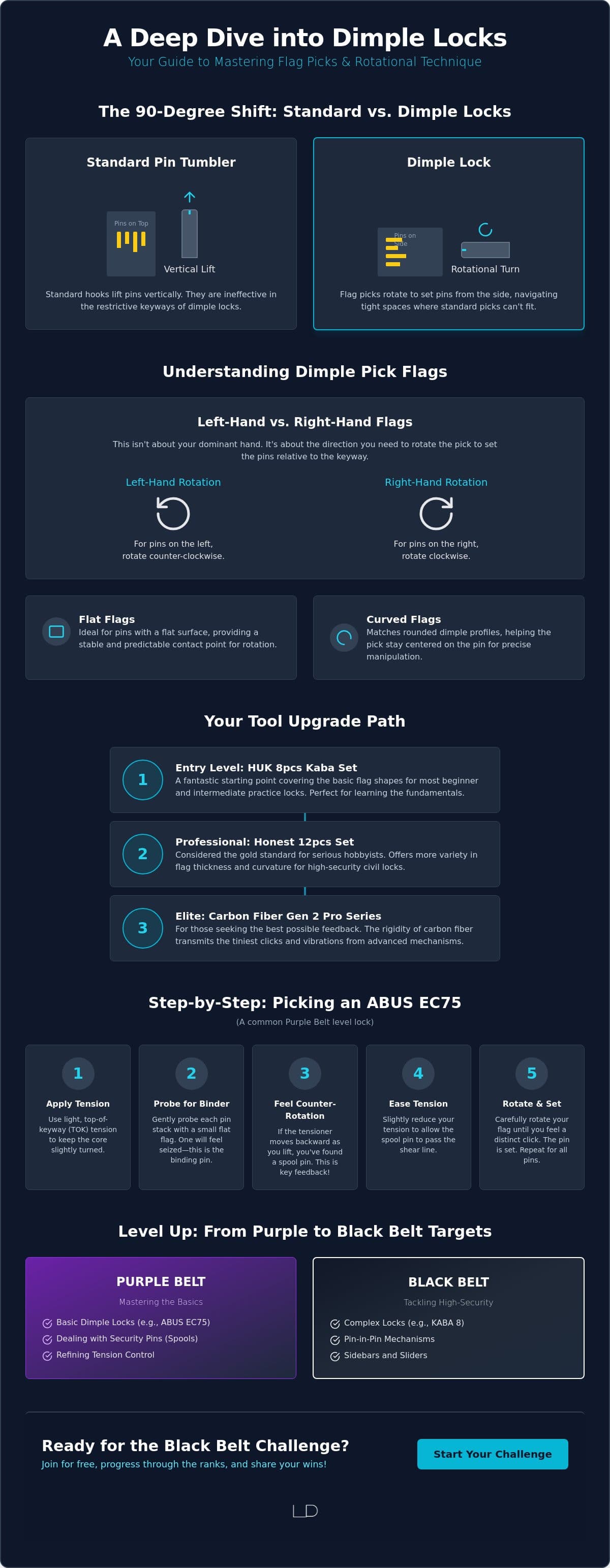
The first mistake pickers make with dimple locks is treating them like sideways pin tumblers. This Lockpick Pros masterclass pushes in the opposite direction: if you want to open higher-security cylinders, you need to think in terms of flag geometry, hand orientation, and tension that leaves room for subtle movement. That shift matters most when you move into ABUS and KABA-style locks, or into pin-in-pin mechanisms, where familiar pin-tumbler habits stop giving clean information.
Dimple locks are a different discipline
Dimple work sits in the advanced tier for a reason. No Starch Press’ *Locksport* places dimple locks alongside security pins, keyways, antique locks, and competition techniques, which is a useful clue about where they belong in the hobby. They are not a minor variation on the standard padlock cylinder. They ask you to read the lock from a different angle, literally and mentally, and to stop expecting the feedback patterns that come from a normal hook and top-pin setup.
That is why these cylinders intimidate so many pickers who have spent their first stretch on basic pin-tumbler practice. The lock itself does not just feel different in the hand, it behaves differently under tension. If you approach it like a standard cylinder, you can spend a long time forcing a tool into the keyway without ever building a reliable picture of what is happening inside.
Community practice has already moved this way
The broader locksport world has long treated this as a skills-based progression, not a gimmick. TOOOL, the Open Organisation Of Lockpickers, describes its mission as advancing public knowledge about locks and lock picking through teaching, research, and competition. TOOOL Netherlands adds a useful piece of context, calling itself the oldest lockpicking sports club in the world after the German SSD e.V.
That matters because dimple work rewards the same kind of organized, deliberate practice that those groups have championed for years. It is not about brute forcing a harder lock. It is about learning how different mechanical systems speak, and about making your tool choice part of your skill development instead of an afterthought.
Flag geometry is not cosmetic
The central lesson in dimple picking is that flag shape and orientation are part of the lock-reading process. Left-hand and right-hand flags are not interchangeable decorations. They determine how you approach the lift, how the tip reaches the pin stack, and whether the tool matches the internal orientation of the cylinder you are facing.
That is why the wrong flag can sabotage the whole session. A picker who keeps using ordinary pin-tumbler habits, or grabs whatever flag happens to be nearby, may never get a clean sense of what the lock is telling them. The geometry has to fit the space, and the space has to be understood on its own terms. In dimple work, the tool is part probe, part translator.
Tension is the other half of the conversation
If geometry is the map, tension is the pacing. Dimple locks need enough rotational control to let the tool work without overwhelming the feedback loop. The guide’s emphasis on a tensioning style that leaves room for precise work is important because overcommitting pressure can flatten the tiny cues you are trying to read.

That feedback can be subtle. The difference between a pin moving, binding, or setting is often felt through tiny changes in rotation rather than through the familiar pin-tumbler sensations people expect. Advanced dimple picking is built around that sensitivity. The goal is not to muscle through the lock, but to create conditions where the cylinder can tell you what is binding and when.
What high-security cylinders are designed to do
ABUS’ D6PS gives a concrete picture of the category. Its product literature describes it as a 6-pin dimple-key-cylinder, and the company says it includes special pins, drill protection, and a pre-snap feature. ABUS was founded in 1924 in Volmarstein, Germany, and its 2026 catalog says one cylinder line offers 30,000 real guaranteed key differs under a master key.
Those details show why dimple cylinders attract security-focused buyers and frustrate casual picking attempts. Special pins and drill protection are not marketing flourishes, they are design choices meant to raise the bar. The key system complexity also matters, because tighter key control and more controlled differ counts create a lock family that demands more from anyone trying to understand it mechanically.
Medeco shows how the high-security arms race evolved
Medeco provides the historical backdrop. The company says it was founded in 1968 in Salem, Virginia, and its original locking principle used angled key cuts and special pin tumblers to deliver millions of key combinations. Later Medeco descriptions add chisel-tipped pins and sidebar interaction, both of which deepen the challenge by adding another layer of mechanical decision-making.
That evolution explains why dimple locks belong in the same advanced conversation as sidebar-style systems. These designs were built to make unauthorized entry harder and key duplication more controlled. For pickers, that means the lock is not just a barrier, it is a lesson in how security engineers multiply difficulty without changing the basic idea of a cylinder.
The real step up is mental
Once you leave standard pin tumblers behind, the game changes from force to mapping. Dimple locks reward a picker who can match left-hand or right-hand flags to the cylinder, manage tension without smothering feedback, and understand why a particular tool geometry belongs in a particular keyway. That is why they feel like their own discipline.
The next level in locksport is not about having a bigger kit. It is about building a better mental model, one that treats each dimple cylinder as a distinct mechanical language and listens closely enough to hear it.
This article was produced by Prism’s automated news system from verified source data, official records, and press releases, then run through automated quality and moderation checks before publishing. The system is built and supervised by the people who set the standards it runs under. Read our full AI policy.
Did this article answer your question?