Why disc-detainer locks matter in advanced lockpicking
Disc-detainers make you unlearn pin-tumbler instincts fast: the sidebar and rotating discs turn picking into a different feedback game, from Abloy cylinders to competition locks.

Disc-detainer locks are where beginner instincts go to die. If pin tumblers teach you to listen for binding stacks, chase sets, and read the false-friend clues of a spring-loaded cylinder, disc-detainers ask for something else entirely: rotational alignment, sidebar control, and patience with a feedback loop that does not behave like pins at all.
What you must unlearn first
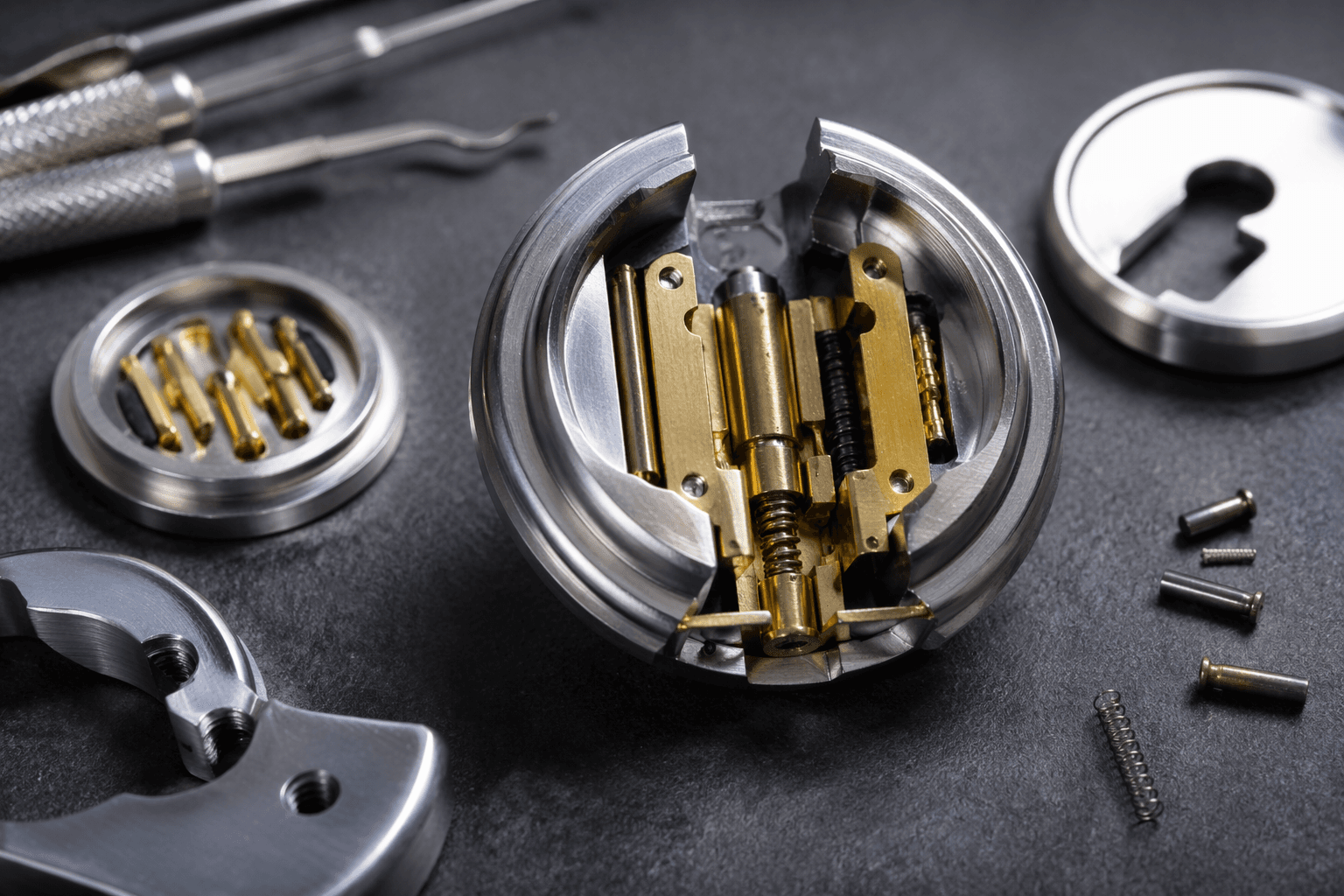
The easiest way to understand the jump is to set the two systems side by side. A standard pin-tumbler lock gives you a stack of pins and a plug that rotates when those stacks are separated at the shear line. A disc-detainer lock uses rotating discs as its locking components, and the lock stays shut until those discs line up a sidebar gate. The target is not a pin stack, but the relationship between discs, sidebar, and locking bar.
That difference changes everything a picker learns by repetition. The familiar habits of oversetting pins, hunting for false sets, and managing individual pin stacks do not map cleanly onto a disc system. In a disc-detainer, the manipulation target is broader and the clues are subtler, because the mechanism is built around rotation rather than vertical movement.
How the mechanism works
ABLOY’s operating principle is simple and elegant: the correct key turns 90 degrees to align the detainer discs, the sidebar gates line up, and the locking bar drops into the aligned slot so the lock can open. Turn the key back and the discs scramble again. That rotation-based architecture is the whole point of the platform.
ABLOY says all of its locks are built on this unique rotating detainer disc principle, and that the idea has been adapted across multiple cylinder and lock forms in more than 80 countries. That means you are not looking at a one-off oddity. You are looking at a mechanism family that has been engineered into everyday hardware as well as high-security products.
For advanced pickers, this matters because the lock does not reward pin-tumbler reflexes. The sidebar becomes the central lock element, and the disc stack becomes the terrain you are trying to map. Lockwiki describes sidebars as a primary locking mechanism in many disc-detainer locks, which is why the sidebar, not a pin stack, is the part that matters most when the discs are finally close to aligned.
A side-by-side comparison that changes the mental model
Pin tumblers and disc-detainers can both be picked, but they do not feel the same in hand.
- Pin tumbler: the plug waits for stacked pins to be separated at the shear line.
- Disc-detainer: the core waits for rotating discs to align a sidebar gate.
- Pin tumbler: the picker listens for binding order and individual stack feedback.
- Disc-detainer: the picker works a rotational system where the disc positions and sidebar alignment define success.
- Pin tumbler: common beginner errors include oversetting and losing progress in a stack.
- Disc-detainer: the problem is usually misreading the rotation state or fighting a mechanism that is built to keep the sidebar blocked until alignment is exact.
That is why disc-detainers defeat habits that feel reliable on a practice lock. The same hands, tension, and patience still matter, but the lock is asking a different question.
This is bigger than one brand
ABLOY may be the name most people attach to disc-detainers, but Lockwiki makes clear the family is broader than that. Disc-detainer locks are also made by ABUS, Kryptonite, and other brands, which is part of what makes the subject so useful in advanced lockpicking. The mechanism is not a boutique curiosity attached to a single manufacturer. It is a shared design language with multiple implementations.
ABUS’s own product world shows how easy it is to mix up related but different ideas. The company’s Diskus line is a disc-shaped padlock design, and ABUS says it has been manufactured at its Wetter-Volmarstein headquarters for seven decades. That is a useful reminder that “disc” can mean a lock body shape, not just the rotating-disc mechanism inside a cylinder. The security strategy is different, even if the word sounds familiar.
Lockwiki’s ABUS Plus 88/50 page shows how the disc-detainer idea evolved beyond the original Abloy lineage. It describes a modern disc-detainer padlock that uses seven code discs, plus additional discs that interact with a sidebar. That is the kind of detail advanced pickers care about, because it shows how the family kept its core concept while changing the internal layout.
Why the history still matters
Disc-detainers are not just a modern competition problem. ASSA ABLOY says the ABLOY lock was invented in 1907 by Emil Henriksson, a young precision mechanic from Helsinki, after he realized the rotating discs of a cash register could be adapted into a lock mechanism. Large-scale production began in 1918 with the founding of Ab Låsfabriken-Lukkotehdas Oy, the company that later became AB Abloy Oy.
That history explains why the mechanism still feels unusually distinct in the hand. It was built from the start around a rotating principle, not as a small tweak to a pin-based lock. ASSA ABLOY’s ABLOY Classic line still reflects that idea, describing the platform as an asymmetrical five-to-eleven-disc system and calling it a benchmark for keying platforms worldwide. The old design has never stopped being relevant because the core concept remains mechanically different from the lock most people meet first.
Where the hobby meets the real world
Disc-detainers are tracked as their own category in organized locksport through Lock Pickers United, which is one sign that the community treats them as a distinct skill set rather than a novelty. They also show up in timed competition. Toool’s Blackbag coverage of the Dutch Open 2023 Disc Detainer competition featured five locks, including Fort Knox, Parkside, No-name, and ABUS Plus variants.
The competition rules from 2024 underline the seriousness of the niche. Newcomers are told to ask experienced pickers for instruction, and the rules warn that disc-detainer picks can be damaged by improper use. That combination tells you everything about the learning curve: this is not a gentle extension of pin-tumbler practice, but a discipline with its own tools, its own mistakes, and its own expert norms.
That is why disc-detainers matter in advanced lockpicking. They are where the hobby stops being about transferring one familiar skill and starts being about learning a different mechanism from the ground up. Once you understand why the sidebar, the 90-degree turn, and the rotating discs matter, the old pin-tumbler habits stop looking universal, and the lock in your hand starts looking exactly like what it is: a different machine.
This article was produced by Prism’s automated news system from verified source data, official records, and press releases, then run through automated quality and moderation checks before publishing. The system is built and supervised by the people who set the standards it runs under. Read our full AI policy.
Did this article answer your question?