Agent Phil Coulson leads a Hero-heavy mono-white Commander deck
Coulson turns mono-white Heroes into an ensemble deck that snowballs with counters, attacks cleanly, and wins without leaning on the usual pile of Commander staples.
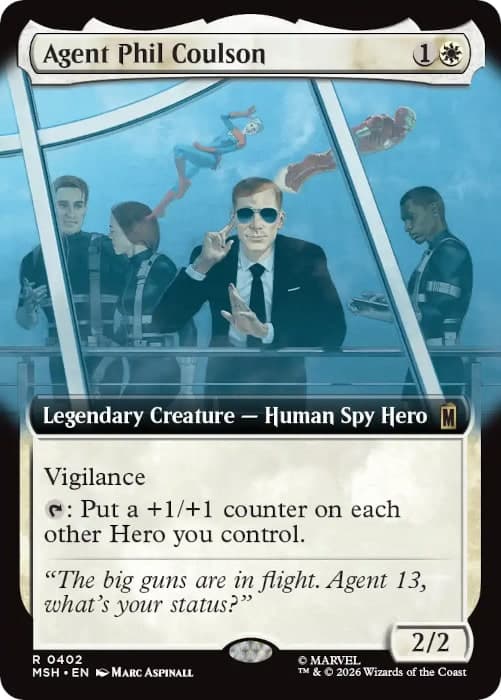
Agent Phil Coulson is the kind of commander that asks you to build smarter, not greedier. Instead of jamming every obvious white staple into a shell that tries to overpower the table, this deck treats Coulson as a support piece and lets a Hero-heavy board do the real work.
Why Coulson is worth the slot
Coulson is a 2/2 Human Spy Hero with vigilance and a tap ability that puts a +1/+1 counter on each other Hero you control. That looks modest until you picture it on the battlefield: every extra Hero turns the same activation into more stats, more pressure, and more reason to keep attacking. He does not need to be the biggest body in play, because the deck is built so that his real value comes from making everyone else dangerous.
That is why the deck feels so different from the usual mono-white Commander pile. You are not trying to turn one legendary creature into a one-card engine and hope the rest of the list carries dead weight. You are building an ensemble cast where Coulson is the organizer, the accelerant, and the reason the team gets better every turn.
What the commander actually asks you to do
The cleanest way to pilot Coulson is to think in combat steps. Vigilance matters here because he can attack and still remain available for the tap ability, so he helps you apply pressure without giving up his support role. Once he starts handing out counters, even the smallest Hero bodies begin to scale into real threats.
That makes the deck’s direction unusually clear for mono-white. Fill the list with Heroes, turn them sideways, and let Coulson keep widening the board’s stats. The commander is not asking you to assemble a delicate combo or hold up a pile of reactive spells every turn. He is asking you to commit to board presence and make every combat step count.
Why the deck is safer now than it used to be
There is also a format-history wrinkle that matters here. In the old tuck rule era, a commander that got tucked into the library could disappear in a way that was brutal for a build-around like this, because the whole plan depended on Coulson staying accessible. Under today’s rules, the deck can lean on the 99 with much more confidence.
That change matters more for a support commander than it does for a generic value legend. If Coulson is answered, the deck still functions because the Hero core is doing real work on its own. You are not building a glass cannon around one card that must survive at all costs. You are building a structure that keeps pressure on the table even when the commander gets removed.
Build the Hero shell first
The most important structural choice is Hero density. The notes here make that point plainly: there are enough Heroes available in mono-white to make the deck feel coherent, even if Phil himself is only one piece of the machine. That density is what keeps the list from turning into a novelty deck that looks cute and then folds to actual Commander play.
Once that density is in place, the rest of the construction gets easier. You want Heroes that matter in combat, Heroes that keep the board stable, and Heroes that become better when they pick up counters from Coulson. The deck is strongest when each creature is useful on its own and even better when it is sitting next to three or four other targets for the commander’s ability.

The Marvel Hero pool helps here because it gives the deck a clear identity beyond generic white goodstuff. The Captain America cards get special attention because they fit Coulson’s thematic lane so naturally, but the larger point is bigger than one character pairing. The deck works because the Marvel Hero roster gives you a real tribal backbone, which means the list feels like a team instead of a stack of unrelated all-stars.
How the deck actually closes games
The game plan is simple, but not simplistic. Develop early Heroes, use Coulson to widen their threat range, and keep attacking so the table has to answer a growing board rather than a lone commander. The vigilance on Coulson makes that line cleaner, because he does not force you to choose between pressure and support.
What separates this from an overhyped theme deck is that the synergies are doing honest work. A board full of Heroes getting repeated counters becomes progressively harder to ignore, and mono-white’s ability to keep an organized battlefield matters more when every body is part of the plan. You are not chasing raw power for its own sake. You are making the deck’s flavor and its function point in the same direction.
That is the real appeal of Agent Phil Coulson in Commander. He is rare because he rewards clever construction instead of demanding that you jam the strongest cards available, and he lets a Hero-heavy mono-white list win by acting like an ensemble. If you want a commander that turns theme into pressure without pretending to be the whole show, this is exactly the kind of build that earns its seat at the table.
This article was produced by Prism’s automated news system from verified source data, official records, and press releases, then run through automated quality and moderation checks before publishing. The system is built and supervised by the people who set the standards it runs under. Read our full AI policy.
Know something we missed? Have a correction or additional information?
Submit a Tip