Commander Brackets and Game Changers Explained, From Casual to cEDH
One mismatched pod can ruin a Commander night. Here's how to read your deck's bracket in under a minute and explain it at the table in 20 seconds.
You sit down, call it a casual Meren graveyard deck, and by turn four someone across the table is staring at your Necropotence, Demonic Tutor, and Underworld Breach wondering what happened to their Thursday night. That's not a rules violation. It's a bracket mismatch, and the Commander Format Panel built an entire system specifically to prevent it.
Introduced in February 2025, the Commander Brackets system gives players a shared language to communicate a deck's power level before the game even starts. It pairs with the Game Changers list, a curated roster of cards flagged for their outsized impact on games. Together they're the two most consequential structural changes to the format in years, and if you're still treating them as optional formalities you're leaving a genuinely useful tool on the table.
The Five Brackets, Decoded
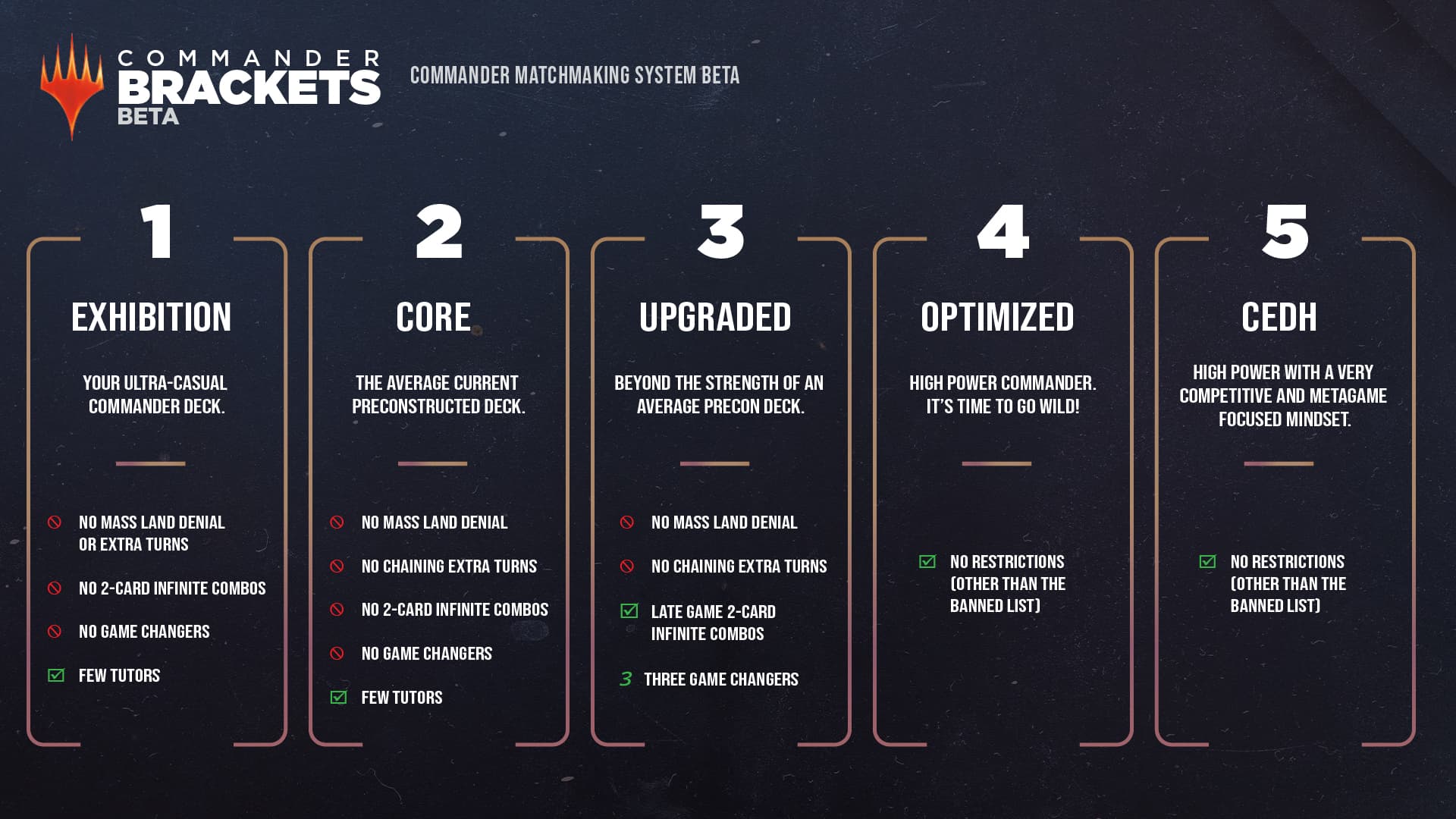
The system runs from Bracket 1 (Exhibition) to Bracket 5 (cEDH), and each tier carries a name for a reason: it's easier to say "this is a Core deck" than to negotiate the meaning of "six out of ten" mid-shuffle.
Bracket 1 (Exhibition) is for ultra-casual decks that prioritize a theme over power, with no Game Changers allowed. Bracket 2 (Core) is for straightforward, unoptimized decks. These are the bread-and-butter Friday Night Commander tiers, the tables where someone is trying to make Cromat work on a $40 budget.
Bracket 3 (Upgraded) allows up to 3 Game Changers, alongside strong synergy, but restricts early-game two-card infinite combos and mass land destruction. This is where most tuned-but-not-optimized brews actually land, whether their pilots know it or not. Bracket 4 (Optimized) is lethal and consistent, with no card restrictions beyond format legality. And then there's Bracket 5.
Bracket 5 describes decks meticulously designed to battle in the cEDH metagame, with the ability to win quickly or generate overwhelming resources, often built using existing cEDH knowledge, tools, and decklists. If your pregame conversation begins and ends with "cEDH?", you're already operating in Bracket 5 territory.
How to Self-Audit Your Deck in Under Five Minutes
The fastest bracket check works like a decision tree. Run through these steps in order:
1. Pull up the official Game Changers list on Moxfield, Archidekt, or Scryfall (all three integrated GC tagging when the system launched). Count how many flagged cards are in your 99 plus commander.
2. If the count is zero and you have no combos, no mass land destruction, no extra turn spells: you're likely Bracket 1 or 2.
3. If the count is 1-3, you have no early two-card infinite combos and no MLD: Bracket 3.
4. If the count exceeds 3, or you have optimized fast-win lines: Bracket 4.
5. If you built the deck from a cEDH primer and every card earns its slot on efficiency alone: Bracket 5.
The system rewards honesty. Early adoption has been strong, with about 54% of Commander games on SpellTable Discord servers using the system, and at MagicCon: Chicago, 87% of players who tried it reported the brackets were helpful for their games. That adoption number doesn't happen if people find the self-assessment unreasonably difficult.
The Game Changers List: A Watchlist, Not a Banlist
This distinction matters. When the system launched, the Commander Format Panel kept the initial Game Changers list deliberately small at exactly 40 cards, concerned about the number of cards players would have to track, and worked with community tools like Archidekt, Moxfield, and Scryfall to ensure those sites were ready to roll out GC tracking immediately.
The initial 40 included names you already know are problematic in mixed pods: Demonic Tutor, Vampiric Tutor, Cyclonic Rift, Rhystic Study, Smothering Tithe, Necropotence, Mana Vault, The One Ring, Thassa's Oracle, and Underworld Breach, among others. The October 21, 2025 update removed ten cards from the Game Changers list following a major tweak to the bracket system. The list isn't static; it's a living governance tool.
Crucially, the Game Changers list also functions as a way to categorize cards for format management rather than triggering immediate format-wide bans. A card can be a Game Changer at a Bracket 2 table and completely appropriate at Bracket 4. That context-sensitivity is the point. Store organizers can restrict specific Game Changers for particular events without dismantling anyone's competitive deck permanently.

Case Study: Meren Accidentally at Bracket 4, Fixed for Bracket 3
This is a real scenario. You build a Meren of Clan Nel Toth value engine, load it with recursion and a few card selection tools, and end up with five Game Changers in the 99 before you've consciously made a single "power" decision:
- Demonic Tutor
- Vampiric Tutor
- Necropotence
- Survival of the Fittest
- Underworld Breach
Before (Bracket 4 - 5 Game Changers):
Five Game Changers pushes you into Bracket 4 territory. If you want to play Bracket 3 nights legitimately, two cuts get you there without gutting the deck's identity:
- Keep: Demonic Tutor, Underworld Breach, Necropotence
- Cut: Vampiric Tutor → swap in Buried Alive (stronger graveyard synergy for Meren specifically, no GC flag)
- Cut: Survival of the Fittest → swap in Fauna Shaman (similar creature tutoring, significantly slower, not on the Game Changers list)
After (Bracket 3 - 3 Game Changers):
The deck still does everything it wants to do. You're still recurring threats with Meren's trigger every end step. You've just removed the lines that compress your game into turns two and three.
The 20-Second Rule Zero Script (Copy-Pastable)
The biggest friction point at Commander tables isn't bracket disagreement, it's the absence of any conversation at all. Use this before you start:
*"My deck is Bracket [X]. I'm running [N] Game Changers: [name them]. My fastest realistic win is around turn [Z]. Any concerns before we shuffle up?"*
That's it. Twenty seconds, three pieces of information, zero ambiguity. Bracket labeling presumes players will self-select into the experience they actually prefer, and this script is the mechanism that makes self-selection work at the table rather than in theory.
What Organizers Should Actually Do
Store organizers can use brackets on event listings and discuss Game Changers list items in event rules, and should provide clear signage and pre-game checks so newcomers aren't unintentionally blindsided. The most practical setup: post the bracket on your event listing with a one-line description ("Bracket 2 night, no Game Changers, please leave Cyclonic Rift at home"), and build five minutes of pre-game check-in into your event structure for new players. Rotating bracket nights to accommodate both casual and more competitive communities turns your store into a destination for multiple audiences instead of forcing one playstyle onto everyone who walks through the door.
The bracket system doesn't solve every Commander conflict, but it solves the most common one: the silent assumption that everyone at the table wants the same game. Check your count, name your Game Changers, and say so out loud. That 20-second conversation is doing more work for the format than any banlist update ever could.
This article was produced by Prism’s automated news system from verified source data, official records, and press releases, then run through automated quality and moderation checks before publishing. The system is built and supervised by the people who set the standards it runs under. Read our full AI policy.
Did this article answer your question?