Halana, Kessig Ranger turns deathtouch shells into flexible removal engines
Halana turns every cheap deathtoucher into repeatable kill pressure, and the right partner turns that engine into either card flow or combo speed.

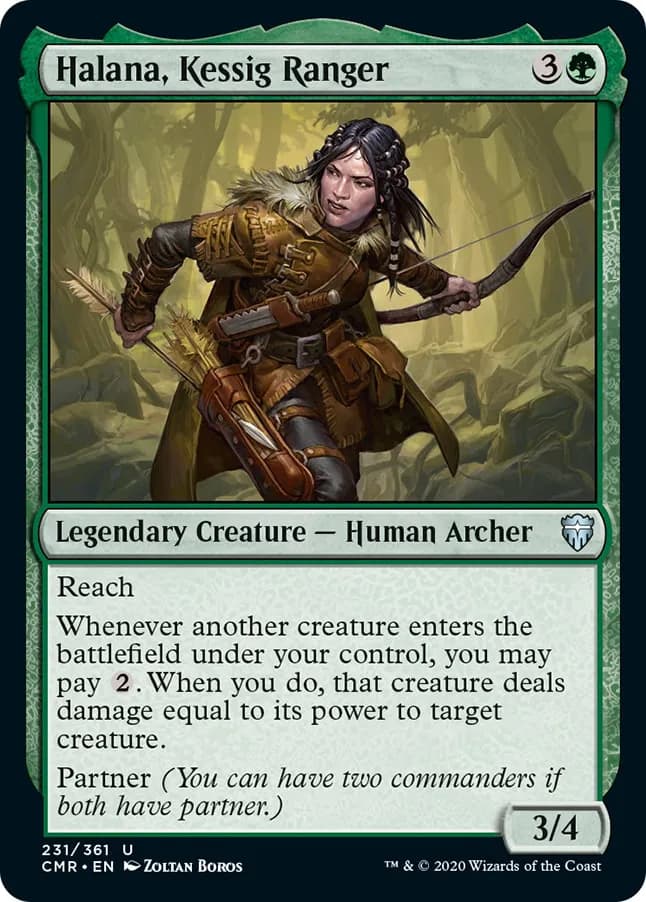
Halana, Kessig Ranger turns every new creature into a paid bite spell the moment it enters the battlefield. In a deathtouch shell, that means even the smallest creature can function like a piece of removal. Halana does not ask you to play like a generic Gruul combat deck; she turns creature drops into a steady stream of problem-solving.
How Halana turns small creatures into removal
Halana was printed in Commander Legends, the set Wizards of the Coast released on November 20, 2020. Her Oracle text is simple but extremely flexible: whenever another creature you control enters, you may pay {2}; when you do, that creature deals damage equal to its power to target creature. Every token, recursion target, or low-cost utility creature can arrive and immediately threaten something else on the board.
Halana’s trigger goes on the stack without a target, which gives opponents a window to respond before the damage is assigned. The deck therefore rewards timing, board awareness, and creatures that can stand on their own if the table tries to interfere.
Deathtouch is the real trick. When the creature dealing damage has deathtouch, even a single point of damage is enough to kill what it hits. So a cheap deathtouch creature plus Halana turns into repeatable removal on demand, and a stream of creature entries can keep pressure on the table without burning through a hand full of one-for-one spells.
Why the partner slot matters so much
Halana’s partner choice decides whether the deck leans into consistency or raw speed. Tymna the Weaver is the most popular pairing by a clear margin, with EDHREC listing 523 decks for Halana and Tymna together. Alena, Kessig Trapper is close behind at 484 decks, which shows the community has split between the partner that smooths draws and the partner that pushes mana production.
Tymna solves the most obvious weakness in a creature-heavy control shell: running out of cards. A Halana deck spends a lot of resources turning board presence into repeated interaction, so Tymna’s draw engine keeps the hand stocked and lets you keep deploying creatures after the first wave has been spent. EDHREC also tags the Halana and Tymna pairing around sacrifice, combo, and deathtouch, which fits the way the deck naturally branches once the battlefield gets cluttered.
Alena, by contrast, solves closing speed. Her activated ability is a mana ability, so it does not use the stack and cannot be responded to, and that makes her excellent at converting big power creatures into immediate mana. Alena and Halana are partners in both work and life in the Ulvenwald and Kessig region near Gatstaf. Alena helps pay for Halana’s {2} trigger, and in the right setup she can create infinite mana lines.
The support package that makes the deck feel like Halana
The deck stops looking like generic Gruul combat once the support cards are chosen with intent. The strongest version does not just fill the board with attackers. It plays creatures that either replace themselves, punish combat, or turn every small body into a threat the opponent has to respect. That is why cards like Acidic Slime and Defacing Duskmage matter here: they become two-for-ones when Halana is turning each creature entry into a removal trigger.
The deathtouch package is what gives the list its identity. Black Widow, Deadly Hunter, and Viridian Longbow all help convert ordinary board presence into repeated pressure, and Longbow in particular rewards any creature that can pester the table multiple times. With Halana online, those support cards stop being cute value pieces and start acting like tools for keeping the board clear.
The deck also wants card advantage that respects the battlefield rather than ignoring it. Toski, Bearer of Secrets and Ohran Frostfang reward you for making combat miserable for everyone else, and they help keep your hand full while your creatures do the work.
How the deck actually closes games
Halana decks win by making the board uncomfortable, then exploiting the emptiness they create. Once opposing creatures stop surviving, higher-impact threats like Unstoppable Slasher become much more dangerous because the table has fewer clean ways to stabilize. You are not simply attacking into blockers, you are using Halana to strip those blockers away and then cashing in on the cleared path.
The strongest builds also keep one eye on combo lines. Halana lets you target your own creatures, so you can deliberately kill your own board when that advances the game plan. That opens up lines with Protean Hulk and Pattern of Rebirth, which turns the commander from a fair removal engine into a piece that can fuel a much more explosive endgame.
MTG Rocks put her around $0.35 while Tymna sat near $25.
This article was produced by Prism’s automated news system from verified source data, official records, and press releases, then run through automated quality and moderation checks before publishing. The system is built and supervised by the people who set the standards it runs under. Read our full AI policy.
Did this article answer your question?