Loki Commander deck turns legendary attacks into villainous value
Loki is all cartoon menace on the surface, but the attack trigger turns every combat step into a temporary legendary theft engine.
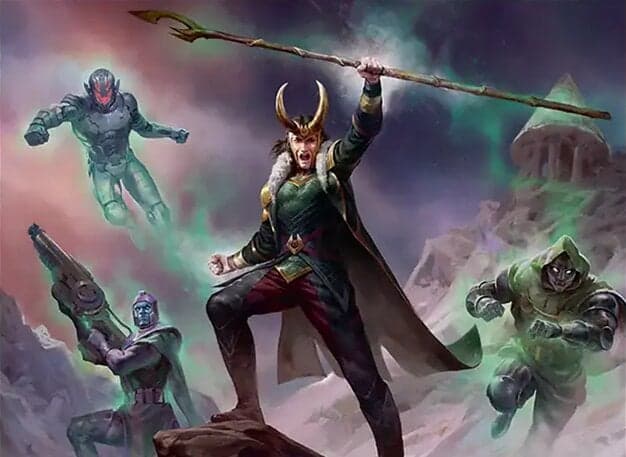
Loki looks like the kind of Commander commander built for pure mischief: a Marvel villain in blue-black-red, grinning through every combat step while someone else’s best legend gets dragged into the fight. The joke lands fast, but the real appeal is tighter than the flavor text. Loki, the Deceiver turns attacks into a copy engine, and that means the deck is not just a pile of trickster cards, it is a very pointed Grixis plan built around deception, pressure, and stolen value.
A villain deck that actually attacks for a reason
Owain Roberts’ deck tech leans hard into the theatrical side of Loki, and that is exactly why it works. The deck is built around attacking with Loki, making a token copy of another Villain you control, and then cashing in that temporary body for damage, disruption, or both before it disappears. That sequence gives the deck a clear combat incentive instead of the usual “sit back and generate value” Commander loop.
The important detail is that the copied token is not legendary. In Commander, that matters a lot, because it lets you turn on powerful legends without getting stuck in the usual copy restrictions. A lot of copy decks get clumsy when the best targets are legendary creatures; Loki sidesteps that problem by making the minion nonlegendary, so the deck can keep reusing premium Villains without losing tempo to legend rule headaches.
That is also why Loki feels more focused than a generic Grixis trickster shell. The commander asks you to attack, reward yourself with a copy, and keep the board unstable. It is a very specific rhythm, and once you lean into it, the deck starts playing like a villain movie montage instead of a pile of random goodstuff.
The mechanical heart: theft, deception, and identity swaps
Loki’s actual text is the reason the deck has legs. He is a legendary 4/4 blue-black-red God Sorcerer Villain, and whenever he attacks, he creates a tapped and attacking token that is a copy of another target Villain you control, except it isn’t legendary and is also an Illusion in addition to its other types. That token gets sacrificed at the beginning of the next end step.
That gives the deck a clean identity-swap line every combat. You do not need Loki to stick around forever, and you do not need the copied Villain to be a permanent board resident. You just need the right target in play when Loki attacks, because the token immediately enters combat and starts doing ugly work for you right away.
The sacrifice clause is not a drawback so much as a built-in timing puzzle. You are encouraged to use the token aggressively, whether that means pushing damage, forcing bad blocks, or extracting an attack trigger from the copied creature before it vanishes. Commander players who like combat math will recognize the pattern immediately: the deck keeps asking, “What is the most annoying thing I can do with one more attack step?”
Connive ties the whole package together. The deck tech frames Loki as a connive deck as much as a copy deck, and that matters because the commander is not only making temporary bodies, he is also smoothing draws and fueling the hand. That gives the list a real engine instead of a single gimmick. You attack, you copy, you connive, and the table has to keep dealing with the fact that the next Villain could be worse than the last one.
Why the Villain restriction makes the build sharper
The Villain clause is what keeps Loki from becoming a generic clone commander. You are not copying any creature in sight, only another target Villain you control, which pushes the deck toward a tighter package of cards and a more coherent battlefield plan. Instead of trying to play every splashy legend in blue-black-red, you get rewarded for building a real Villain roster.

That is where the deck tech’s tone becomes useful, not just cute. Naming Doctor Octopus, Madame Hydra, and Ultron is not just Marvel fan service; it gives you a clear picture of the kind of cast Loki wants. These are threats that belong on the table for more than one reason, whether you are looking for pressure, utility, or a body that becomes obnoxious when Loki turns it into a temporary attacker.
In practice, that means the deck wants to keep the board messy. You are not playing for elegance. You are playing for a board state where every attack can turn into a new problem for the other three players. That is a strong place for a Commander deck to live, because it gives you a reason to commit to combat while still feeling like you are getting paid every time you do it.
The Marvel set context makes Loki feel bigger than a one-off gimmick
Loki sits inside Magic: The Gathering | Marvel Super Heroes, which Wizards described as part of a multi-year collaboration with Marvel. The set is scheduled for global tabletop release on June 26, 2026, and Wizards has also confirmed four ready-to-play Commander decks: Avengers Assemble, Wakanda Forever, The Fantastic Four, and Doom Prevails.
The rollout matters because it shows Loki is not hanging out as a novelty commander on the fringe of the release. He is part of a major Commander launch built for real tabletop use, and the preview schedule reflects that scale. Wizards previewed the set on June 2, said Commander cards would be revealed from June 8 through June 11, and said the complete card image gallery would be available on June 12.
That makes Loki a good example of what Universes Beyond can do when the flavor lines up with the mechanics. The character fantasy is obvious the second you read the card, but the gameplay loop is just as clean: attack, copy, connive, pressure. The result is a commander that feels like a Marvel villain and still behaves like a real deckbuilding engine.
Why players are already building around him
EDHREC’s Loki, the Deceiver commander page listed 838 decks at the time of capture, which tells you the card has already found an audience beyond casual curiosity. The card page also showed 2.48% inclusion across 88K decks, a useful sign that players are testing Loki in more than one shell instead of locking him into a single template.
That spread makes sense. Loki is flexible enough to appeal to Commander players who like theft, deception, and combat tricks, but he is still narrow enough to feel intentional. He rewards a pilot who wants to plan around attack steps, keep a villainous board state, and turn temporary copies into repeated misery.
That is the real answer to the question at the center of the deck: Loki is not just overhyped flavor. He gives you a distinct Grixis-style trickster engine that weaponizes legendary creatures without tripping over the usual copy problems, and he does it with enough villain energy to make every combat step feel like part of the scheme.
This article was produced by Prism’s automated news system from verified source data, official records, and press releases, then run through automated quality and moderation checks before publishing. The system is built and supervised by the people who set the standards it runs under. Read our full AI policy.
Did this article answer your question?