Kinnan, Bonder Prodigy stays a cEDH benchmark with explosive combo lines
Kinnan keeps surviving cEDH shifts because every early mana source becomes a real win. The choice is whether you lean into turbo combo or grindier value.

Why Kinnan still sets the pace
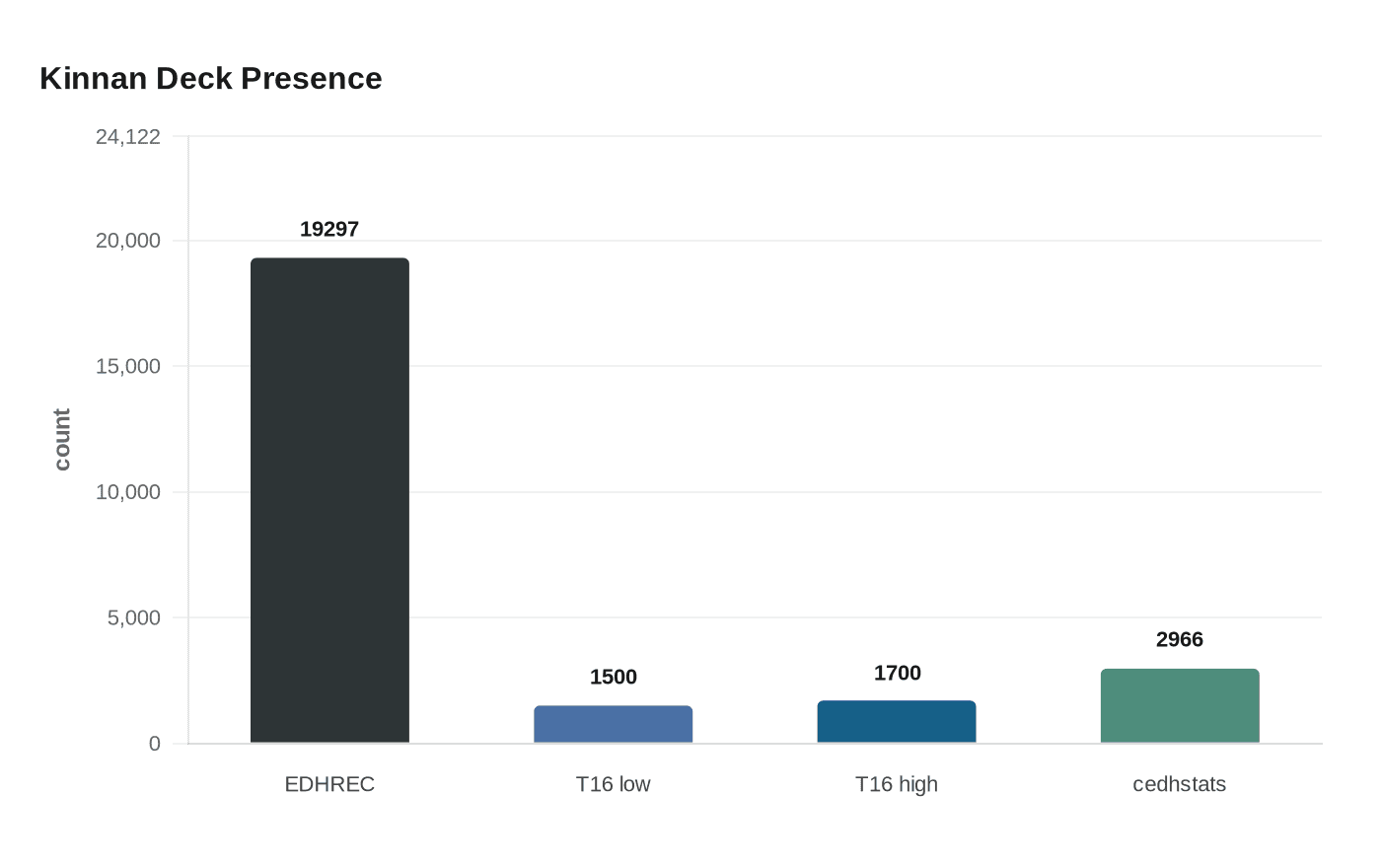
Why does Kinnan, Bonder Prodigy never really leave the cEDH conversation? Because the card does exactly what competitive Commander asks for: it turns cheap acceleration into more mana, more mana into faster development, and faster development into a board state that forces the table to answer immediately. EDHREC’s Kinnan page backs that up with 19,297 Commander decks and clear Combo, Ramp, and Midrange tags, which tells you the archetype is not a one-note glass cannon.

The broader competitive data says the same thing. EDH Top 16 shows Kinnan with roughly 1,500 to 1,700 entries depending on the filtered view, around a 6.5% to 6.6% meta share, and conversion rates near 19% to 20%. cedhstats puts the deck at 2,966 entries, a 7.93% meta share, and 1.30 average PPG, which is exactly the kind of sustained output that marks a benchmark commander rather than a passing trend.
The results keep reinforcing that status. Brandon Biehslich took first with Kinnan at The Decatur Deathmatch on January 10, 2026, and Evan Pierce did the same at the Dallas $10k c/TEDH on February 7, 2026. That matters because Kinnan is not surviving on old reputation alone, it is still converting into wins in large, recent fields.
The real fork: turbo combo or resilient value
The question that actually shapes the list is simple: do you build Kinnan to race, or do you build it to outlast? Both shells start from the same premise, but they ask different things from the opening hand. The speed-first version tries to turn Kinnan into a mana engine immediately, then closes with deterministic combo lines before opposing decks fully stabilize.
The resilience-value version leans harder on engines that survive longer games. It still wants explosive mana, but it also wants cards like The One Ring, Rhystic Study, and Seedborn Muse to keep the pressure up when the table is trading resources. In practice, this build fork comes down to pod expectation: if you expect turbo decks and a lot of stack interaction, you need a hand that can threaten early; if you expect slower midrange and grind, you can afford to keep more value-heavy openers that snowball over several turns.
Kinnan is unusually good at supporting both because the commander itself does not care which route you take. Any nonland permanent that generates mana gets better, and any card that becomes absurd when you are ahead on mana becomes live faster than the table expects. That is why the archetype can shift between combo, ramp, and midrange without losing its identity.
What the speed-combo build is actually trying to do
If you want the faster shell, the package is built around mana rocks and clean finishers. The most recognizable core includes Basalt Monolith, Dramatic Reversal, Mana Vault, Mox Amber, Chrome Mox, and Isochron Scepter, with Force of Will, Fierce Guardianship, and Mana Drain there to protect the line when the table tries to stop it. Those cards are not just good on rate, they are good because Kinnan turns one small advantage into a deterministic start.
- Kinnan plus acceleration
- a fast mana piece plus interaction
- a direct combo line with protection
The mulligan priorities are brutally practical. You want Kinnan or a hand that produces equivalent pressure quickly, plus fast mana, plus a way to force through your first meaningful turn. A keep usually looks like:
Hands that are land-heavy, slow, or full of medium-speed value cards usually do not belong here. In this build, the pod expectation is clear: you are trying to stay ahead of decks that can win quickly, not trying to outdraw them over six turns.
What the value-resilience build is buying with its slower hands
The grindier Kinnan lists do not abandon combo, they just widen the path to it. Hullbreaker Horror, Tidespout Tyrant, Deadeye Navigator, Palinchron, Freed from the Real, Thassa’s Oracle, and Finale of Devastation all show up repeatedly in current deck techs because they let the deck convert a mana advantage into a win even after the table has fought over the early turns. These cards are especially attractive when the pod is full of removal, countermagic, and awkward board states.
This version also leans harder on card-advantage engines. Rhystic Study and The One Ring help the deck keep up when the first wave of acceleration gets answered, and Seedborn Muse gives Kinnan a way to keep generating value across multiple turn cycles. That makes the deck feel less like a pure sprint and more like a threat that never stops asking the table to spend resources.
The mulligan here is different too. Instead of demanding an immediate combo, you can keep hands that have strong mana development, a draw engine, and at least one payoff card. That is the right call when you expect longer games, more attrition, and more removal, because Kinnan’s ability still lets every incremental advantage compound into a kill.
Why the benchmark keeps resetting around Kinnan
Kinnan’s staying power comes from how cleanly the commander converts setup into payoff. It was printed in Ikoria: Lair of Behemoths, a set that Wizards of the Coast made legal for sanctioned Constructed play on April 17, 2020, and the official Commander banned list does not ban Kinnan while treating cards as legal with their set prerelease. That early-2020 entry point matters because Kinnan did not arrive as a novelty, it arrived as a commander whose ability immediately fit the speed and efficiency that cEDH was moving toward.
That is still the core story behind the deck today. Whether the list is built to win off fast mana and stack protection or to grind through value engines and then convert into a combo finish, Kinnan remains the cleanest Simic example of how explosive mana production turns into real game-ending pressure. That is why the question is never whether Kinnan belongs in the conversation, but which version of the conversation the table is prepared to survive.
This article was produced by Prism’s automated news system from verified source data, official records, and press releases, then run through automated quality and moderation checks before publishing. The system is built and supervised by the people who set the standards it runs under. Read our full AI policy.
Did this article answer your question?