Martyrdom gets a second look as a versatile Commander damage shield
Martyrdom looks like bulk, but Oracle text turns it into a real shield, a damage-engine tool, and a combo piece with surprising Commander teeth.
Martyrdom’s hidden job description
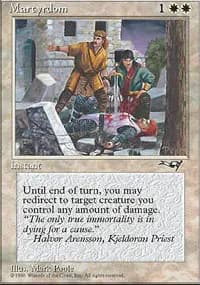
Martyrdom is one of those cards that slips past a lot of Commander tables on first read, then quietly rewards anyone who comes back to it with fresh eyes. Printed in Alliances, it now plays through Oracle text rather than the old wording on the card, and that update matters because it turns Martyrdom from a narrow old Fog into a temporary activated ability on one of your creatures. In practice, you are not merely blanking combat once. You are giving a creature you control the power to absorb damage from any source for a turn, which is a much broader and more interesting tool.

That broader use is exactly the sort of thing Oracle was built for. Wizards uses Oracle text as the official wording for older cards so they function consistently under modern rules, and Gatherer is the place to check that wording, the rulings, and any functional changes. Commander, with its 100-card singleton structure and multiplayer games that are typically four-player pods starting at 40 life, is the format where that kind of old-card reinterpretation really pays off. A card from Magic’s early years can look dusty in a binder and still have a very live job in a deck built from across the game’s history.
What Martyrdom actually does at the table
The simplest line is defensive. If someone swings an alpha strike at you, Martyrdom can put a single creature in the path of the damage and let the rest of your board and life total survive the turn. It is not a blanket prevention spell, and it is not pretending to be one. The value comes from how precisely it can reroute the danger onto a body you are willing to sacrifice, or at least willing to expose, for one turn cycle.
That same logic makes it a strong answer to sweepers that deal damage, especially something like Blasphemous Act. If you know the board is about to take a huge hit, Martyrdom can turn one of your creatures into the damage sink so the rest of your battlefield gets a better shot at living through the blast. The spell becomes much less about “fogging” a single attack step and much more about choosing where the damage lands.
Why the card gets much better in creature-damage shells
Once the damage is being deliberately routed onto one of your creatures, Martyrdom starts to look like utility for decks that care about damage being dealt to creatures. That is where enrage-style strategies get interesting, because they do not just survive the hit, they profit from it. Polyraptor is a perfect example: its Oracle text says that whenever it is dealt damage, its controller creates a token copy of it. If Martyrdom can point damage at Polyraptor on your terms, the card stops being a mere shield and starts becoming part of a growth engine.
Apex Altisaur pushes that idea even harder. It is a Dinosaur from Commander 2019, and Wizards highlighted it in the product materials for that set, which should already tell you the card was meant to be noticed by Commander players. In a shell where damage is intentionally redirected onto it, Apex Altisaur’s enrage-style trigger can keep firing, turning one awkward exchange into repeated value. Martyrdom does the unglamorous work of choosing the body that takes the hit, and that choice can convert a defensive spell into a trigger-dense setup piece.
The cards that make Martyrdom feel nasty instead of cute
Indestructible creatures make the whole package much cleaner. A creature like Giggling Skitterspike can absorb redirected damage without dying, which removes one of the awkward parts of Martyrdom and makes repeated damage routing much more attractive. Instead of using the spell once and losing your best target, you can keep pointing damage at a survivor that is built to stand there and take it.
Phyrexian Obliterator is the opposite kind of fun. Its Oracle text punishes damage by forcing the source’s controller to sacrifice that many permanents, so redirecting damage onto it can become brutally expensive for the opponent. Martyrdom plus Obliterator is the kind of play that makes combat math feel suddenly hostile in a very Commander way. The moment damage gets aimed at the wrong permanent, the punishment is not just life loss, it is permanents leaving the battlefield.
The combo line that turns a forgotten instant into a real problem
The most dramatic interaction is Martyrdom plus Arcbond plus an indestructible creature. Arcbond is an instant from Fate Reforged that reflects damage in a delayed way, and when you combine that with Martyrdom’s ability to route damage to a creature that survives the initial hit, the loop can turn one burst of damage into infinite damage to the board. That is the kind of line Commander players gravitate toward because it feels old-school, weird, and just technical enough to be satisfying.
The key detail is that the indestructible creature survives the first wave long enough for the reflected damage to keep moving through the system. Martyrdom sets the target, Arcbond turns the impact into a broader damage event, and the indestructible body keeps the engine from collapsing immediately. It is not the kind of combo that every deck wants, but in the right shell it gives a forgotten instant real end-game text.
What kind of deck should actually care
Martyrdom is not a universal staple, and that is part of why it is interesting. In a generic midrange Commander deck, it is probably a niche protection spell with occasional blowout potential. In a deck that already wants creatures to take damage, trigger on damage, or survive repeated hits, it moves up fast from “curiosity” to “worth a slot.”
The best homes are shells that already support one or more of these plans:
- Enrage creatures and damage-matters engines
- Indestructible or otherwise resilient creatures that can soak redirected damage
- Combo builds looking for a strange damage-routing piece
- Metas full of combat decks, where an alpha strike can be turned against the attacker
That is where Martyrdom starts to look less like a rules oddity and more like quietly efficient technology. It gives you a way to choose the damage sink, which matters a lot more when your deck can turn being hit into an advantage.
The real Commander payoff
This is the part that makes Martyrdom worth a second look. Oracle errata did not just preserve an old card’s legality, it widened the card’s practical life in Commander. Wizards has continued publishing Oracle update announcements over the years, which is a reminder that older cards are not frozen in their printed form, and Commander is one of the places where those changes can suddenly matter a lot.
So yes, Martyrdom can still be a clean damage shield. But it is also the kind of bulk rare that deserves a watchlist note, because the moment your deck wants redirected damage, enrage triggers, or a weird combo line with Arcbond, it stops being “that old Fog-ish instant” and starts being a compact piece of tech. That is the charm of Commander at its best: a forgotten card from Alliances can still step back into the room and change the whole shape of combat.
This article was produced by Prism’s automated news system from verified source data, official records, and press releases, then run through automated quality and moderation checks before publishing. The system is built and supervised by the people who set the standards it runs under. Read our full AI policy.
Did this article answer your question?