Overburden resurfaces as a brutal Commander tool for creature-heavy tables
Overburden punishes every nontoken creature drop with a land bounce, and that becomes miserable for creature-heavy pods fast. In the right Chulane or landfall shell, it stops being a tax and starts looking like a combo piece.
Why Overburden is back on the menu
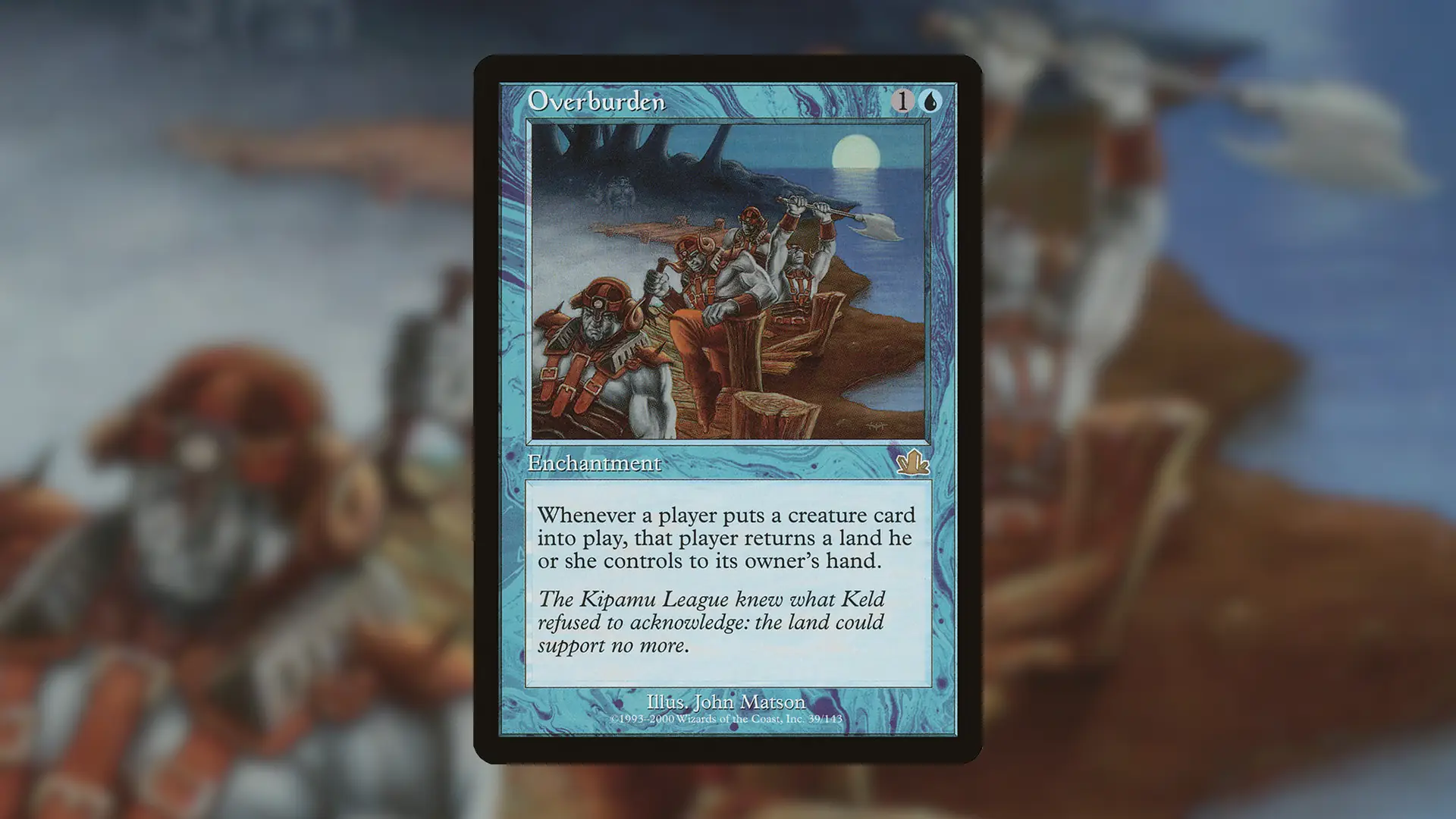
Overburden looks like the kind of old enchantment Commander players shrug at until it lands on a table full of mana dorks, value creatures, and curve-out nonsense. Its Oracle text is brutally simple: “Whenever a player puts a nontoken creature onto the battlefield, that player returns a land they control to its owner's hand.” That one line makes every nontoken body into a tempo cost, and because it hits every player, it can warp an entire pod around whoever resolves it first.

The card is Prophecy card #39, from a set released in 2000, which makes it 26 years old in 2026. That age matters less as nostalgia than as evidence that Commander has quietly given it a much better home than it ever had in its original era. In modern tables, where creature counts are often high and turns are full of multiple creature deployments, Overburden punishes development in a way that feels far nastier than its mana value suggests.
When it becomes oppressive
Overburden is at its worst when the table wants to keep adding bodies to the battlefield every turn. Go-wide creature decks, flicker-value shells, and lists that try to chain multiple nontoken creatures in a single turn all get squeezed by the same problem: every creature becomes a land setback. If a deck is trying to curve out cleanly, the enchantment turns that clean curve into a stutter.
The board state that breaks Overburden wide open is one where opponents are already committed to creature development and still need to keep spending mana on more creatures to stay relevant. A player who taps out for a two-drop, then a three-drop, then a four-drop, starts handing back lands instead of building forward. In those spots, Overburden does more than slow the game. It can deny the mana needed to keep pace, making the table feel like it is always one land drop behind.
It is especially punishing against decks that need repeated creature entries to function. Flicker shells want to reuse enter-the-battlefield creatures. Overburden makes every reset painful. Creature-heavy value decks that are happy to add one more body every turn get hit just as hard, because the enchantment asks them to choose between board presence and mana development.
When it looks embarrassing instead
The card is symmetrical, so there are also plenty of tables where it will not feel oppressive at all. If the pod is low on nontoken creatures, Overburden can sit there doing almost nothing. Token decks are the cleanest example, since the enchantment only cares about nontoken creatures. If the battlefield is full of token production and very few actual creature casts, the tax barely bites.
It also looks much weaker once players already have enough lands in play to absorb the tempo hit. A table with a stable mana base can afford to bounce a land and continue, especially if the creatures being cast are small and incidental. In that kind of game, Overburden is more annoying than backbreaking, and the player who spent a card on it may not have changed the pace enough to matter.
That is why timing matters so much. Overburden is strongest when it comes down early, before creature decks have fully established themselves. The same card that looks mediocre into a quiet board can become a brutal soft lock into an active one.
The best homes are the decks that can cheat the tax
Overburden becomes much more dangerous when the pilot is happy to replay lands or simply cares less about the land-bounce clause than everyone else. Control shells can use it as a time-buying tool, forcing creature decks to stall while the control player keeps the board from snowballing. That alone makes it a legitimate prison piece.
Landfall decks are where the enchantment starts feeling unfair. Bouncing your own land is not just a drawback if your deck actively wants lands to re-enter the battlefield. Aesi, Tyrant of Gyre Strait is a natural fit because extra land drops help offset the tempo loss, and official rulings confirm that Aesi’s extra land-drop effect is cumulative with effects like Exploration. The same rulings also make clear that landfall triggers whenever a land you control enters for any reason. That means Overburden can turn into a repeatable engine for extra landfall triggers, not merely a tax you have to endure.
The practical takeaway is simple: the best Overburden decks are the ones that can either ignore the bounce or cash it in for value. If your list can replay lands, gain landfall triggers, or operate while the rest of the table is stumbling over land drops, the enchantment stops being symmetrical in any meaningful sense.
The combo shell that makes people sit up
Overburden is not just a prison card. In the right build, it is part of a combo package that can push a game into absurd territory. Chulane, Teller of Tales plus Shrieking Drake plus Overburden is listed as producing infinite card draw, infinite draw triggers, near-infinite enter-the-battlefield triggers, near-infinite leave-the-battlefield triggers, and near-infinite storm count. That is a huge amount of text to attach to a single enchantment, and it shows why Overburden has more than one life in Commander.
The line matters because Shrieking Drake keeps coming back as a recurring piece in Chulane combo structures. There is also a related Chulane, Teller of Tales plus Shrieking Drake plus Earthcraft package that can generate infinite enter-the-battlefield triggers, infinite leave-the-battlefield triggers, infinite storm count, and put lands from hand and library onto the battlefield. Then there is the older Chulane plus Mana Breach plus Shrieking Drake line, which gives additional historical context for why Drake keeps showing up in these engines.
That broader pattern matters for deckbuilders. Overburden is not some isolated hate enchantment that only slows the table. In the right Chulane shell, it is one more piece in a machine that can turn a seemingly fair creature loop into an overwhelming resource loop.
How to use it at the table
The play pattern is straightforward, but the difference between strong and mediocre is in the matchup. Bring Overburden to tables where creatures are doing the heavy lifting, especially if those decks need to keep deploying new nontoken bodies to stay ahead. It is strongest when the pod is full of go-wide pressure, flicker value, or creature-chain engines that cannot afford to pause.
- Cast it before the creature decks have stabilized.
- Aim it at pods where nontoken creatures are the main source of pressure.
- Pair it with land replay or extra land-drop effects if your deck can exploit the bounce.
- Use it as a tempo weapon in control, or as a combo enabler in Chulane and landfall shells.
When those conditions line up, Overburden does exactly what Commander players hate most: it makes normal gameplay expensive. When they do not, it is just another old enchantment waiting for the wrong table. The trick is knowing which table you are sitting across from, because that is where Overburden stops being fair and starts feeling like a lock.
This article was produced by Prism’s automated news system from verified source data, official records, and press releases, then run through automated quality and moderation checks before publishing. The system is built and supervised by the people who set the standards it runs under. Read our full AI policy.
Did this article answer your question?