Silverquill Budget Deck Blends Spellslinger Copying With Aristocrats Value
Silverquill turns cheap tokens into copy fuel, and Tyler Bucks’ $40 shell shows exactly how to make spellslinger and aristocrats work together.
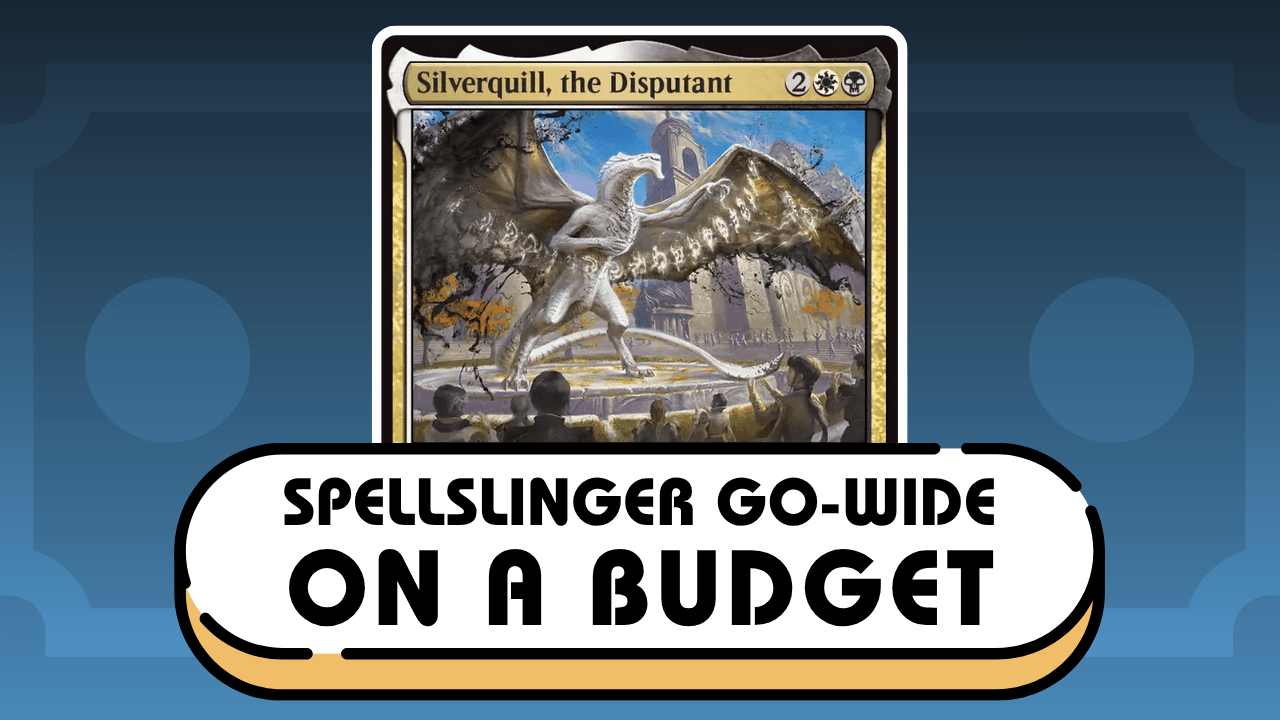
Silverquill’s first build finally gives the deck a clear job
Silverquill, the Disputant does not ask you to pick between spellslinger and aristocrats. It turns every instant and sorcery into casualty 1, so the same token that attacks early can later be cashed in to copy your best spell. That is the whole trick behind Tyler Bucks’ budget list, a build that comes in at about $40 before the commander and gives you a real first build without leaning on precon prices or chase-card staples.
The result is a deck that feels focused instead of crowded. You are not trying to win through raw combat, and you are not trying to assemble a fragile combo line. You are building a board, making tokens, and using those bodies as fuel for spells that get much better when they are copied. That is exactly the kind of plan Silverquill, the Disputant rewards.
Why the commander pulls the archetypes together
Silverquill, the Disputant is a 2WB legendary Elder Dragon with 4/4 stats, flying, and vigilance. Its rules text gives each instant and sorcery you cast casualty 1, which means you may sacrifice a creature with power 1 or greater as you cast the spell to copy it. That one line explains why the deck naturally moves toward tokens and sacrifice value instead of generic Orzhov midrange.
The commander's body matters too. Flying and vigilance let it pressure life totals while still holding the line, so it can play the role of a sturdy source of inevitability. But the real power is in the text box: every token maker becomes a future resource, and every good spell becomes a better spell if you have the right creature to throw away.
That is why the best Silverquill lists do not treat tokens and aristocrats as separate packages. In this shell, tokens are both board presence and spell fuel, while sacrifice payoffs turn each copied spell into a tempo swing. The deck becomes stronger every time it makes a body that does not need to survive.
The core engine is copied spells plus disposable bodies
Tyler Bucks’ list points straight at the cards that make this work. X-spells and token makers such as United Front, Blot Out the Sky, and Horn of Valhalla are the perfect shape for the commander, because they scale naturally and get even nastier when copied. A single cast already develops the board; a copied cast can bury the table under extra bodies and extra value.
The support spells matter just as much. Aerith Rescue Mission, Will of the Mardu, and Season of the Burrow show how the deck blends token generation, utility, and board development without wandering off-plan. These are the kinds of cards Silverquill wants: flexible enough to be fine when drawn early, but strong enough to feel premium when casualty doubles them.
That flexibility is what keeps the list from becoming a pile of competing subthemes. A weaker build might split into token swarm, aristocrats drain, and spellslinger cantrips that never help each other. This one avoids that trap by making each piece serve two jobs. Tokens feed casualty, copied spells create more board presence, and sacrifice payoffs make every exchange of resources feel favorable.
Why the budget shell is a real starting point
The most useful part of the list is that it is not pretending to be expensive. At around $40, excluding the commander because prerelease pricing was still moving, the deck is aimed at the exact player who wants to try the new legend before spending real money on upgrades. That makes it a practical first build rather than a collector’s exercise.
The budget approach also fits the way Silverquill plays. Because the commander rewards card function more than card rarity, the deck can get a lot done with affordable token makers, utility spells, and sacrifice fodder. You are not paying for a pile of flashy haymakers just to prove the concept. You are building a working engine that already shows what the commander is meant to do.
The other upside is that this style has room to grow. If the budget version works for you, the upgrade path is obvious: more efficient token makers, stronger aristocrats payoffs, and higher-end spells that are excellent when copied. The shell already teaches the deck’s best habits, so every upgrade makes the same plan cleaner and faster instead of changing the deck into something else.
How it fits into the Secrets of Strixhaven window
The timing around Secrets of Strixhaven makes this even more relevant. Wizards of the Coast says the set releases on April 24, 2026, prerelease events begin on April 17, 2026, and the preview season started on March 31, 2026. Silverquill, the Disputant is the set’s White-Black commander face for Silverquill Influence, which gives you the cleanest product-level comparison if you are deciding between the preconstructed route and a budget build.
That comparison is important because the commander itself already has a defined identity. It is a new Elder Dragon from Strixhaven University on Arcavios, and it is clearly built to reward players who like making value from small creatures and spell-based pressure. If you were hoping for a flashy combat dragon, this is not that. If you wanted a commander that turns every token into future spell value, this is exactly the right lane.
Why the deck is already drawing attention
EDHREC showed Silverquill, the Disputant at 1,834 decks at the time of retrieval, and the archetype tags already split the commander across Tokens, Spellslinger, Aristocrats, and Control. That spread says a lot. The card is flexible enough to invite multiple builds, but the best versions still seem to circle the same idea: make bodies, copy spells, and turn sacrifice into advantage.
Tyler Bucks’ enthusiasm also comes through in the personal angle. The article nods back to Shadrix Silverquill, the earlier version of the character, which helps explain why this new Elder Dragon feels like such a satisfying follow-up. It has the same identity roots, but the casualty text gives it a more immediate and more playable path for Commander tables.
For anyone looking for a first Silverquill list, this is the right kind of blueprint. It is cheap, coherent, and easy to understand at the table, but it still has a high ceiling once you start tuning it. That combination of low entry cost and obvious upgrade paths is exactly what makes Silverquill, the Disputant one of the more practical new commanders to build around.
This article was produced by Prism’s automated news system from verified source data, official records, and press releases, then run through automated quality and moderation checks before publishing. The system is built and supervised by the people who set the standards it runs under. Read our full AI policy.
Did this article answer your question?