Stonecloaker gives Commander decks protection, value and graveyard hate
Stonecloaker earns its slot by saving a key creature, stripping a graveyard, and quietly threatening combo turns, all from one flash body.
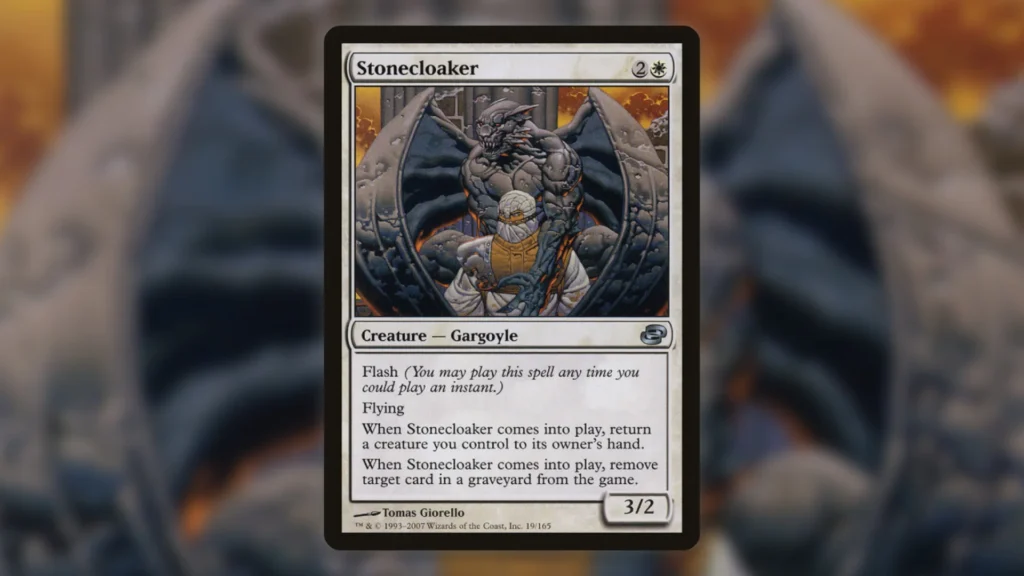
Stonecloaker is the kind of card Commander keeps rewarding
Commander deckbuilding is always a tradeoff between threats, interaction, and resilience, and Stonecloaker slips into that tension beautifully. It asks for only one slot, but it can behave like protection, value, or disruption depending on the table in front of you, which is exactly the sort of flexibility that makes an old, overlooked card feel newly relevant.

What Stonecloaker actually does
Stonecloaker’s Oracle text is clean and deceptively packed. It is a 2/2 Gargoyle with flash and flying, and when it enters the battlefield, you return a creature you control to its owner’s hand and exile target card from a graveyard. That means the same card can save your commander from removal, reset an enter-the-battlefield trigger, and still knock out a reanimation target or a combo piece hiding in a graveyard.
The flash matters as much as the text. You do not have to commit Stonecloaker to the board early, so it plays like a reactive tool instead of a sorcery-speed setup piece. Its bounce trigger also does not target, which means no one gets a chance to interrupt the choice and the return, and if you control no other creature, the rules tell you to return Stonecloaker itself.
The easiest way to understand the card is by the slots it replaces
Stonecloaker is appealing because it compresses three jobs into one body, and that changes how you build around it. In a lot of Commander lists, you would normally need separate cards for protection, graveyard hate, and a value creature that keeps your engine moving. Stonecloaker can cover all three if your deck cares about creatures entering and leaving the battlefield.
- It can replace a narrow protection trick when you want your commander or key creature to survive removal.
- It can replace a dedicated graveyard-hate card when your meta is full of reanimation, recursion, or graveyard-based combo turns.
- It can replace a generic value creature in decks that want to replay enter-the-battlefield abilities from cards like Loran of the Third Path or Solemn Simulacrum.
That last point is where Stonecloaker starts to feel especially clever. Bouncing your own creature is not just defensive, it can be a way to turn a good battlefield into a better one, especially when the creature you pick up already made value once and wants to do it again.
Why the graveyard hate is more than incidental
A lot of Commander graveyard interaction is either efficient but narrow, or flexible but underpowered. Stonecloaker sits in a sweet spot because the hate is attached to a relevant body and a relevant line of play. Exiling a card from a graveyard while also advancing your own board means the card is never just sitting there as dead insurance.
That matters in real games. It can snipe the exact card a reanimator player was planning to bring back, or cut off the last piece of a graveyard combo turn before it gets started. Even when the exile trigger is not a hard shutdown, it still forces opponents to play through an extra layer of friction, and in Commander that often buys the turn you need.
The combo ceiling is much higher than the card looks
Stonecloaker is already useful as a fair utility creature, but its self-bounce ability is what pushes it into engine territory. With Aluren on the battlefield, Stonecloaker can be cast for free, return itself, and repeat, creating infinite casts and infinite enter-the-battlefield and leave-the-battlefield triggers. Depending on your colors and build, that turns into easy wins with payoffs like Impact Tremors or Altar of the Brood.
Intruder Alarm opens another route. Its Oracle text says creatures do not untap during their controllers’ untap steps and whenever a creature enters, untap all creatures, which means a Stonecloaker loop can keep refreshing your board over and over. Commander Spellbook lists Stonecloaker plus Intruder Alarm as producing infinite ETB triggers, infinite LTB triggers, infinite mana from creatures you control, infinite storm count, and infinite untaps, so with enough mana production the loop can go all the way to infinite mana.
There is even a more elaborate line with Zacama, Primal Calamity and Panharmonicon. In that setup, Panharmonicon doubles the relevant triggers, Zacama’s enter-the-battlefield trigger untaps your lands, and Stonecloaker keeps the loop moving. Commander Spellbook’s write-up says that if your lands can make enough mana, the result is infinite mana, infinite lifegain, infinite ETB and LTB triggers, and infinite storm count.
The data says players have found the hidden engine already
This is not just theory-crafting in a vacuum. EDHREC’s combo database shows Stonecloaker plus Aluren in hundreds of decks, and Stonecloaker plus Intruder Alarm in about 201 decks. Those numbers matter because they show players independently treating Stonecloaker as more than a cute protection creature. It is a card people have already leaned on as a combo piece, even while it still reads like a fair utility include.
Why the reprints help the card stay relevant
Stonecloaker first appeared in Time Spiral, which released on October 6, 2006, and Wizards of the Coast has brought it back in Commander Anthology and Time Spiral Remastered. Those reprints help explain why the card keeps showing up in Commander conversations long after its debut. It has not only survived the format’s power creep, it has quietly fit into new shells every time players revisit old creatures with fresh deckbuilding eyes.
That is the real appeal of Stonecloaker. It is not asking for a dedicated plan, but it gives you a way to protect your best creature, police the graveyard, and maybe even start a loop when the right support shows up. In Commander, where every slot has to justify itself, that kind of overlap is not filler, it is premium space.
This article was produced by Prism’s automated news system from verified source data, official records, and press releases, then run through automated quality and moderation checks before publishing. The system is built and supervised by the people who set the standards it runs under. Read our full AI policy.
Did this article answer your question?